← All women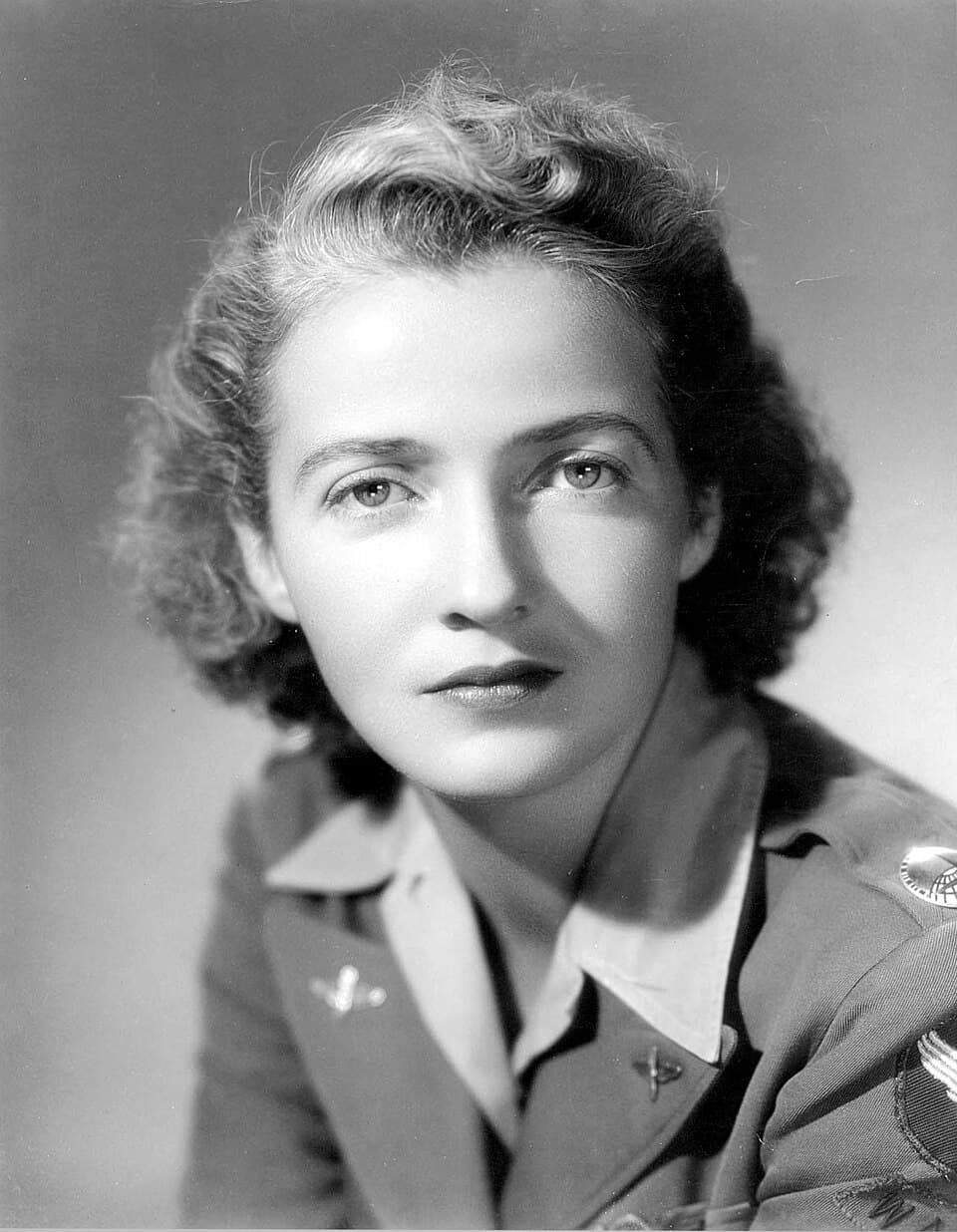
American · Aviation
Nancy Harkness Love
February 14, 1914 – October 22, 1976
Early Life and Background
Nancy Harkness Love, born Hannah Lincoln Harkness on February 14, 1914, in Houghton, Michigan, emerged from the remote Upper Peninsula to become one of the most important figures in the history of women’s military aviation.[1][9][12] She was the daughter of Dr. Robert Bruce Harkness and Alice Graham Harkness (née Chadbourne), an educated family whose status afforded her access to quality schooling and international experiences. Houghton, a small mining town on the Keweenaw Peninsula, was far from the major aviation centers, but her upbringing there did not limit her ambitions.[4][12]
During her childhood, Nancy’s family spent time in Europe, exposing her to a broader world at a young age. A pivotal moment occurred on May 21, 1927, when, at age thirteen, she stood in the crowd at Le Bourget Field near Paris to witness Charles Lindbergh’s historic arrival after his first solo nonstop transatlantic flight.[7] Biographical accounts emphasize that seeing Lindbergh land in the Spirit of St. Louis profoundly influenced her, reinforcing a fascination with flight that had already begun.
Nancy later attended Milton Academy, a prestigious preparatory school in Massachusetts. There she combined strong academic performance with a growing passion for aviation. Sources differ slightly on her exact age at first solo, but it is clear that by her mid‑teens she was taking flying lessons and rapidly accumulating hours.[6][5] She went on to study at Vassar College, where she not only continued flying but also helped organize student flying clubs and actively promoted aviation among her peers.[6]
Career Beginnings and Development
By the early 1930s, Nancy Harkness had already distinguished herself among American women pilots. After intensive summer training while at Milton Academy, she earned her private pilot’s license by September 10, 1932, and was described in contemporary accounts as the youngest woman in the United States to do so, at age eighteen.[6][1] She quickly moved beyond private flying.
During her years at Vassar, Nancy expanded her aviation activities. She organized flying clubs, flew passengers from Poughkeepsie Airport to augment her income, and pursued advanced ratings.[6] By 1933 she had qualified for a commercial pilot’s license and was reported as the youngest woman in the country to hold such a license.[2][6] Her rapidly growing credentials placed her in a small elite group of professional women pilots at a time when most female aviators were treated as novelty acts or confined to sport flying.
Following college, Nancy worked in several aviation roles. She sold aircraft for companies such as Beechcraft and Waco, gaining experience in the business side of aviation.[9] She then took a job with Inter‑City Air Lines, a fixed‑base operation owned by Robert L. "Bob" Love, whom she later married.[5][9] Economic conditions during the Great Depression made aircraft sales difficult, prompting Nancy to diversify her work.
In 1935, Nancy was hired by the Bureau of Air Commerce to work on the national Air Marking Program, one of only three women pilots selected for this Works Progress Administration initiative.[6][10] She flew around the country painting city names and compass headings on rooftops, water towers, and other structures to aid air navigation. This work gave her broad experience with cross‑country flying and practical navigation under varied conditions.
Later in the 1930s, she served as a test pilot for the Gwinn Aircar Company in Buffalo, New York.[9][5] At Gwinn she helped demonstrate and refine the tricycle landing gear, a configuration that would later become standard on many aircraft. Her willingness to fly experimental designs under test conditions further established her reputation for skill and courage.
Wartime Advocacy and the Creation of WAFS
By 1940, with war escalating in Europe and U.S. rearmament underway, Nancy Harkness Love recognized that the Army Air Corps would soon face serious shortages of qualified ferry pilots. Drawing on her extensive contacts among experienced women aviators, she compiled a list of female pilots who met high professional standards—many with hundreds or thousands of flight hours.[12]
Around June 1940 she formally proposed to the Air Corps Plans Division, led by Lt. Col. Robert Olds, that these experienced women be used as ferry pilots to move aircraft from factories to bases.[9][12] Her proposal argued that employing women in non‑combat roles would free male pilots for combat missions and tap a skilled but underutilized resource. Despite the logic of her plan, the Army initially rejected the idea; deep cultural resistance remained to the notion of women flying military aircraft.
Nonetheless, Nancy’s proposal laid intellectual and administrative groundwork for later developments. She continued to maintain her roster of qualified women and kept in contact with sympathetic officers. When the United States entered World War II after Pearl Harbor, the Air Corps’ need for ferry pilots intensified, and her earlier groundwork became newly relevant.
In 1942, Colonel William H. Tunner of the Air Transport Command’s Ferrying Division reconsidered Nancy’s ideas. Recognizing both the growing pilot shortage and her organizational abilities, he invited her to develop a women’s ferrying program.[2][9] Nancy’s long‑prepared list of pilots and her established reputation made her a natural choice to lead such an initiative.
First Female Pilot in the Army Air Forces and Leadership of WAFS
On September 7, 1942, after undergoing rigorous evaluations and check rides, Nancy Harkness Love officially qualified as the first female pilot in the U.S. Army Air Forces (AAF), assigned to the Air Transport Command’s Ferrying Division.[9][11] This formal qualification marked a decisive institutional breakthrough: the Army had now recognized at least one woman as meeting its standards for operational flight duties.
Within days, on or around September 10, 1942, Nancy was publicly announced and effectively installed as leader of the newly formed Women’s Auxiliary Ferrying Squadron (WAFS)
By fall 1942, she was recognized as the director of WAFS within the Air Transport Command’s Ferrying Division, making WAFS the first organization of women pilots to conduct regular operational missions for the U.S. armed forces.[2][9] Under Nancy’s leadership, WAFS pilots ferried liaison and training aircraft from factories to training bases and operational fields, a crucial logistical role as U.S. aircraft production surged. Her leadership required constant negotiation with male commanders, many of whom were skeptical of women’s abilities. Nancy’s strategy was to let performance speak: she maintained strict discipline, high standards, and a spotless safety record to demonstrate that women pilots could match or exceed the reliability of their male counterparts.[9] In 1943, the Army chose to consolidate its separate women’s flying programs. Nancy’s WAFS merged with Jacqueline Cochran’s Women’s Flying Training Detachment to form the Women Airforce Service Pilots (WASP)
By August 1943, Nancy was appointed WASP Executive in the Air Transport Command, with staff responsibility for six ferrying squadrons and over 300 women pilots.[9][2] In this role, she coordinated assignments, established qualification standards for various aircraft types, and oversaw safety and performance metrics. Her work ensured that women pilots were employed efficiently in moving aircraft from factories to coastal and inland bases across the continental United States. Throughout this period, Nancy continued to push boundaries regarding which aircraft women were allowed to ferry. Initially assigned mostly to smaller and less complex planes, women under her command gradually gained access to more advanced equipment as she demonstrated their competence through careful training and exemplary performance.[2][9] Nancy Harkness Love was not only an organizer and commander; she was also an exceptionally skilled pilot. On February 27, 1943, she became the first woman to check out in the P‑51 Mustang, the fastest U.S. pursuit aircraft of its time.[9][8] Mastery of the Mustang required advanced handling skills and courage, as it was a cutting‑edge fighter designed for high‑speed combat. Over the course of the war she systematically pursued qualifications on increasingly complex aircraft. By mid‑war—around June 1944—she had become the first woman to fly the B‑25 Mitchell, the P‑51 Mustang, and the Douglas C‑54 Skymaster, and was one of the first two women checked out in the B‑17 Flying Fortress.[2][8] These achievements demonstrated her ability to operate both high‑performance fighters and multi‑engine bombers and transports. Her record ultimately extended even further. By late World War II, Nancy was recognized as the first woman to have flown virtually all of the Army Air Forces’ complex, high‑performance combat aircraft, including P‑38 Lightning fighters, B‑17 heavy bombers, and various multi‑engine attack aircraft and transports.[2][9] Each new type required overcoming institutional reluctance and proving her skill to skeptical commanders through demanding check rides. These technical firsts had broader implications. They offered concrete evidence that women could meet the highest technical and physical demands of military aviation. At a time when women were formally barred from combat and denied permanent military status, Nancy’s mastery of front‑line aircraft undermined arguments that women lacked the capacity for such roles. One of Nancy’s most dramatic wartime achievements occurred on January 8, 1945, when she became the first woman pilot to fly "the Hump", the treacherous air route over the Himalayas between India and China.[8] This route was used to supply Chinese and Allied forces after Japanese control cut off other supply lines. The Hump was notorious for extreme weather, high mountains, and deadly turbulence; many experienced pilots lost their lives attempting the crossing. Nancy’s mission, arranged by Generals William Tunner and Edward H. Smith, involved flying a combat ferry over one of the most dangerous air corridors of World War II.[8] Although she and other WASPs were not officially designated as combat pilots, this flight was indistinguishable from the hazardous missions flown by male crews. Her successful crossing provided powerful evidence of women’s capabilities in the most challenging environments and became a symbolic culmination of her wartime service. Despite their contributions, the WASP program was disbanded in 1944, and women pilots, including Nancy, were released from service without formal military status or veterans’ benefits.[2] As the war’s manpower shortages eased and male pilots returned from combat, political support for maintaining a separate women’s program waned. Nancy returned to civilian life around late 1945, still advocating for recognition of women military pilots. In the immediate postwar period, Nancy received some official acknowledgment. An Air Force biography notes that she was awarded the Air Medal in 1946 for her wartime leadership in ferrying operations.[2] The medal recognized her role in organizing and commanding women pilots who moved thousands of aircraft within the United States and abroad. However, neither the Air Medal nor other honors fully compensated for the lack of formal status. Nancy and her colleagues were classified as civil service employees rather than military personnel, leaving them without veterans’ benefits. Efforts to secure recognition continued for decades. Nancy’s personal and professional lives were closely intertwined. In the early 1930s, while working for Inter‑City Air Lines, she met Robert L. "Bob" Love, the company’s owner.[5][9] The two married in 1936.[10] Bob Love, himself involved in aviation, supported Nancy’s career and shared her commitment to flying. Biographical sources focus primarily on Nancy’s professional achievements and say little about children or broader family life, suggesting that her public identity remained centered on aviation and military service. Her marriage, however, provided both partnership and professional collaboration, particularly in the prewar years when they worked together in civilian aviation. After the war, Nancy Harkness Love did not return to the same level of public prominence she had held during her WAFS and WASP leadership. She continued to be involved in aviation circles and remained an advocate for recognition of women pilots, but the dissolution of WASP and prevailing gender norms limited her opportunities in military aviation. On October 22, 1976, Nancy died of cancer at age sixty‑two.[1][4][12] Sources generally cite Martha’s Vineyard, Massachusetts, as her place of death, though some accounts have mentioned Florida connections; the date and age, however, are consistent.[1][4] Her passing came just three years before Congress finally granted veteran status to former WASPs in 1979, a recognition she had long hoped for but did not live to see.[2][9] In the decades following her death, historians and institutions increasingly recognized Nancy Harkness Love’s contributions. The 1979 grant of veteran status to WASPs retroactively acknowledged that she and her pilots had performed military service, albeit without the benefits accorded at the time.[2] On July 16, 2005, Nancy was enshrined in the National Aviation Hall of Fame in Dayton, Ohio.[9] The Hall of Fame citation highlighted her leadership of WAFS, her executive role in WASP, and her record as the first woman to fly virtually all of the Army Air Forces’ complex, high‑performance combat aircraft. This honor placed her among the nation’s most revered aviation pioneers. In 2011, she was inducted into the Michigan Women’s Hall of Fame, which celebrated her as an "angel of the airways" and emphasized her role in making women ferry pilots a reality during World War II.[5] The Hall framed her as one of Michigan’s most significant women, connecting her local origins in Houghton to her national influence. Other recognitions include her presence in the Women in Aviation International Pioneer Hall of Fame[10] and numerous museum exhibits and scholarly works that feature her as a central figure in the history of women’s military aviation. The U.S. National Museum of the Army and the National Park Service have both produced biographical materials highlighting her story.[7][9] Nancy Harkness Love’s legacy rests on three interlocking achievements: her early pioneering as a professional woman pilot, her organizational leadership in creating and directing WAFS and WASP ferrying operations, and her technical mastery of front‑line military aircraft. As a young woman, she broke records by earning private and commercial licenses at ages when few women flew at all.[2][6] Her work in the Air Marking Program and as a test pilot demonstrated that women could handle demanding technical roles outside traditional spheres. These early experiences prepared her to envision and advocate for women’s participation in military ferrying. Her 1940 proposal to the Air Corps Plans Division and her subsequent role in founding WAFS represent major turning points in U.S. military policy toward women. By assembling a roster of highly qualified women, insisting on high standards, and delivering flawless operational performance, Nancy made it possible for the Army to accept women pilots in wartime roles.[9][12] Technically, her record in flying the P‑51, B‑25, B‑17, C‑54, and other aircraft types proved that women could handle the full complexity of combat aircraft. Her first crossing of the Hump in 1945 symbolized the ultimate test of women’s capabilities in extreme environments.[2][8] Despite these accomplishments, the delayed recognition of her and her colleagues underscores enduring gender inequities. The disbandment of WASP without veteran status, the decades‑long struggle for acknowledgment, and the posthumous nature of her major honors all illustrate how institutional structures lagged behind women’s actual contributions. Today, Nancy Harkness Love is widely regarded as a trailblazer whose work helped pave the way for women’s eventual integration into regular military pilot training and combat aviation roles. Her life story is a central case study in women’s history, military history, and the sociology of professions, demonstrating how individual initiative and excellence can challenge and gradually transform entrenched gender barriers. Major sources on Nancy Harkness Love include biographical entries from the National Aviation Hall of Fame, the National Museum of the United States Army, the Michigan Women’s Hall of Fame, Air Force historical publications, and scholarly and popular histories of the WASP program.[2][5][7][9][10][12] Additional perspective comes from articles in Milton Academy publications, encyclopedia entries, and works focusing on women’s roles in World War II aviation. Some details in the record—such as the precise dates of certain aircraft checkouts or minor biographical facts—remain inconsistent across sources, reflecting the limited documentation of women’s contributions at the time. Nonetheless, the broad contours of Nancy’s life and achievements are well established and widely corroborated. Historians analyzing her career emphasize both her personal bravery and her strategic organizational skill. She is seen not only as an exceptional pilot but also as a visionary administrator who understood how to navigate military bureaucracy to create opportunities for women. Her story continues to be revisited as new scholarship on women in the armed forces expands and as military institutions seek to understand the historical foundations of gender integration in their ranks.WASP Executive and Expansion of Women’s Ferrying Operations
Technical Firsts: Fighters, Bombers, and Transports
First Woman to Fly "the Hump"
WASP Deactivation and Postwar Recognition
Personal Life
Later Life and Death
Posthumous Recognition and Honors
Legacy and Historical Impact
Sources and Historiography
Dated achievements
17 indexed.
- Feb141914Aviation
Birth of Nancy Harkness Love
Birth of Nancy Harkness Love (Hannah Lincoln Harkness) in Houghton, Michigan, to Dr. Robert and Alice Harkness.
View details National Aviation Hall of Fame – Nancy Harkness Love - May211927Aviation
Witnesses Lindbergh’s arrival at Le Bourget
At age 13, she witnesses Charles Lindbergh’s transatlantic arrival at Le Bourget Field near Paris on May 21, 1927.