← All women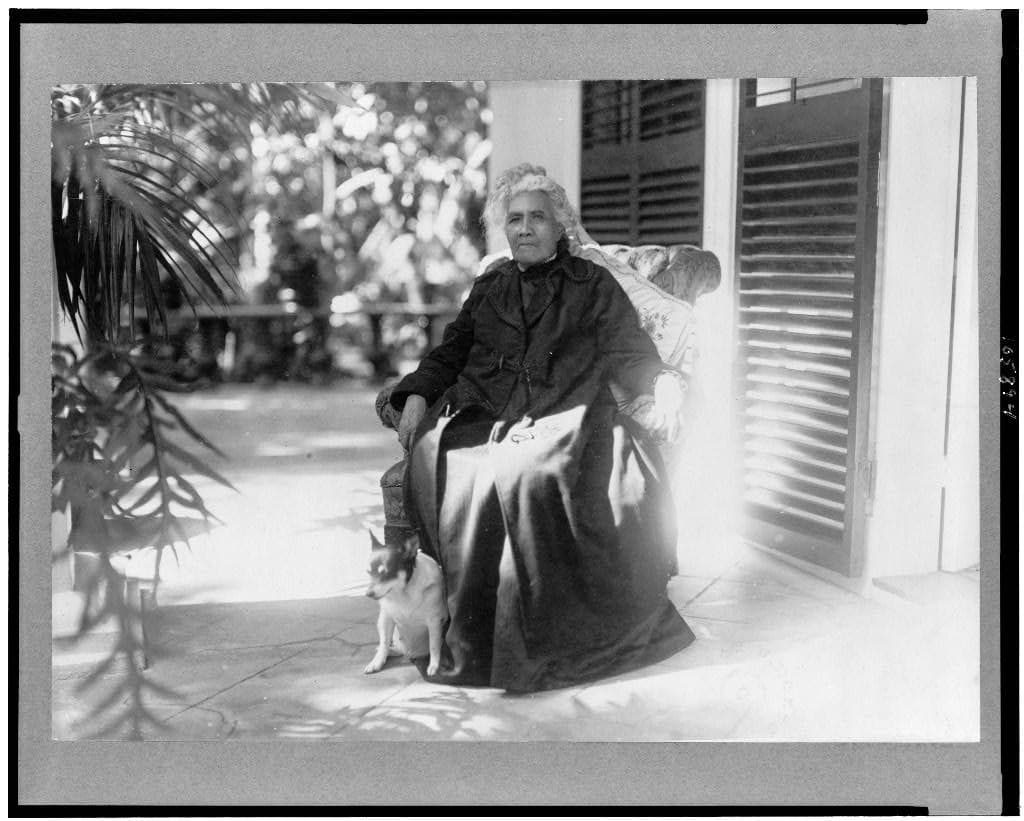
Hawaiian · Politics · Activism · Arts · Literature · Law
Lili’uokalani
September 2, 1838 – November 11, 1917
Early Life and Background
Lydia Liliʻu Loloku Walania Kamakaʻeha, later known as Queen Liliʻuokalani, was born on September 2, 1838, in Honolulu, on the island of Oʻahu in the independent Kingdom of Hawaiʻi.[1][2] She was the biological daughter of High Chief Caesar Kapaʻakea and Analea Keohokālole, members of the aliʻi (nobility) who traced their lineage to ancient Hawaiian chiefs.[1][17] In accordance with the customary practice of hānai, an informal but socially binding adoption, she was given as an infant to Abner Pākī and his wife Laura Kōnia, who raised her as their own daughter.[1]
Liliʻuokalani grew up in a milieu that combined Hawaiian traditions with increasing Western influence. She attended missionary-founded schools, including the Royal School, where children of high-ranking chiefs were educated in English and European subjects by American Protestant missionaries.[1][7] This education gave her fluency in English, familiarity with Western political ideas, and musical training, while she retained a strong grounding in Hawaiian language, protocol, and cultural values.
As a child and young woman, Liliʻuokalani was exposed to the complexities of diplomacy and governance. The Hawaiian Kingdom, internationally recognized and party to numerous treaties, was navigating relationships with the United States, Britain, and other powers while maintaining its sovereignty.[6][9] These dynamics shaped her understanding of the fragility of independence and the importance of constitutional frameworks.
Her upbringing as a hānai child in a prominent household and as part of the aliʻi elite fostered a strong sense of duty. She later wrote that her early life instilled in her a belief in the sacred bond between land and people and the responsibilities of leaders to safeguard both.[8] This sense of kuleana (responsibility) would define her actions as princess, queen, and later as an advocate for her people after the monarchy’s overthrow.
Marriage and Personal Life
In 1862, Liliʻuokalani married John Owen Dominis, an American-born resident of Honolulu whose family held the prominent property known as Washington Place.[1][2] Dominis served in various governmental roles, including as governor of Oʻahu under King Kalākaua.[1] The marriage linked Liliʻuokalani to powerful foreign-descended circles while also illustrating the multiethnic character of Hawaiian society in the 19th century.
The couple did not have biological children. Liliʻuokalani engaged in the Hawaiian practice of hānai with several children of relatives, including her brother’s children, and she maintained close relationships with younger family members.[1][17] Washington Place became both a family home and, later, a critical site of her political life—serving as the residence where she lived under house arrest after her imprisonment and where she eventually died.
Liliʻuokalani’s personal life was also deeply entwined with music and spirituality. A devout Christian, she participated in church life, yet retained an appreciation for traditional Hawaiian beliefs and customs.[7] Her sensitivity to suffering, particularly of children and the poor, informed both her compositions and later philanthropic initiatives, culminating in the creation of the Queen Liliʻuokalani Trust in 1917.[1][12]
Career Beginnings and Development
Liliʻuokalani’s public career began long before she ascended the throne. As a member of the royal family, she was drawn into ceremonial and governmental responsibilities. In 1874, her brother David Kalākaua was elected king by the legislature after a contested succession.[1][2] Liliʻuokalani supported his reign and increasingly took on duties as his representative.
In 1877, Kalākaua formally designated her as heir apparent and invested her as Crown Princess on February 12, placing her first in line for the throne.[1] She later served as regent when the king traveled abroad, gaining direct experience in overseeing governmental affairs.[1][17] These roles allowed her to observe cabinet deliberations, legislative proceedings, and the evolving balance of power between the monarchy and the growing class of foreign planters and businessmen.
Liliʻuokalani was also active in social initiatives. She supported education and health care institutions, including fundraising for the Queen’s Hospital, founded by Queen Emma and King Kamehameha IV.[13] She engaged in charitable work focused on women and children, which reflected both Christian influences and long-standing Hawaiian values of communal care.
By the late 1880s, the Hawaiian Kingdom had come under increased pressure from foreign residents seeking political control. The "Bayonet Constitution" of 1887, imposed on King Kalākaua by an armed militia, sharply limited royal authority and disenfranchised many Native Hawaiians by tying voting rights to property and income qualifications.[1][15] Liliʻuokalani witnessed these developments closely, and they heavily informed her later determination, as queen, to restore the rights of her people.
Accession as Queen and Constitutional Reform
King Kalākaua died unexpectedly in San Francisco on January 20, 1891, while visiting the United States.[1] News of his death reached Honolulu, and within days, Liliʻuokalani assumed the throne. On January 29, 1891, she took the oath of office and was formally proclaimed Queen Liliʻuokalani before the kingdom’s ministers and Supreme Court justices.[1][2]
As queen, she became Hawaiʻi’s first and only queen regnant and its last sovereign monarch.[1][2][13] Her accession occurred at a time when the kingdom was economically prosperous but politically constrained, with sugar exports tied closely to U.S. markets and foreign investors wielding significant influence.
Liliʻuokalani sought to govern within constitutional bounds while addressing the inequities created by the 1887 charter. She advocated for policies that protected public lands and infrastructure, such as the Highways Act of 1892, which safeguarded trails and roads for public use and remains foundational to Hawaiʻi’s public access laws.[4][12] She emphasized the welfare of Native Hawaiians, pushing for measures that supported health, education, and land rights.
Central to her reign was the desire for a new constitution. On January 14, 1893, she announced her intention to promulgate a charter that would restore monarchic authority and broaden suffrage for Native Hawaiians, reversing the disenfranchising effects of the Bayonet Constitution.[1][15] While she did not sign the new constitution, the mere proposal galvanized her supporters and alarmed foreign-descended elites.
Overthrow of the Monarchy
Liliʻuokalani’s constitutional initiative became the pretext for a dramatic political crisis. The Committee of Safety, composed of U.S. and European businessmen and residents—many with ties to the sugar industry—claimed that her actions endangered property rights and political stability.[1] In coordination with U.S. Minister John L. Stevens, they arranged for the landing of U.S. Marines from the USS Boston in Honolulu.
On January 17, 1893, the Committee declared a provisional government and announced that Liliʻuokalani had been deposed.[1][2] Facing the possibility of bloodshed if she ordered loyal forces to resist, Liliʻuokalani chose a path of nonviolence. She yielded her authority under protest, explicitly stating that she did so to avoid conflict and in the expectation that the United States would later investigate and restore her constitutional rights.[1][2]
The overthrow was later scrutinized in the Blount Report, commissioned by U.S. President Grover Cleveland, which found that American representatives had improperly aided the coup.[1] However, subsequent political developments in Washington led to the recognition of the provisional government and then the Republic of Hawaiʻi, headed by Sanford B. Dole.[1][10]
Liliʻuokalani’s deposition ended the Hawaiian Kingdom as an independent, monarchic state. For Native Hawaiians and many observers, it represented a clear injustice and an act of imperial expansion. For women’s history, the event underscores how a woman sovereign confronted not only domestic opposition but also the power of a foreign nation-state, choosing peaceful protest over armed resistance.
Imprisonment, Abdication, and House Arrest
After the establishment of the Republic of Hawaiʻi, royalist sentiment remained strong among many Native Hawaiians. In early 1895, supporters of the monarchy attempted a counter-revolution aimed at restoring Liliʻuokalani to the throne.[1][17] The uprising was suppressed, and weapons were discovered, leading the republican authorities to target the former queen.
On January 16, 1895, Liliʻuokalani was arrested at her private home, ʻĀinahau, and taken to ʻIolani Palace.[1][17] She was imprisoned in an upstairs room, under constant guard, for several months. During this time, she spent many hours in prayer and composed music, later describing the emotional toll of her confinement in her autobiography, Hawaii’s Story by Hawaii’s Queen.[15]
The republican government charged her with misprision of treason—knowing of treason and failing to report it—based on allegations that she had been aware of the plot to restore the monarchy.[1][17] Under pressure and seeking to protect her supporters from harsh punishment, Liliʻuokalani agreed to sign a formal act of abdication on February 24, 1895, in favor of the Republic.[1][17] She later maintained that she had done so primarily to secure clemency for those involved in the uprising.
In September 1895, her sentence was commuted. On September 6, 1895, she was released from palace imprisonment and allowed to reside at Washington Place under conditions resembling house arrest.[1] Though her movements and political activities remained constrained, this transfer allowed her to resume limited social life and continue her advocacy through writing and music.
Anti-Annexation Activism and Diplomatic Protests
Even after the monarchy’s formal abolition, Liliʻuokalani remained an active political figure. She opposed the Republic’s efforts to secure annexation by the United States and supported Native Hawaiian resistance. In 1897, when a treaty of annexation was proposed, Hawaiian organizations circulated extensive anti-annexation petitions, gathering signatures from tens of thousands of citizens.[16][17] Liliʻuokalani lent her support to these efforts and traveled to the U.S. mainland to advocate against annexation.
On June 16, 1897, she submitted a formal letter of protest to U.S. President William McKinley, asserting that the proposed annexation treaty was illegitimate and violated the rights of the Hawaiian monarchy and people.[1][17] She pointed out that the Republic of Hawaiʻi did not represent the will of the majority of Hawaiians and that the 1893 overthrow had been aided by U.S. officials.
The initial annexation treaty failed to gain sufficient support in the U.S. Senate, due in part to the petitions and opposition voiced by Native Hawaiians and their allies.[16] However, geopolitical considerations during the Spanish–American War soon shifted the calculus, and Congress adopted the Newlands Resolution in 1898, annexing Hawaiʻi by joint resolution rather than treaty.[1]
After this development, Liliʻuokalani continued her diplomatic protests. On September 6, 1898, she filed an official diplomatic protest against annexation in Washington, D.C., maintaining her opposition to the transfer of Hawaiian sovereignty.[1] She refused to attend annexation ceremonies in Honolulu, unwilling to witness the lowering of the Hawaiian flag and the raising of the U.S. flag.[13]
Later that year, on December 18, 1898, she sent a letter to President McKinley formally withdrawing her annexation protests, though she continued to assert claims over crown lands and sought compensation.[1] This shift signaled a move from contesting sovereignty itself to focusing on the economic and legal consequences of annexation.
Authorship, Music, and Cultural Contributions
Liliʻuokalani was an accomplished writer and composer whose cultural work significantly shaped Hawaiian identity. She authored "Hawaii’s Story by Hawaii’s Queen", published in 1903
In the realm of music, Liliʻuokalani composed more than 150–200 songs, blending Hawaiian poetic forms with Western harmonies.[13][17] Among her most famous works is "Aloha ʻOe", a song of farewell that has become perhaps the best-known Hawaiian composition worldwide.[13][15] She also wrote "He Mele Lāhui Hawaiʻi" in 1866, at the request of King Kamehameha V; it served as the national anthem of the Hawaiian Kingdom for about twenty years.[4][17] Her music often expressed themes of love, loyalty, loss, and devotion to the land and people of Hawaiʻi. During her imprisonment and under house arrest, composing offered solace and a means of subtle political expression. Songs such as "The Queen’s Prayer", written during her confinement in ʻIolani Palace, carried spiritual and political resonance for her supporters.[17] Liliʻuokalani’s songwriting contributed to the preservation and dissemination of Hawaiian language and aesthetics at a time when colonial forces were suppressing indigenous cultures. Her compositions continue to be performed and studied, making her a central figure in Hawaiian musical history as well as political history. After annexation, the former crown lands of the Hawaiian monarchy were absorbed into what became U.S. public lands. Liliʻuokalani believed that these lands were her personal property as sovereign and that she had been unlawfully deprived of them without compensation.[1][17] On December 2, 1909, she filed Liliuokalani v. United States in the U.S. Court of Claims, seeking monetary compensation for the taken crown lands.[1] Her legal argument emphasized the historical distinction between crown lands, associated with the monarch’s estate, and other government lands. The case required the court to consider complex questions about the nature of royal property and the implications of the overthrow. On May 16, 1910, the Court of Claims dismissed her suit and ruled against her, finding that the crown lands had been lawfully transferred to the republic and then to the United States, and that she was not entitled to personal compensation.[1] Liliʻuokalani appealed the ruling. On May 27, 1911, the U.S. Supreme Court affirmed the dismissal, definitively ending her legal effort to recover the value of the crown lands.[1] Although unsuccessful, the case stands as an important episode in the legal history of Hawaiʻi, highlighting the limitations of colonial courts in addressing indigenous claims and providing a detailed record of the arguments made by a deposed monarch seeking redress. Liliʻuokalani’s commitment to the welfare of her people extended beyond politics into philanthropy. Throughout her life she supported charitable initiatives, particularly those focused on health and education for Native Hawaiians.[13] Her concern for vulnerable children was especially strong. On October 10, 1917, she executed a trust deed establishing what is now known as the Queen Liliʻuokalani Trust, dedicating much of her remaining estate to the care and education of orphaned and destitute children of Hawaiian blood.[1][12][17] The trust directed that its assets be managed for the benefit of these children, reflecting her belief that investing in the next generation was essential to the survival of Hawaiian culture and community. The trust has endured for more than a century and today operates programs that provide counseling, social services, educational support, and cultural enrichment to Native Hawaiian children and families.[12] It stands as one of the most significant legacies of her later life and a pioneering example of indigenous-led philanthropy. In her later years, Liliʻuokalani lived primarily at Washington Place in Honolulu. Although she had lost her throne and her legal battles over crown lands, she remained a respected figure in Hawaiian society and continued to be visited by dignitaries, relatives, and supporters.[1][7] She experienced declining health, including the effects of a stroke, but persisted in her involvement with the trust and in maintaining communication with her people. Her home became a quiet center of memory and reflection on the kingdom’s past. On November 11, 1917, Liliʻuokalani died at Washington Place at the age of 79.[1][2] Her death marked the end of the line of reigning Hawaiian monarchs. Funeral observances honored her as a beloved aliʻi and as the last sovereign of Hawaiʻi. Queen Liliʻuokalani’s legacy is multifaceted, encompassing political leadership, cultural creativity, legal advocacy, and philanthropy. As Hawaiʻi’s only queen regnant and last monarch, she symbolizes the era of Hawaiian independence and the trauma of its loss.[1][2][13] Politically, she is remembered for her efforts to restore Native Hawaiian rights through constitutional reform and for her principled, nonviolent response to the 1893 overthrow. Her protests against annexation, her support for petition campaigns, and her legal suit over crown lands have informed later movements for Hawaiian sovereignty and calls for recognition of historical injustices.[1][16][17] Culturally, her authorship of Hawaii’s Story by Hawaii’s Queen created a vital first-person account of the monarchy’s fall and offered a narrative counter to American justifications for annexation.[15][17][20] Her songs—especially "Aloha ʻOe"—have become enduring emblems of Hawaiian identity and emotion, performed worldwide and cherished within Hawaiʻi. As a woman leader, Liliʻuokalani occupies a prominent place in global women’s history. She ruled an internationally recognized nation, navigated complex diplomatic relationships, and confronted foreign imperial power with both firmness and restraint. Her experiences illustrate the gendered dimensions of colonialism and the ways in which indigenous women wielded authority and resisted dispossession. Institutions such as the Queen Liliʻuokalani Trust, educational programs, statues, and museum exhibits continue to honor her memory.[8][12] Her life is taught in schools, featured in documentaries, and invoked in contemporary debates over land, sovereignty, and cultural revival. For many Native Hawaiians, she remains a symbol of aloha (love), justice, and enduring national consciousness. In sum, Liliʻuokalani’s story is not only the tale of a kingdom’s last queen but also of an indigenous woman who used the tools of law, literature, and music to assert her people’s dignity in the face of imperial expansion, leaving a legacy that resonates far beyond the Hawaiian Islands.Legal Battles Over Crown Lands
Philanthropy and the Queen Liliʻuokalani Trust
Later Life and Death
Legacy and Historical Impact
Dated achievements
16 indexed.
- Sep021838Politics
Birth in Honolulu, Kingdom of Hawaiʻi
Birth of Lydia Liliʻu Loloku Walania Kamakaʻeha (Queen Liliʻuokalani) in Honolulu, Oʻahu, Kingdom of Hawaiʻi.
View details Liliʻuokalani – Biography - Feb121877Politics
Named heir apparent and Crown Princess of Hawaiʻi
King Kalākaua names Liliʻuokalani heir apparent and Crown Princess of the Hawaiian Kingdom.