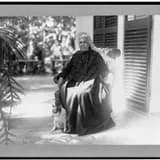
Arrest of Liliʻuokalani after the failed 1895 counter-revolution and her confinement in an upstairs room of ʻIolani Palace.
On January 16, 1895, following a failed royalist counter-revolution, former Queen Liliʻuokalani was arrested at her private residence, ʻĀinahau, and taken to ʻIolani Palace, where she was confined in an upstairs room.[1][17] Her supporters had attempted to restore the monarchy, but the Republic of Hawaiʻi suppressed the uprising and used it to target her.
Liliʻuokalani was held under close guard, forbidden visitors except under strict conditions, and subjected to surveillance for months.[1] During this period of imprisonment, she spent time in prayer and composition, later writing about the emotional and physical toll of confinement in her autobiography, Hawaii’s Story by Hawaii’s Queen.
The arrest was a turning point in her transformation from reigning monarch to political prisoner. It underscored the republic’s determination to eliminate any remaining claim to the throne and illustrated the use of legal charges and incarceration to silence indigenous female leaders.[17]
For women’s and indigenous history, January 16, 1895, symbolizes both repression and resilience. Liliʻuokalani’s conduct in captivity—marked by dignity, refusal to incite violence, and continued assertion of Hawaiian rights—helped sustain a narrative of peaceful resistance. Her later writings about this period have become foundational texts documenting the human consequences of the overthrow and the broader struggle against colonial rule.[1][15][17]