← All women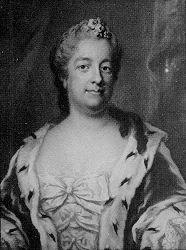
Swedish · Science
Eva Ekeblad
July 10, 1724 – May 15, 1786
Overview
Eva Ekeblad (née De la Gardie; 10 July 1724 – 15 May 1786) was a Swedish countess, agronomist, salon hostess, and experimental scientist whose work linked aristocratic estate management with Enlightenment science.[1][2][5][10] She is best known for demonstrating how potatoes could be processed into flour and alcohol, a discovery that helped relieve pressure on grain supplies in 18th‑century Sweden.[2][11][12][17] In 1748 she became the first woman elected to the Royal Swedish Academy of Sciences, an institutional milestone for women in European science.[1][3][5][10][11]
Early life and background
Eva De la Gardie was born on 10 July 1724 in Stockholm, Sweden.[1][2][6][10] She belonged to one of the kingdom’s most prominent aristocratic families. Her father, Magnus Julius De la Gardie, was a privy councillor and state marshal (overstemarskalk), while her mother, Hedvig Catharina Lillie, was a countess from another influential noble house.[5][6][8] Contemporary and later biographical accounts emphasize that she grew up in a milieu of political power, landownership, and court culture.[5][8]
Although detailed records of her formal education are scarce, elite Swedish girls of her rank typically received instruction in reading, writing, religion, music, modern languages, and the practical skills needed to manage large households and estates.[5][8] The intellectual climate of early 18th‑century Sweden was increasingly shaped by Enlightenment ideas and by organizations such as the recently founded Royal Swedish Academy of Sciences (1739), which promoted applied research in agriculture and industry.[5][11] As the daughter of a privy councillor, Eva would have been exposed to discussions of state policy, economic reform, and scientific innovation.
Her upbringing also involved learning the complexities of estate administration—overseeing food production, storage, textile manufacture, and the welfare of tenant farmers and servants. Later historians note that this combination of aristocratic responsibility and curiosity about practical problems laid the groundwork for her experimental interests in agronomy and chemistry.[5][11][17]
Marriage, estates, and entry into scientific life
In 1740, at the age of 16, Eva De la Gardie married Count Claes Claesson EkebladEva Ekeblad. The union linked two powerful families and placed her at the head of large landed properties, including the Ekeblad family’s main estates in Västergötland.[5][8]
As a countess and landowner, Ekeblad was responsible for overseeing agricultural production, food preservation, and the provisioning of the household and dependents. These duties were not merely domestic; they were central to the economic viability of the estates and to the livelihoods of many rural people. In this context, experimental approaches to crops, storage, and processing had immediate practical consequences.
Sources describe Ekeblad as managing estates largely in her husband’s absence, especially when he was engaged in governmental duties.[5][8] She is also reported to have hosted salons—gatherings where members of the nobility, officials, and intellectuals exchanged ideas—though the surviving documentation is limited.[1][4][7][9] Through these social and administrative roles, she became part of the wider network in which the Royal Swedish Academy of Sciences sought information and collaboration on agricultural and technical questions.
Sweden, famine risk, and the potato
Ekeblad’s scientific work needs to be understood against the background of 18th‑century Sweden’s food economy. The country was vulnerable to bad harvests and periodic famine, as cereal crops such as rye, barley, and oats had to provide both daily bread and raw material for distilling spirits (brännvin).[2][12][17] The potato, introduced to Sweden earlier in the century, was still not universally accepted as a staple food; in many places it was grown primarily as a garden plant or animal fodder.[11][13][17]
Swedish authorities and the Academy were keen to encourage new crops and techniques that could increase food security. In this environment, practical experiments carried out on noble estates could acquire national significance. Ekeblad’s later fame rests on the way she applied estate‑based experimentation to the potato, transforming it from a marginal crop into a key component of Sweden’s agrarian strategy.[2][11][12][17]
Potato experiments and discovery (1746)
In 1746, Ekeblad conducted experiments on her estates to determine how potatoes could be processed into usable food products and spirits.[2][11][13][17] She cooked, mashed, and dried potatoes to obtain a starchy flour, which could be mixed with or partly replace grain in baking.[13][17] She also demonstrated how potatoes could serve as a raw material for distilled alcohol, providing an alternative to cereal-based brännvin.[2][11][12][17]
According to Encyclopaedia Britannica and multiple national-language biographies, her findings were reported to the Royal Swedish Academy of Sciences in 1746.[2][11][17] While the precise day of the submission is not preserved in standard references, the Academy recognized her work as an important contribution to agronomy and national provisioning.[2][11] The discovery meant that potatoes—previously underused—could take over much of the role of grains in alcohol production. This allowed more cereal harvests to be reserved for bread, which contemporaries viewed as a way to reduce the risk of famine.[2][12][17]
Later sources sometimes credit Ekeblad with “inventing vodka from potatoes,” a formulation that simplifies a more complex history of potato distillation across Europe.[13][19] Nonetheless, Swedish and international accounts consistently agree that she was among the first to present a systematic method for producing both flour and spirits from potatoes in Sweden, and that this work was central to her reputation during her lifetime.[2][11][12][17]
Election to the Royal Swedish Academy of Sciences (1748)
On 3 December 1748, Eva Ekeblad was elected to the Royal Swedish Academy of Sciences, becoming the first woman admitted to the Academy.[3][5][10][11] Contemporary and later Academy records describe her election as recognition for her practical experiments with potatoes and their implications for food supply and rural economy.[2][11][17]
The Academy, founded in 1739, sought to promote "useful knowledge" in agriculture, mining, and crafts. Its membership consisted primarily of men: civil servants, professors, clergymen, and landowners engaged in scientific or technical pursuits. Ekeblad’s election thus represented a significant departure from prevailing norms. She was not a professional academic in the modern sense but a noble estate manager whose experiments addressed pressing social needs.[5][11]
Accounts from the Swedish National Biography and the KTH Royal Institute of Technology emphasize that Ekeblad’s membership reflected the Enlightenment ideal that women could be recognized as "intellectual, educated and creative individuals" in public life.[5][11][15] However, practical constraints remained. Ekeblad lived on rural estates far from Stockholm and did not regularly attend Academy meetings. Instead, she contributed through correspondence and submitted reports on her experiments.[5][11]
Later relationship with the Academy
Although Ekeblad is frequently described as a full member of the Academy at the time of her election, later sources report that by 1751 she was considered an honorary member rather than a regular fellow.[2][14][18] The precise administrative process is not fully documented in standard references, but the change reflects the Academy’s reluctance to maintain women as full participants under its statutes.
Despite this reclassification, Ekeblad continued to communicate with the Academy. Swedish secondary accounts note that she submitted results on soap production for bleaching textiles in December 1751 and that a notice dated 4 April 1752 recorded her findings on bleaching cotton yarn.[hemtrevligt.se via editor’s brief] These references indicate that the Academy preserved her work in its records even after her formal status had been curtailed.
Textile bleaching and applied chemistry (1750s)
In addition to her potato experiments, Ekeblad carried out investigations into textile bleaching and cosmetics, extending her applied chemistry beyond foodstuffs.[2][11][17] Around 1751, she is reported to have developed a method for bleaching cotton and yarn with soap.[2][17] This work addressed an important practical problem: how to whiten cotton and mixed fabrics more effectively than traditional methods, which relied on repeated washing and exposure to sunlight on bleaching fields.
Later narratives of her life state that she experimented with different types of soap and washing procedures to improve the appearance and durability of cotton textiles.[2][17] The Royal Swedish Academy of Sciences appears to have taken notice. An article in the Swedish magazine Icakuriren summarizing archival material mentions a December 1751 submission in which Ekeblad presented the results of her experiments on soap production for bleaching cotton‑linen textiles, and a 4 April 1752 notice that recorded her findings on bleaching cotton yarn.[hemtrevligt.se via editor’s brief] These references suggest that the Academy considered her textile work sufficiently important to record formally.
Cosmetics and potato flour (1752)
Ekeblad’s experiments also extended into the realm of personal care. Around 1752 she proposed the use of potato flour as a substitute for more dangerous ingredients in cosmetics, particularly face powders.[2][17] At the time, many cosmetic powders used by European elites contained toxic substances such as lead and arsenic, which could cause serious health problems.
By demonstrating that finely ground potato starch could function as an aesthetically acceptable alternative, Ekeblad offered a safer and locally producible option for powder ingredients.[2][17] This innovation, like her earlier work on potato flour and spirits, reflects her orientation toward practical, achievable improvements in daily life rather than abstract theoretical chemistry. It also illustrates the interplay between aristocratic beauty culture and applied science in the 18th century.
Scope and nature of Ekeblad’s scientific work
Ekeblad’s surviving contributions are primarily known through Academy records and later biographical syntheses; no monograph or treatise authored by her has been identified in major catalogues.[2][5][11][17] Her work can be characterized as estate-based experimental science: she used the resources of large rural properties—fields, kitchens, laundry facilities, and labor—to test new methods of processing crops and textiles.
This pattern was typical of many early modern scientific practitioners, especially in applied fields like agriculture and household chemistry. What made Ekeblad unusual was that she was a woman operating within an institutional framework that typically recognized only men, and that her work had direct relevance to national concerns about food supply and economic development.[2][5][11] Modern historians have therefore seen her as an important example of how aristocratic women could contribute to science while fulfilling expected roles as wives, mothers, and estate managers.
Awards, honors, and later recognition
The principal formal honor Ekeblad received during her lifetime was her election to the Royal Swedish Academy of Sciences in 1748.[1][3][5][10][11] Even though her status was later downgraded to honorary, this recognition marked her as an exceptional figure in Swedish science and remains her most cited institutional achievement.
No other contemporary awards comparable to modern scientific prizes are documented in standard biographical sources. However, her standing as a countess and the wife of a privy councillor meant that her work was noticed and respected within elite circles. The Academy’s continued recording of her submissions in the early 1750s suggests that her contributions retained prestige even after formal barriers were reasserted.
In the 20th and 21st centuries, Ekeblad’s reputation has grown as part of a broader effort to recover women’s roles in the history of science. She has been profiled in the Swedish Women’s Biographical Dictionary (SKBL), the Tekniska museet (Swedish National Museum of Science and Technology), and educational materials from institutions such as the KTH Royal Institute of Technology
As Countess Ekeblad, Eva lived primarily on rural estates owned by her husband’s family in western Sweden, although she maintained connections with Stockholm and the royal court.[5][8] She and Claes Ekeblad had several children; genealogical sources indicate that the couple raised a large family, consistent with aristocratic norms of the period.[5][8][20] While detailed information about her children’s lives is sparse in standard scientific biographies, her role as mother and manager of extensive properties formed the backdrop to her scientific activities. Ekeblad’s surviving correspondence and later accounts portray her as a capable and authoritative estate manager. She handled matters ranging from agricultural planning to the running of the household, including the supervision of servants and the welfare of tenant farmers.[5][8] Her experiments with potatoes, textiles, and cosmetics were woven into these responsibilities, rather than being conducted in separation from them. In this sense, her personal and professional lives were deeply intertwined. There is limited evidence about her emotional life or individual relationships beyond her immediate family. As with many women of her rank and era, the historical record focuses more on her public roles—as countess, wife of a privy councillor, and member of the Academy—than on her inner experiences. Nonetheless, the initiative she showed in corresponding with the Academy and conducting independent experiments suggests a strong sense of intellectual agency. In her later years, Ekeblad continued to live on and manage family estates, especially in the region of Lidköping.[2][5][8] There is no evidence in standard references of major new scientific initiatives after the early 1750s, and it is likely that her time and energy were increasingly absorbed by family matters and estate administration as she aged and as her children grew to adulthood. Swedish biographical entries note that she remained a respected figure within noble society and retained her reputation as a scientifically minded estate manager.[5][8] Her earlier work on potatoes had by then been integrated into broader agrarian practice, and potatoes had become an established part of Swedish agriculture and diet.[11][17] Her role in this transformation may not always have been foregrounded in contemporary discussions, but later historians have emphasized her significance in this process. Eva Ekeblad died on 15 May 1786 in Lidköping, Sweden, at the age of 61.[1][2][7][9][10] Standard biographical references agree on this date and place of death, though details of her final illness or circumstances are not widely documented. She was buried with the honors appropriate to her status as a countess and the wife of a privy councillor. At the time of her death, the Royal Swedish Academy of Sciences and the broader public sphere were increasingly professionalized, and the memory of her work seems to have persisted more in local and family circles than in formal scientific historiography. It was only much later, when historians began to investigate the contributions of women to science, that she re-emerged as a figure of wider international interest.[1][5][11][12] Ekeblad’s legacy operates on several levels: agrarian, scientific, institutional, and symbolic. On the agrarian level, her 1746 demonstration that potatoes could be processed into flour and spirits helped accelerate the crop’s integration into Swedish agriculture and food culture.[2][11][12][17] By providing a practical method for using potatoes in alcohol production, she contributed to freeing cereal grains for bread, which contemporaries regarded as a key measure for reducing the risk of famine.[2][12][17] Her experiments thus had tangible implications for food security in 18th‑century Sweden. Scientifically, Ekeblad stands as an early practitioner of applied chemistry and agronomy within a domestic and estate setting. Her work on bleaching textiles and substituting potato flour in cosmetics illustrates how scientific reasoning and experimentation could arise from the practical concerns of household management and aristocratic life.[2][11][17] These activities prefigured later developments in industrial chemistry and the commercialization of starches and bleaching agents. Institutionally, her election to the Royal Swedish Academy of Sciences in 1748 was a landmark event: she was the first woman to be admitted to this body, even though her status was later reframed as honorary.[1][3][5][10][11][18] Her membership did not immediately open the door to widespread female participation in scientific institutions, but it established a precedent that could be cited by later generations. Symbolically, Ekeblad has become an important figure in narratives about women in science. Modern biographies, museum exhibits, and educational resources highlight her story as an example of how women have long contributed to scientific knowledge, even when barred from formal education and professional roles.[5][8][11][12][15] Her life illustrates the ways in which scientific innovation has often emerged from domains coded as "domestic" or "feminine," such as cooking, laundry, and cosmetics, and challenges narrow definitions of where and by whom science is done. In contemporary Sweden and beyond, she is frequently cited as one of the country’s early female chemists or agronomists, alongside later figures such as Anna Sundström and Louise Hammarström.[10][11][17] Public interest, including media coverage around the 2017 Google Doodle dedicated to her, has anchored her more firmly in popular memory as "the woman who reinvented the potato" and as a pioneer for women’s participation in scientific institutions.[13][19] From the perspective of modern historiography, Ekeblad’s achievements were shaped by both privilege and constraint. Her noble birth and marriage gave her access to land, labor, and institutional networks that few women—and not all men—could command. At the same time, gender norms limited her ability to participate fully in scientific institutions and to pursue a professional scientific career in the modern sense. Nonetheless, within these constraints she pursued a program of practical experimentation that addressed pressing problems of food supply, textile production, and health. Her election to the Royal Swedish Academy of Sciences, however qualified, indicates that her contemporaries recognized the importance of her work. The subsequent partial erasure and later recovery of her story underscore how gender has shaped not only scientific practice but also the writing of scientific history. Today, Eva Ekeblad is remembered as a pioneering agronomist and experimentalist whose work with potatoes, textiles, and cosmetics bridged the domestic sphere and institutional science, and as a symbol of women’s longstanding—but often unacknowledged—contributions to scientific and technological change.[1][2][5][11][12][17]Personal life and family
Later life
Death
Legacy and historical impact
Assessment
Dated achievements
9 indexed.
- Jul101724Science
Birth of Eva Ekeblad
Birth of Eva Ekeblad (née De la Gardie) in Stockholm, Sweden, to a prominent noble family.
View details Encyclopaedia Britannica – Eva Ekeblad - Jan011746Science
Reports potato alcohol and flour experiments to Academy
In 1746, Ekeblad reported experiments showing potatoes could be used to make alcohol and flour, easing pressure on grain supplies.