← All women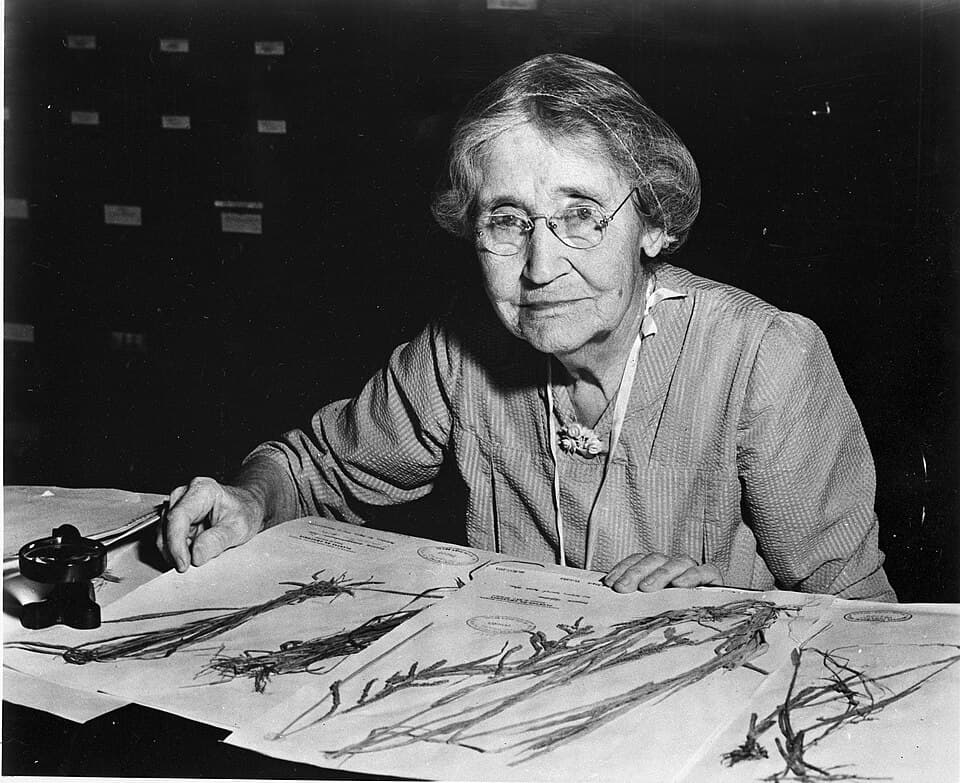
American · Science · Activism
Mary Agnes Chase
April 20, 1869 – September 24, 1963
Early Life and Background
Mary Agnes Chase, born Mary Agnes Meara, entered the world on 20 April 1869 in Iroquois County, Illinois, probably near Watseka in the state’s rural east.[5][8][12] She was the second child of Martin Meara and Mary Cassidy Brannick Meara, Irish American parents of modest means.[8] Her father died when she was very young, leaving the family in precarious financial circumstances.[5][8] As a result, Chase’s formal schooling ended early; she attended local schools and a convent school but did not go to college.[2][5][12]
Despite limited education, she showed strong aptitude for drawing and a keen interest in nature. Like many working-class women of her generation, she held various jobs, including work as a proofreader and typesetter, to help support her family.[2][5][8] Her intellectual formation came largely through self-directed study: she took occasional evening classes, read widely in science and literature, and practiced botanical illustration. This combination of artistic skill and autodidactic science would later prove crucial to her entry into professional botany in an era when women, especially those without degrees, were rarely accepted as researchers.[2][5][12]
Chase’s early exposure to economic hardship and gendered expectations shaped her lifelong commitments. She understood both the power of education and the barriers that kept many women, particularly from working-class backgrounds, outside laboratories and lecture halls. These experiences informed her later activism for women’s suffrage and her informal mentoring of younger women scientists, whom she often hosted and encouraged in their careers.[2][5][8]
Career Beginnings in Illustration and Museum Work
Chase’s professional entry into science came through botanical illustration. By the early 1890s she was living in Chicago, where the newly established Field Columbian Museum (later the Field Museum of Natural History) sought skilled illustrators for botanical publications.[3][8] Around 1893, she began working with Charles Frederick Millspaugh, curator of plants, who hired her as an illustrator and recognized her talent and diligence.[3][5]
At the Field Museum she produced detailed drawings for taxonomic papers, learning plant morphology and scientific methods directly from curators and visiting botanists.[3][8] Millspaugh advocated for her career, writing to colleagues in Washington, D.C., to secure her access to the U.S. National Herbarium and broader professional networks.[3] This support proved pivotal; although she lacked formal credentials, her illustrations demonstrated a deep understanding of structural detail, and her reliability made her a valued collaborator.
In 1901, Chase began more sustained collaboration with Millspaugh and continued to develop her reputation in botanical circles.[5][8] Her work in Chicago coincided with a period of rapid expansion in American museums and federal scientific agencies, which were amassing large plant collections from across the continent. Her skill as an illustrator opened doors into this world just as agrostology—the study of grasses—was emerging as an important field for agriculture and ecology.[2][12]
Move to Washington and Rise in Agrostology
Chase’s career advanced dramatically after she moved to Washington, D.C. In 1903 she was appointed a botanical illustrator at the U.S. Department of Agriculture (USDA), a position that brought her into close contact with leading plant taxonomists.[3][5] That same year she married William Ingraham Chase; he died later in 1903, leaving her a widow but stabilizing her surname as "Mary Agnes Chase" for all subsequent scientific work.[5][8]
Her responsibilities soon expanded beyond illustration. By 1906, Chase had joined the staff of the U.S. National Herbarium at the Smithsonian Institution and the USDA’s Bureau of Plant Industry as an assistant in agrostology.[5][7][12] She worked closely with Albert Spear Hitchcock, the senior grass specialist, who recognized her abilities and encouraged her taxonomic training. In 1909 she was appointed assistant botanist, reflecting her transition from illustrator to recognized researcher.[3][12]
Over the next decades, Chase helped systematize the enormous grass collections being assembled in Washington. In 1910 she co-authored "The North American Species of Panicum" with Hitchcock, a foundational treatment of one of the largest and most challenging genera of grasses.[5][12] Through meticulous study of specimens and field notes, she clarified species boundaries and synonymies, laying the groundwork for later revisions by other systematists.
Her institutional position, however, remained precarious in gendered ways. As a woman in a male-dominated federal agency, Chase encountered skepticism about her capacities and faced limitations on travel and promotion. She overcame these barriers through sustained excellence in research and by cultivating networks across the USDA, Smithsonian, and international herbaria.[2][12]
Major Works and Field Expeditions
Chase’s scientific reputation rests on a series of major publications and extensive fieldwork in the Americas. Following her early collaboration on Panicum, she produced several landmark monographs.
- In 1915, the USDA Bureau of Plant Industry issued her monograph "Tropical North American Species of Panicum", offering a comprehensive taxonomic treatment of tropical grasses in this complex genus.[4][16] The work provided keys, descriptions, and distribution data that greatly expanded knowledge of tropical agrostology.
- In 1917, the Carnegie Institution of Washington published her "Grasses of the West Indies", documenting the grass flora of the Caribbean with systematic rigor and attention to biogeography.[4][12][16]
- In 1922, Macmillan brought out her widely read textbook "First Book of Grasses: The Structure of Grasses Explained for Beginners", which demystified grass morphology for students, farmers, and amateur botanists.[1][5][12]
Parallel to this writing, Chase conducted demanding field expeditions. She collected grasses across the United States and Latin America, sometimes under harsh physical conditions. Her most famous journeys were to Brazil. In 1920, after USDA officials declined to sponsor travel on the grounds that sending a woman alone was unsuitable, she embarked on a largely self-funded expedition to Brazil, departing on 15 October 1920.[12][15] There she traveled widely, collecting thousands of specimens in varied habitats and collaborating with Brazilian botanists.
She returned to Brazil for another major expedition in 1929, during which some accounts credit her with climbing one of South America’s highest peaks, though detailed and verifiable documentation is lacking.[5][12] Across her journeys, Chase eventually collected and catalogued more than 10,000 grass specimens, many of which were new to science or poorly understood.[2][8][13] Her work contributed to an annotated index of about 80,000 specimens of Gramineae housed in Washington, a resource that remains foundational for grass taxonomy.[12]
Chase’s methodological approach combined careful field observation with herbarium scrutiny. She emphasized variation within species, ecological context, and the importance of accurate illustrations. Her more than 70 scientific publications addressed taxonomy, nomenclature, and morphology, and they are still cited by researchers working on tropical and temperate grasses.[1][10][12]
Activism and Social Engagement
Beyond her scientific work, Chase was deeply engaged in social movements, particularly women’s suffrage and racial justice. In the 1910s she became active in the National Woman’s Party, joining protests aimed at securing a federal amendment for women’s voting rights.[2][15] On 14 June 1913 she was arrested in Washington, D.C., while participating in a suffrage demonstration and imprisoned for eight days.[2][15]
Her activism drew reprimands from USDA supervisors, who feared that her public politics could damage the department’s reputation and questioned whether civil servants should participate in protests.[2] Nonetheless, she refused to renounce her involvement, and her scientific stature offered some protection. In 1918 she took part in high-profile National Woman’s Party actions that again risked her position but helped sustain pressure for women’s enfranchisement.[2][15]
Chase also supported racial justice causes. Biographical accounts note her sympathy for African American civil rights and her belief in equal access to education and professional opportunities, including in science.[2][5] She mentored younger women and international students, opening her Washington home—nicknamed "Casa Contenta"—to visiting female botanists who needed lodging and encouragement.[14] Through this informal network, she helped many women gain experience with the National Herbarium collections and navigate male-dominated institutions.
Her activism and mentorship highlight how she viewed science as inseparable from broader struggles for equality. She challenged gender discrimination within the USDA and Smithsonian while also contesting exclusionary laws in the public sphere, making her a notable example of a scientist who used her position to advance social change.[2][12]
Awards, Honors, and Recognition
Over time, Chase’s contributions were recognized by major scientific bodies, although formal honors arrived relatively late in her life. She continued working at the USDA and Smithsonian into the 1930s, formally retiring from the USDA in 1936 but remaining an honorary collaborator and later honorary curator of grasses at the National Herbarium.[3][7][12]
In the 1950s, a series of high-profile honors acknowledged her standing:
- Botanical Society of America Certificate of Merit (1956): On 28 August 1956, the BSA awarded her a Certificate of Merit for distinguished achievement in botanical science, describing her as "one of the world’s outstanding agrostologists".[3][7][11]
- Honorary doctorate from the University of Illinois (1958): On 15 June 1958, she received an honorary doctorate in science from the University of Illinois, a significant recognition for a self-taught scientist who had never attended college.[5][7][10]
- Honorary Fellow of the Smithsonian Institution (1959): On 21 April 1959, the Smithsonian named her an Honorary Fellow, honoring her decades of work on its grass collections and her leadership in agrostology.[7][12]
- Honorary Member of the Linnean Society of London (1961): On 25 May 1961, she was elected an Honorary Member of this historic biological society, reflecting international recognition of her scientific achievements.[7][12]
These honors, conferred by professional societies, a major university, and a national museum, collectively affirmed Chase’s place among the foremost botanists of her generation. They also signaled changing attitudes toward women’s contributions in science, even though many structural barriers remained.
An intriguing, lesser-known recognition of her scientific breadth came in the form of a U.S. patent. On 8 July 1962, she was granted Patent No. 2,609,322 for "Production of Penicillin Mold and Jelly," linking her name to antibiotic production technology and illustrating her engagement with applied research beyond classical botany.[17]
Personal Life and Relationships
Chase’s personal life was marked by both loss and deep intellectual companionship. Her 1903 marriage to William Ingraham Chase ended with his death later that year, and there is no evidence that the couple had children.[5][8] Widowed at a relatively young age, she focused her energies on her scientific career and activism.
Colleagues and students described her as determined, independent, and generous. She maintained strong professional friendships, particularly with Albert Spear Hitchcock, with whom she collaborated on numerous projects.[1][12] Her home in Washington, "Casa Contenta," became an informal gathering place for botanists, especially women and Latin American visitors, who found both hospitality and mentorship there.[14]
Chase remained close to her extended family and to communities of suffrage activists and scientists. Her religious background, shaped by Catholic schooling, coexisted with progressive politics and a commitment to social reform.[2][5] Throughout her life she balanced a demanding workload with correspondence, mentoring, and participation in professional societies, embodying a model of scientific citizenship that extended beyond individual research output.
Later Life and Continued Work
After her formal retirement from the USDA in 1936, Chase did not withdraw from scientific work. She continued to serve as an honorary curator of grasses at the National Herbarium, regularly visiting the collections and advising staff and researchers.[3][12] She remained active into her seventies and eighties, annotating specimens, refining identifications, and corresponding with botanists worldwide.
Even as younger systematists adopted new approaches and taxonomic concepts, Chase’s detailed specimen work and historical knowledge of collections remained invaluable. She helped trace the provenance of important type specimens and guided revisions by pointing to overlooked material and clarifying earlier nomenclatural decisions.[12]
Her later years also saw the consolidation of her global reputation. Biographical entries began to describe her as "preeminent among American students" of grasses and "one of the world’s outstanding agrostologists."[3][10] Institutions that had once questioned her travel or promotion now honored her with fellowships, honorary degrees, and awards, affirming the long-term impact of her contributions.
Chase remained engaged with social issues, continuing to support women in science and civil rights causes. She used her status to advocate for inclusivity in scientific institutions, encouraging them to welcome students and researchers from underrepresented groups.[2][5]
Death
In the early 1960s, as age and health limited her activities, Chase moved into a nursing home in Bethesda, Maryland, near Washington. She died there on 24 September 1963, at the age of ninety-four.[7][8] Obituaries and later biographical accounts emphasized both her scientific achievements and her activism, portraying her as a figure who had "devoted her life to the study of grasses" and helped "hold the world together" through understanding these ecologically crucial plants.[2][8][15]
Her death closed a career that spanned the transformation of botany from nineteenth-century morphology and cataloguing to mid-twentieth-century ecology and global systematics. She had witnessed and contributed to the integration of American, European, and Latin American botanical work, particularly in the realm of grasses.
Legacy and Historical Impact
Mary Agnes Chase’s legacy is multifaceted, encompassing scientific innovation, institutional development, mentorship, and activism. In taxonomy, her monographs on Panicum and West Indian grasses, her textbook "First Book of Grasses," and her many shorter papers laid a foundation for modern agrostology.[1][4][12] Her emphasis on careful description, broad sampling, and clear illustration influenced methodological standards in grass systematics.
The collections she helped build at the USDA and Smithsonian—tens of thousands of specimens from North and South America—remain central to research on grass diversity, evolution, and biogeography.[8][12] Her annotated index of about 80,000 specimens, painstakingly compiled over decades, continues to guide curators and taxonomists in navigating historical material, making her work a lasting infrastructure for botanical science.
Institutionally, Chase demonstrated that women and self-taught scientists could occupy central roles in major national scientific organizations. Her promotions within the USDA, her leadership in systematic agrostology, and her honorary positions at the Smithsonian challenged assumptions about who could be a professional scientist in the early twentieth century.[2][12] Her recognition by the Botanical Society of America, University of Illinois, and Linnean Society of London further cemented the idea that excellent research could overcome entrenched biases, even if slowly and incompletely.
In the realm of activism, Chase’s participation in suffrage protests and her willingness to risk arrest and job security illustrated the convergence of scientific and political citizenship. She embodied a generation of women who saw access to the vote and to scientific careers as linked struggles. Her mentoring of younger women and international botanists helped diversify the field and provided models of supportive, inclusive scientific communities.[2][5][14]
Historians of science and women’s history now regard Chase as one of the most influential agrostologists of the twentieth century and a key figure in the broader narrative of women’s entry into professional scientific research.[2][10][12] Her life story demonstrates how determination, self-education, and collaborative networks enabled a woman without formal degrees to shape an entire subdiscipline of botany and to participate in major social movements of her day.
Today, her name continues to appear in taxonomic literature as the author abbreviation "Chase" associated with many grass species, and her biography is cited in educational resources aimed at inspiring new generations of scientists.[1][2][10][12] Through both her scientific work and her activism, Mary Agnes Chase "held the earth together" not only by studying the grasses that bind soils and ecosystems, but also by helping to bind together communities of scientists and activists striving for a more inclusive world.
Dated achievements
13 indexed.
- Apr201869Science
Birth of Mary Agnes Chase
Birth of Mary Agnes Meara (Mary Agnes Chase) in Iroquois County, Illinois, into a working-class family that shaped her self-taught path in botany.
View details Botanist Biographies: Mary Agnes Chase - May221903Science
Marriage to William Ingraham Chase
Mary Agnes Meara married William Ingraham Chase, becoming Mary Agnes Chase; she was widowed the same year and increasingly devoted herself to botany.