← All women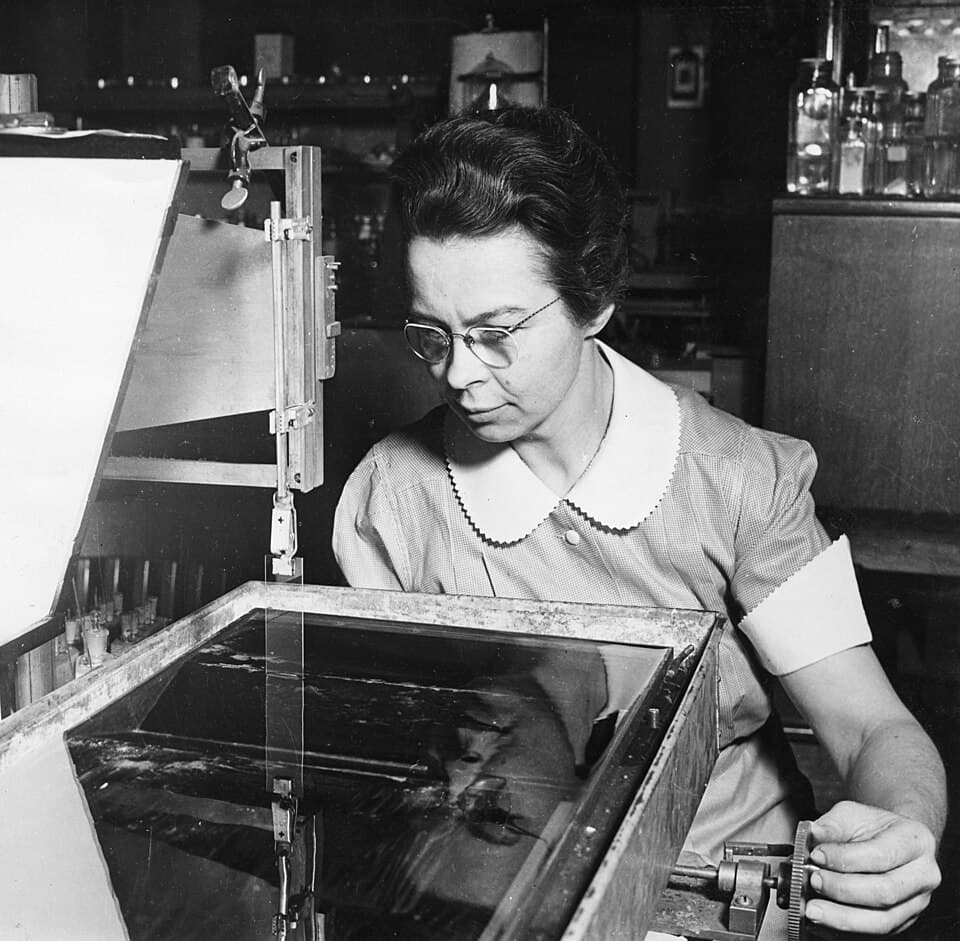
American · Science
Katharine Blodgett
January 10, 1898 – October 12, 1979
Early Life and Family Background
Katharine Burr Blodgett was born on January 10, 1898, in Schenectady, New York, a city that was rapidly becoming synonymous with the electrical industry and with General Electric (GE).[1][5][8][14] She was the daughter of George Bedington Blodgett, a patent attorney for GE, and Katharine Buchanan (Burr) Blodgett
Blodgett’s childhood unfolded in Schenectady amid the expanding presence of GE’s manufacturing works and its pioneering research laboratory. The family’s connection to GE through her father’s work as a patent attorney gave her an early awareness of the world of invention and industrial science. Sources note that she showed an early aptitude for mathematics and science and attended local schools before leaving for college at an unusually young age.[4][5][15] She completed high school around the age of 15 and moved into higher education just as opportunities for women in academia were slowly increasing. Blodgett enrolled at Bryn Mawr College, one of the leading women’s colleges in the United States, where she majored in physics.[4][5][15] She completed her A.B. degree in 1917
Upon graduating, she moved to the University of Chicago, an institution known for its strong research emphasis, where she pursued graduate work in physics and chemistry. She earned an M.S. degree in 1918, concentrating in chemistry.[4][5] Her master’s thesis work further developed her quantitative and experimental skills. During this period, she became aware of opportunities at General Electric’s Research Laboratory in Schenectady, which had been founded in 1900 as one of the earliest industrial research laboratories in the United States.[1][4] Blodgett’s formative influences included both academic mentors and industrial scientists. Her later collaboration with Irving Langmuir, the Nobel Prize–winning chemist at GE, would be central to her career.[1][11][12] The combination of Bryn Mawr’s support for women in science, Chicago’s research environment, and the example of GE’s cutting‑edge work in physics and chemistry positioned Blodgett to become one of the first women to pursue a full‑time career in industrial research. In 1918, shortly after completing her master’s degree, Blodgett joined the General Electric Research Laboratory in Schenectady as a research scientist.[1][3][5][6] She is widely documented as the first woman scientist hired at the GE Research Laboratory.[1][3][5][6][7] At that time, GE’s laboratory was one of the most prestigious industrial research centers in the world, and its staff included eminent scientists such as Irving Langmuir, William Coolidge, and others working on topics ranging from vacuum tubes to surface chemistry. Blodgett initially worked as an assistant to Irving Langmuir, who would receive the Nobel Prize in Chemistry in 1932 for his work on surface chemistry.[1][6][11] Langmuir’s research included investigations of monomolecular films—thin layers of organic molecules spread on the surface of water—which exhibited unique physical and chemical properties.[11] Under his mentorship, Blodgett learned the sophisticated experimental techniques required to study these films and began contributing her own ideas and innovations. The early years at GE exposed Blodgett to the interplay between basic research and industrial application. She operated within an environment that expected scientists to translate discoveries into patents and products, an expectation that she embraced. Her presence at the lab was also socially significant: she navigated a predominantly male corporate research culture at a time when women scientists were rare, especially in physics and chemistry.[3][5][7] In 1924, GE arranged for Blodgett to undertake advanced study in Britain, reflecting both Langmuir’s support and the laboratory’s investment in her abilities.[4] She traveled to the Cavendish Laboratory at the University of Cambridge, one of the world’s leading centers for experimental physics, where she studied under Sir Ernest Rutherford, a pioneering figure in nuclear physics and atomic structure.[1][4][9] The Cavendish had only recently established a formal PhD in physics, in 1919.[9] Blodgett conducted research at the Cavendish from 1924 to 1926, focusing on topics in experimental physics while maintaining ties to GE.[4] In 1926, she was awarded a PhD in physics by the University of Cambridge, becoming the first woman to receive a PhD in physics from Cambridge.[1][4][5][6][7][9][10] This milestone came against a backdrop of longstanding restrictions on women’s participation and recognition at British universities; Cambridge did not grant full membership to women until decades later. Her achievement was widely noted in later historical accounts and is now often cited as a landmark in women’s history in physics. It demonstrated that a woman trained in U.S. institutions could succeed at one of Europe’s most prestigious scientific centers, and it bolstered her authority and standing when she returned to GE. After completing her PhD, Blodgett returned to the GE Research Laboratory and resumed work with Langmuir.[1][4] Their collaboration focused on monomolecular and multimolecular films, exploring how organic molecules spread on water and could be transferred onto solid surfaces. Langmuir had demonstrated that certain molecules formed ordered monolayers; Blodgett extended this work by studying how these layers could be built up in multiple layers on substrates like glass.[6][11][12] In 1933, Blodgett developed a color‑gauge method for measuring the thickness of extremely thin films.[5][8] By observing changes in color caused by constructive and destructive interference of light as film thickness increased, she created a practical way to determine film thickness in the laboratory. This method was critical in enabling precise control over the number of layers deposited and hence over the optical properties of the films. Blodgett and Langmuir’s techniques for transferring films from water to solid supports became known as Langmuir–Blodgett films, and the equipment used—a trough allowing films to be compressed and transferred—became the Langmuir–Blodgett trough.[1][6][11][12] Their work opened a new subfield in surface chemistry and thin‑film science, with applications that extended far beyond GE. Blodgett’s most celebrated achievement came in the late 1930s. Building on her color‑gauge work and film‑deposition techniques, she explored ways to significantly reduce the reflection from glass surfaces. In 1938, she demonstrated that by depositing a film approximately 44 molecules thick onto glass, she could produce glass with almost no reflection of visible light.[5][8] The film’s own reflection destructively interfered with the reflection from the glass, yielding what was widely described as “invisible” glass.[6][7] GE publicly announced her success in invisible glass in December 1938, drawing attention from both the scientific community and industry.[8] Shortly thereafter, Blodgett secured a series of U.S. patents related to the underlying methods and resulting products: patents 2,220,860 (“Film Structure and Method of Preparation”), 2,220,861 (“Reduction of Surface Reflection”), and 2,220,862 (“Low-Reflectance Glass”) were all issued on November 5, 1940.[1][5][16] These patents documented the structures and processes needed to manufacture nonreflective glass at scale. The impact of Blodgett’s invisible glass was immediate. During World War II, nonreflective glass found applications in aircraft windows, submarine periscopes, gunsights, and spy cameras, where reduced glare improved visibility and safety.[3][5][15] In peacetime, her coatings were used in camera lenses, eyeglasses, museum display cases, and scientific instruments, helping define modern standards for optical clarity.[3][7] Today, anti‑reflective coatings are ubiquitous in consumer electronics and optics, and Blodgett’s pioneering work is recognized as a foundation for these technologies. Blodgett’s contributions during the Second World War extended beyond invisible glass. She worked on the development of smoke screens and
smoke generators for the Allied military, seeking to obscure ships and installations from enemy observation.[3][5] Her expertise in surface chemistry and particle behavior was crucial in designing smokes that produced dense, persistent clouds. She also participated in research on de‑icing materials for aircraft and on materials capable of absorbing poison gas, both critical safety concerns in wartime aviation and chemical warfare.[14] These projects illustrate the breadth of her applied research: she was able to pivot from optical coatings to problems in atmospheric chemistry and materials engineering as national needs demanded. While much of this wartime work remained classified or less publicly documented than her invisible glass, later accounts emphasize her role in ensuring that surface‑chemistry insights were brought to bear on urgent military applications.[3][5][14] Such contributions fit into a broader pattern of women scientists who played significant but often under‑recognized roles in wartime research. Following the war, Blodgett continued to innovate in thin‑film measurement and applications. In 1950, she and GE colleague Vincent J. Schaefer received U.S. patent 2,493,745 for an “Electrical Indicator of Mechanical Expansion”, and they later obtained patent 2,589,983 in 1952 for a related design.[2][5][15] These inventions provided ways to convert minute mechanical changes into electrical signals, contributing to advances in instrumentation. On February 26, 1952, Blodgett was issued patent 2,587,282 for a “Step Gauge for Measuring Thickness of Thin Films”, a device capable of measuring film thicknesses to within micro‑inches.[8] Later that year, on May 20, 1952, she obtained patent 2,597,562 for an “Electrically Conducting Layer”, describing techniques for creating thin conductive coatings on substrates.[2][14] On April 28, 1953, Blodgett received patent 2,636,832 for a “Method of Forming Semiconducting Layers on Glass and Article Formed Thereby”.[2] This work linked her thin‑film expertise to semiconductor technology, showing how semiconducting materials could be deposited onto glass to produce composite structures with both optical and electronic properties. Collectively, these postwar patents highlight her sustained engagement with emerging fields and the extension of surface chemistry into electronics and measurement science. Blodgett’s scientific achievements garnered substantial recognition. In 1939, she received an honorary Doctor of Science degree from Elmira College.[8] In 1942, she was awarded honorary doctorates from Brown University and Western College, and in 1944, she received another honorary doctorate from Russell Sage College.[8] These honors reflected both her scientific stature and her role as a trailblazing woman in industrial research. In 1945, the American Association of University Women (AAUW) presented her with its Annual Achievement Award, recognizing her contributions to surface chemistry and the invention of nonreflecting glass.[5][8] This award placed her among the most distinguished women scientists of her generation. In 1951, Blodgett received the Francis P. Garvan Medal from the American Chemical Society, one of the most important awards for women chemists.[1][5][8] She was notably the first industrial scientist to win this medal, underscoring that significant chemical research was being carried out in corporate laboratories and that women could lead such work.[1][8] That same year, she was selected by the U.S. Chamber of Commerce as one of 15 “women of achievement,” a designation that highlighted her national prominence.[5][7] Blodgett’s home city of Schenectady also celebrated her. On June 13, 1951, the mayor proclaimed “Katharine Blodgett Day” to honor her scientific achievements and contributions to the community.[4] Later, in 1972, she received the Photographic Society of America’s Progress Medal in recognition of the importance of her invisible glass and related work for photography.[5][8] Posthumously, Blodgett was inducted into the National Inventors Hall of Fame in 2007, cited for her pioneering work on nonreflective glass and thin‑film technologies.[2][7] This induction placed her among a select group of inventors whose work has had a lasting impact on society. Despite her public profile as a scientist, Blodgett maintained a relatively private personal life. Sources consistently report that she never married and had no children.[5] She lived for much of her life in Schenectady, near the GE Research Laboratory, and was known by colleagues and friends as modest and dedicated to her work. Accounts of her personality describe her as meticulous, inventive, and quietly determined.[3][11][12] She engaged in professional societies and maintained international contacts in physics and chemistry, but she did not seek celebrity. Her decision to remain unmarried and to prioritize her scientific career was notable in the context of early- and mid‑20th‑century expectations for women, and it likely afforded her the time and focus necessary to sustain a multi‑decade research trajectory. Blodgett continued working at the GE Research Laboratory into the early 1960s. She pursued measurements of thin films, studies of optical properties, and applied projects related to materials and instrumentation. In 1963, she formally retired from General Electric, concluding more than four decades of service.[1][5] Her retirement did not erase her influence: the techniques she had helped develop remained embedded in laboratory practice, and her patents continued to underpin commercial products. Colleagues and later historians emphasized that she had been central to the evolution of surface chemistry from a nascent research area into a practical foundation for coatings technology.[11][12] Katharine Burr Blodgett died on October 12, 1979, in Schenectady, New York, at the age of 81.[1][2][5][10] She passed away at home in the city where she had been born and had spent her entire professional life.[5] By the time of her death, she was recognized as a pioneering woman physicist and chemist whose work had changed the way we see through glass and understand surface films. Blodgett’s legacy is multifaceted. Scientifically, she is best known for her invention of nonreflecting “invisible” glass and for her contributions to Langmuir–Blodgett films, which remain standard methods in surface and materials science.[1][6][7][11][12] Her work on thin films and optical interference laid groundwork for modern anti‑reflective coatings used in eyeglasses, camera lenses, museum glass, scientific instruments, and, by extension, many displays and optical components in contemporary technology. Her career also demonstrates the critical role of industrial research laboratories in 20th‑century science. Working at GE, she exemplified how corporate labs could foster fundamental discoveries and produce transformative products. She showed that women could succeed as industrial scientists, not only in supportive roles but as credited inventors and award‑winning researchers. In the history of women in science, Blodgett occupies a significant place. She was the first woman scientist at GE’s Research Laboratory and the first woman to receive a PhD in physics from the University of Cambridge, breaking barriers in both corporate and academic environments.[1][4][5][6][9][10] Her recognition by organizations such as the AAUW, the American Chemical Society, and the Photographic Society of America underscores the extent to which her scientific contributions were valued during her lifetime. Later commemorations—including her 2007 induction into the National Inventors Hall of Fame—have reinforced her status as a key figure in the history of invention and optics.[2][7] Educational and historical organizations now highlight her story to illustrate the long trajectory of women’s participation in physics and industrial research, and to inspire new generations of scientists. Blodgett’s life, stretching from her birth in 1898 through the turmoil of two world wars and into the age of modern electronics, shows how one woman’s persistent work in surface chemistry could reshape everyday experience—literally changing how the world is seen through glass—and how barriers in education and corporate science, though formidable, could be challenged and gradually transformed.Education and Formative Influences
Career Beginnings at General Electric
Doctoral Studies at Cambridge and Firsts in Physics
Return to GE and Development of Langmuir–Blodgett Films
Invention of Nonreflecting “Invisible” Glass
Wartime Research and Applied Projects
Postwar Patents and Contributions to Thin-Film and Semiconductor Technologies
Awards, Honors, and Public Recognition
Personal Life
Later Career and Retirement
Death
Legacy and Historical Impact
Dated achievements
11 indexed.
- Jan101898Science
Birth of Katharine Burr Blodgett
Katharine Burr Blodgett is born in Schenectady, New York, on January 10, 1898, the future pioneer of invisible glass and surface chemistry.
View details Wikipedia: Katharine Burr Blodgett - Nov051940Science
Patent 2,220,860 for Film Structure and Method of Preparation issued
U.S. patent 2,220,860, “Film Structure and Method of Preparation,” for thin-film structures enabling nonreflective glass, is issued to Katharine Burr Blodgett.