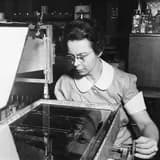
U.S. patent 2,220,860, “Film Structure and Method of Preparation,” for thin-film structures enabling nonreflective glass, is issued to Katharine Burr Blodgett.
On November 5, 1940, Katharine Burr Blodgett was issued U.S. patent 2,220,860 for an invention titled “Film Structure and Method of Preparation.” This patent codified her breakthroughs in building controlled monomolecular and multimolecular films on solid surfaces, a central step in producing nonreflective glass.
Working at the General Electric Research Laboratory, Blodgett drew on earlier monolayer studies with Irving Langmuir to devise a practical method of stacking organic molecules in precise layers on glass, enabling the fine control of film thickness needed to manipulate light reflection. Her 1940 patent described not only the structure of these multi‑layer films but also a reproducible procedure for preparing them, transforming delicate surface‑chemistry experiments into an industrially applicable technology.
This event is historically significant because it helped launch the era of Langmuir–Blodgett films, a foundational technique in surface science and thin‑film engineering. The patent supported the commercial development of anti‑reflective coatings used in camera lenses, eyeglasses, scientific instruments, and military optics. At a time when women were rarely named as inventors of major industrial processes, Blodgett’s patent stands out as a barrier‑breaking achievement in corporate research and intellectual property, marking her as a leading figure in the material science of optics.