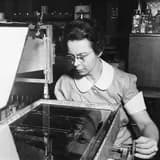
U.S. patent 2,587,282, “Step Gauge for Measuring Thickness of Thin Films,” is issued to Katharine Burr Blodgett for a precise thin-film measuring device.
On February 26, 1952, Katharine Burr Blodgett was issued U.S. patent 2,587,282 for a “Step Gauge for Measuring Thickness of Thin Films.” This invention provided a practical device capable of measuring film thicknesses with extremely high precision, on the order of micro‑inches.
Blodgett’s earlier work on monomolecular and multimolecular films had shown that controlling thickness at the molecular level was crucial for achieving desired optical properties. The step gauge translated these requirements into a robust measurement tool: by depositing films onto stepped surfaces and comparing optical or physical responses, the gauge allowed experimenters and manufacturers to determine film thickness accurately and repeatedly.
This patent is historically important because it strengthened the infrastructure of thin‑film technology at a time when coatings were becoming central to optics, electronics, and materials science. A reliable measuring device made it possible to standardize processes and improve quality control in industrial applications of Langmuir–Blodgett and related films. As a woman inventor advancing precision instrumentation within GE, Blodgett helped ensure that the field she had helped create could be reproduced and scaled, thereby extending the impact of her earlier scientific discoveries into practical engineering routines.