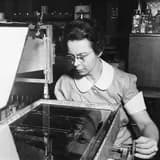
U.S. patent 2,220,862, “Low-Reflectance Glass,” is issued to Katharine Burr Blodgett, protecting her nonreflecting “invisible” glass product.
On November 5, 1940, the same day as two related filings, Katharine Burr Blodgett was issued U.S. patent 2,220,862 for “Low-Reflectance Glass.” This patent extended and consolidated the practical applications of her thin‑film research, specifying glass articles whose surfaces are coated to achieve greatly reduced reflection.
In this work, Blodgett outlined how to translate laboratory‑scale film deposition into durable, usable glass products. The patent described conditions for producing coated glass with superior clarity compared to untreated glass, addressing challenges such as adhesion, uniformity, and stability of the films under everyday use. The result was glass that appeared almost perfectly transparent, quickly dubbed “invisible” glass in contemporary accounts.
This event is historically significant because it marked the formal protection of the finished nonreflective glass product, rather than just its underlying methods. It underpinned the wartime deployment of low‑glare glass in aircraft windows, submarine periscopes, and precision instruments, and later in commercial camera lenses and display glass. Coming from a woman industrial scientist at a time when such roles were exceptional, the patent showcased Blodgett’s dual strengths as an experimental physicist and an applied inventor whose work reshaped everyday optical technologies.