← All women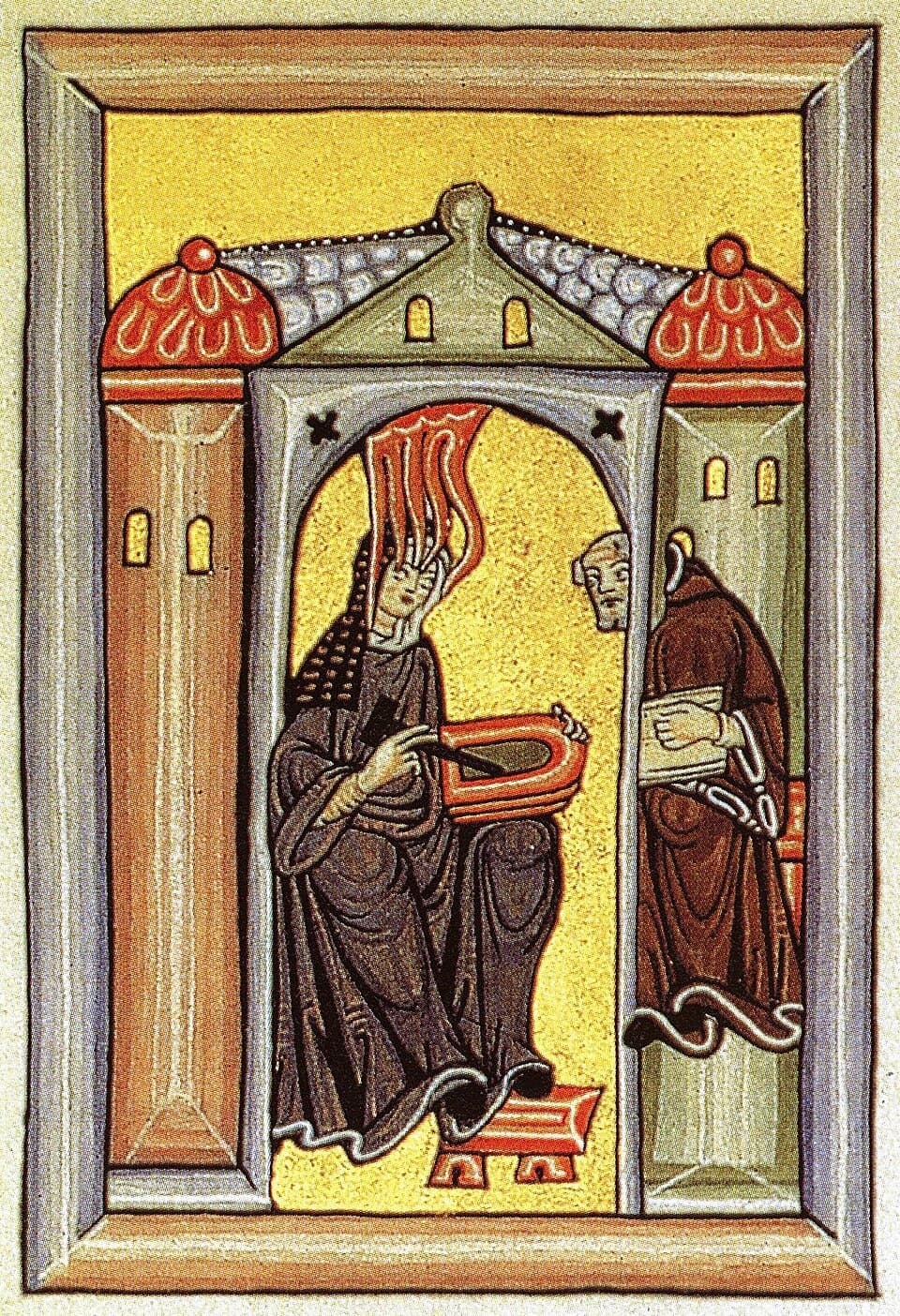
German · Science · Arts · Literature
Hildegard of Bingen
1098 – September 17, 1179
Early Life and Background
Hildegard of Bingen (Latin: Hildegardis Bingensis) was born in 1098 in the Rhineland region of the Holy Roman Empire, probably in Bermersheim vor der Höhe or Niederhosenbach.[1][2][10][18] She was the tenth child of a minor noble family, traditionally identified as Hildebert and Mechthild, who were connected to the counts of Sponheim.[1][4][10] As was common for a "tithe child" in noble households, she was promised to the Church at an early age. From childhood she reported experiencing luminous visions of divine light and symbolic images, though she initially concealed them out of fear and modesty.[1][3][15]
When Hildegard was around eight, her parents arranged for her to be placed under the spiritual care of Jutta von Sponheim, a devout noblewoman who had become an anchoress attached to the Benedictine monastery of Disibodenberg.[1][2][15] In 1112 she was formally enclosed there and took Benedictine vows, entering a life of permanent cloister.[2][14][17] Jutta instructed her in the Latin psalter, basic grammar, and the Benedictine Rule, and exposed her to the liturgy and spiritual reading that formed the core of monastic education. Although Hildegard never received the advanced schooling typical of male clerics, this environment gave her enough Latin and scriptural familiarity to later compose extensive works of theology, natural history, and music.[1][4][18]
From her youth Hildegard’s inner life was marked by what she described as a constant, shimmering light and visionary images accompanying her understanding of Scripture and the world. She experienced these not as ecstasies but as continuous insight, yet she remained reluctant to speak of them publicly. Only in middle age, under pressure from what she interpreted as a divine command and the encouragement of trusted clerics, would she begin systematically to record her visions.[1][3][14]
Monastic Career and Emergence as Leader
Hildegard lived in the women’s enclosure at Disibodenberg for decades, initially under Jutta’s direction and later as a senior member of the growing community of nuns. After Jutta’s death in 1136, Hildegard was elected magistra, the leader of the women’s community.[2][14] This election gave her recognized spiritual and administrative authority over the nuns, though the overall monastery remained subject to a male abbot. As magistra she was responsible for discipline, liturgical organization, and the spiritual formation of her sisters.
By this time Hildegard’s visions had become more insistent, and she began to confide them to her confessor, the monk Volmar, and to other trusted figures. Around 1141 she experienced a particularly powerful vision in which she understood herself to be commanded by God to "write what you see and hear."[1][14] Trembling at the prospect, she initially resisted, fearing both the weight of the task and potential condemnation as a woman presuming to teach. With Volmar’s support and the endorsement of the local abbot, she finally obeyed and began to compose her first major work, the visionary treatise Scivias ("Know the Ways").[1][14]
Hildegard’s growing reputation as a visionary drew attention beyond Disibodenberg. Church leaders sought to discern whether her experiences were orthodox and spiritually beneficial. This scrutiny would soon lead to a remarkable moment of papal approval, transforming her from a local mystical figure into a widely acknowledged prophet and teacher.[1][11][14]
Major Works and Theological Contributions
Scivias and Papal Approval
Between roughly 1141 and 1151, Hildegard wrote Scivias, a visionary exposition of salvation history, the nature of the Church, and the moral life.[1][14] The treatise is structured as a series of visions accompanied by explanatory commentary, rich allegorical imagery, and moral exhortations. It articulates themes that would recur throughout her work: the harmony of creation, the feminine symbolism of divine Wisdom, and the concept of viriditas, the "greening" life force suffusing the cosmos.[1][3][18]
In 1147–1148, segments of Scivias and reports about Hildegard were brought to the Synod of Trier, convened by Pope Eugene III.[1][2] On 5 March 1147, portions of the text were read aloud before the pope and assembled clergy.[1] After listening and consulting with prominent figures such as Bernard of Clairvaux, Eugene III publicly approved Hildegard’s visions and urged her to continue writing.[1][11] This endorsement effectively authorized her as a legitimate theological voice, an extraordinary recognition for a woman in the twelfth century.
The completed version of Scivias, finished around 1151, includes the dramatic musical allegory Ordo Virtutum ("Play of the Virtues"), widely regarded as the earliest known morality play and one of the few medieval dramas with a named female author.[1][11] The work stages the struggle of the human soul between virtues and the Devil, entirely in song except for the Devil’s spoken lines. Hildegard’s integration of theology, allegory, and music in Ordo Virtutum has led scholars to view her as a pioneering figure in the history of Western drama and sacred music.[1][4][11]
Liber vitae meritorum and Moral Theology
In the later 1150s, around 1158, Hildegard began Liber vitae meritorum ("Book of Life’s Merits"), her second major visionary work.[2][14] This treatise focuses on moral theology, presenting a complex series of dialogues and personifications of virtues and vices. It explores how human choices participate in cosmic order or disorder, linking individual ethics to the wider harmony of creation.
Liber vitae meritorum reflects Hildegard’s concern with social and ecclesial reform. She condemns corruption among clergy and laity, addresses issues of justice, and emphasizes the responsibility of rulers to uphold moral law. Her treatment of vice is both psychological and spiritual, showing keen insight into human motivations. Written from the perspective of a woman abbess, the work challenges assumptions that medieval women’s spirituality was merely affective; Hildegard engages rigorously with ethical structures and critiques of power.[11][14]
Liber divinorum operum and Cosmology
Around 1163, Hildegard began Liber divinorum operum ("Book of Divine Works"), the third and most comprehensive part of her visionary trilogy.[2][14][18] This treatise presents a grand synthesis of theology, cosmology, anthropology, and natural philosophy. Its visions depict the universe through complex allegorical images—the cosmic wheel, the human figure as microcosm, and the interplay of elements, stars, and virtues.
In Liber divinorum operum, Hildegard elaborates her understanding of creation as a dynamic, living whole sustained by divine love. She connects cosmic processes to human moral life, insisting that sin distorts not only the soul but the fabric of the world. Modern scholars have highlighted this work as a precursor to ecological theology and as evidence for viewing Hildegard as a founder of scientific natural history in Germany.[1][3][4][18] Her integration of visionary insight with keen observation of nature offers a distinctive alternative to the scholastic methods emerging in contemporary universities.
Scientific, Medical, and Linguistic Writings
Alongside her visionary trilogy, Hildegard composed significant works on natural history and medicine, notably Physica and Causae et curae, written mainly in the 1150s.[8][11] Physica catalogs plants, animals, stones, and elements with descriptions of their properties and medicinal uses. Causae et curae discusses the causes of disease and practical remedies, often framed within a theological understanding of the human person.
These treatises are among the earliest extensive scientific and medical texts known to be authored by a woman in medieval Europe. Hildegard’s discussions of herbal medicine, women’s health, sexuality, and gynecology are particularly notable, as she approaches these topics from a female perspective rare in contemporary literature.[8][11] Her writing on the use of hops in beer—including their preservative qualities—makes her one of the earliest recorded authors to describe hops in brewing, an observation with lasting implications for European beer production.[8][9][11]
In the mid‑twelfth century, Hildegard also devised a constructed language called Lingua ignota ("unknown language"), accompanied by a glossary of invented words.[1][4] It is often described as the first known artificial language in Western history. Scholars debate its purpose, suggesting it may have been a meditative tool, a private sacred vocabulary, or a playful exploration of linguistic creativity. Whatever its function, the Lingua ignota underscores Hildegard’s originality and intellectual freedom within the constraints of monastic life.
Music and Poetry
Hildegard is regarded as one of the most important medieval composers of sacred monophony and the most recorded in modern times.[1][10] Her collection of liturgical songs, often titled Symphonia armoniae celestium revelationum ("Symphony of the Harmony of Heavenly Revelations"), includes antiphons, responsories, hymns, and sequences composed for her community and for saints she particularly venerated.[1][5]
Her music is characterized by wide melodic ranges, soaring lines, and texts that interweave biblical imagery with her visionary symbolism of light, fire, and viriditas. As both poet and composer, she crafted works that expressed her theology in sonic form, emphasizing the role of music as participation in the celestial harmony. Modern performances and recordings of her chants have contributed significantly to renewed interest in medieval women’s creativity and spirituality.[1][5][10]
Preaching, Correspondence, and Public Influence
Hildegard’s recognized prophetic status enabled her to exercise a public role unusual for women of her time. She maintained an extensive correspondence with popes, emperors, bishops, abbots, and laypeople, offering counsel, admonitions, and spiritual encouragement.[1][4][15] Her letters address topics such as church reform, moral conduct, political conflicts, and personal spiritual struggles. She did not hesitate to criticize powerful figures, including Emperor Frederick I Barbarossa, when she perceived them to be acting against divine justice.
In the 1150s and 1160s she undertook several preaching tours along the Rhine and in neighboring regions, speaking publicly in cities such as Mainz, Trier, and Cologne.[1][14][17] According to later sources, she may be the only known medieval woman to have preached in public with ecclesiastical approval.[11][14] Her sermons and admonitions urged clergy to reform, warned against heresy, and called laypeople to a more serious Christian life. These activities, combined with her writings, placed her at the center of religious and political discourse in twelfth‑century Germany.
Through her preaching and letters, Hildegard became a founder of the Rhineland mystic movement, influencing later figures such as Mechthild of Magdeburg and, indirectly, Meister Eckhart.[14][15] Her emphasis on the experiential knowledge of God, the interconnection of creation, and the feminine aspects of the divine contributed to a distinctive regional tradition of German mysticism.
Foundations of Rupertsberg and Eibingen
Hildegard’s desire for greater autonomy for her community led her to seek permission to establish a separate women’s monastery independent of the male house at Disibodenberg. With papal backing, she founded the convent of Rupertsberg near Bingen around 1147, and in 1150 she relocated her nuns there.[1][2][17] The move was contested by the monks of Disibodenberg, who opposed losing the nuns and their resources, but Hildegard persisted, interpreting her visions as divine confirmation of the new foundation.[2][14]
At Rupertsberg Hildegard served effectively as abbess, though some formal titles were nuanced by local arrangements. She oversaw the construction of buildings, organized the liturgy, and fostered a culture of learning and artistic creation. The monastery became the primary setting for her mature work as writer and composer.[1][9]
Around 1165, Hildegard founded a second women’s house at Eibingen, across the Rhine from Rupertsberg.[8][17] This convent extended her monastic network and provided additional opportunities for women to live under the Benedictine Rule shaped by her spiritual vision. In later centuries Eibingen would play a key role in preserving her memory and relics, and today the parish and pilgrimage traditions associated with Eibingen continue to honor her legacy.
Awards, Honors, and Recognition
During her lifetime Hildegard enjoyed considerable esteem among ecclesiastical and secular leaders, though her status remained informal. She was consulted as a prophet and advisor, and her visions were officially approved by Pope Eugene III at the Synod of Trier.[1][11] Medieval martyrologies and hagiographic collections soon listed her as a saint, and by the early fourteenth century she was widely venerated in the Catholic Church.[1][14]
Formal canonization processes initiated in the thirteenth and fourteenth centuries were never completed, leaving her without universal recognition for centuries.[14] Nevertheless, her name appeared in the Acta Sanctorum, and in 1979 Pope John Paul II referred to her as "an outstanding saint" on the 800th anniversary of her death.[14]
A major modern milestone occurred on 10 May 2012, when Pope Benedict XVI extended the veneration of Hildegard to the universal Church by inscribing her in the official catalogue of saints, an act equivalent to canonization.[1][8] Later that year, on 7 October 2012, he proclaimed her a Doctor of the Church, recognizing the exceptional doctrinal authority of her writings.[1][16] Hildegard thus became one of only a few women—currently four—granted this title, which traditionally honors theologians whose teaching has particular significance for the whole Church.
Today Hildegard is celebrated as a patron saint of musicians, writers, and sometimes of creativity more broadly.[16][19] Her feast day is observed on 17 September
Hildegard lived her entire adult life as a Benedictine nun within monastic communities. She never married and had no children. Her most significant relationships were spiritual and intellectual. Early in life she was formed by Jutta von Sponheim, whose ascetic example and mystical devotion shaped Hildegard’s understanding of religious vocation.[1][2][15] Her confessor and secretary Volmar played a crucial role in encouraging her to write and in mediating her visions to the wider Church. After his death, Hildegard lamented the loss of a trusted collaborator.[1][15] Another key figure was Richardis von Stade, a noblewoman and close companion who served as a leader in the Rupertsberg community. When Richardis was appointed abbess of a different monastery, Hildegard strongly opposed her departure, interpreting it as contrary to divine will; she wrote emotionally charged letters to high-ranking officials seeking to reverse the decision.[1][4][15] Hildegard’s extensive correspondence with rulers and clergy reveals both affectionate and confrontational relationships. She addressed figures such as Emperor Frederick Barbarossa and various bishops with frank admonitions, combining respect for office with uncompromising moral critique. Her letters also show pastoral sensitivity in guiding laypeople and religious through illness, grief, and spiritual confusion.[1][4][14] In her later years Hildegard continued to write, compose, and correspond while managing the affairs of Rupertsberg and Eibingen. She faced controversies, including a notable conflict with diocesan authorities when she refused to exhume a nobleman buried in her monastery’s cemetery under suspicion of excommunication. Hildegard defended the man’s Christian burial and resisted episcopal pressure, demonstrating her willingness to confront hierarchical decisions when she believed them unjust.[1][2] Despite periods of illness—sometimes interpreted as linked to the intensity of her visions—she remained active into advanced age. On 17 September 1179, Hildegard died at Rupertsberg, surrounded by her community.[1][2][14] Later tradition reports that at the time of her death two luminous streams crossed the sky, a sign her nuns understood as divine confirmation of her sanctity.[1][14] After her death, Rupertsberg eventually suffered destruction during later conflicts, including the Thirty Years’ War, but her relics and memory were preserved in part through Eibingen and other sites.[1][9] Her writings continued to circulate in manuscript form, influencing mystics, preachers, and scholars across Europe. Hildegard of Bingen is widely regarded as one of the most multifaceted intellectuals of the twelfth century and among the most significant women in medieval Western history.[1][3][18] As a polymath, she combined roles as visionary theologian, composer, poet, natural historian, medical writer, and monastic leader. In theology and spirituality, her visionary trilogy and sermons shaped the development of German mysticism and contributed enduring themes to Christian thought: the cosmic harmony of creation, the interplay of justice and mercy, and the feminine symbolism of divine Wisdom. Her concept of viriditas has inspired modern ecological and creation-centered spirituality, emphasizing life, growth, and interconnectedness.[3][18] In music, Hildegard’s chants represent an extraordinary corpus of female-authored liturgical composition. Their modern revival has altered perceptions of medieval music, highlighting women’s participation in creative and theological expression.[1][5][10] In science and medicine, her treatises Physica and Causae et curae have led many scholars to consider her a founder of scientific natural history in Germany and perhaps the most significant woman scientist of medieval Europe.[4][8][11] Her discussions of herbal remedies, women’s health, and sexuality provide rare insight into female medical perspectives in the Middle Ages. In women’s history, Hildegard stands out as the first woman known to have been explicitly authorized by a pope to write theological works, as the author of the earliest extant morality play, and as the only medieval woman widely recognized for preaching publicly.[11][14] Her ability to exercise leadership, advise rulers, and challenge abuses of power while remaining obedient to the Church’s structures demonstrates a distinctive form of female agency within a patriarchal institution. The modern rediscovery of Hildegard accelerated in the twentieth century, as scholars, musicians, and feminists engaged her writings and music. Recordings of her chants, translations of her works, and academic studies have made her a central figure in discussions of gender and religion, medieval culture, and ecological spirituality.[1][3][5][18] Her canonization and proclamation as Doctor of the Church in 2012 further cemented her status as a major voice in Christian tradition. Hildegard’s legacy continues to influence contemporary theology, musicology, women’s studies, and environmental thought. She exemplifies how a woman in a restrictive era could, through visionary courage, intellectual discipline, and spiritual authority, reshape the religious and cultural landscape of her time and speak compellingly to future generations.Personal Life and Relationships
Later Life and Death
Legacy and Historical Impact
Dated achievements
13 indexed.
- Jan011112Science
Enclosure and Benedictine vows at Disibodenberg
Hildegard was enclosed at the Benedictine monastery of Disibodenberg and took vows as a nun, beginning her formal monastic life.
View details Hildegard von Bingen – Wikipedia (German) - Jan011136Science
Elected magistra of the Disibodenberg convent
Hildegard was elected magistra, leader of the community of nuns at Disibodenberg, gaining recognized spiritual and administrative authority.