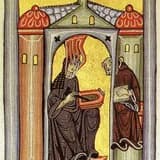
Hildegard and about twenty nuns moved from Disibodenberg to the newly founded monastery at Rupertsberg.
Around 1150, Hildegard and a community of approximately twenty nuns completed their move from Disibodenberg to the newly constructed monastery buildings at Rupertsberg. This relocation marked the practical realization of the foundation Hildegard had begun negotiating and building years earlier.
The move was not without difficulty; sources describe tension with the monks of Disibodenberg over the loss of the nuns' dowries and the prestige associated with hosting such a well-known visionary. Hildegard reportedly endured a period of illness, which she and her contemporaries interpreted as divine displeasure at obstacles to the move, until the relocation was finally permitted to proceed.
Once established at Rupertsberg, Hildegard's community flourished under her direct governance, free from the administrative constraints of a male-led monastery. This independence allowed Hildegard to develop her own liturgical customs, including her elaborate musical compositions, and to continue her prolific writing on theology, natural science, and medicine. The successful establishment of an independent female religious community at Rupertsberg is regarded as one of Hildegard's most significant institutional achievements, demonstrating her capacity for leadership and reform in the highly structured religious landscape of medieval Germany.