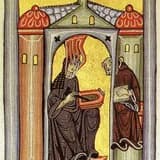
Hildegard began Liber divinorum operum (Book of Divine Works), the third and most comprehensive part of her visionary trilogy.
Around 1163, Hildegard began her final and most ambitious theological work, Liber divinorum operum ("Book of Divine Works"). This text integrates cosmology, theology, and natural philosophy into an expansive vision of the universe as an interconnected whole reflecting divine order, with humanity positioned at its center.
The work elaborates on themes Hildegard had explored throughout her career — the relationship between macrocosm and microcosm, the human body as a mirror of the cosmos, and the moral responsibilities of humankind within creation. It is often regarded as her most sophisticated synthesis of visionary theology and natural science, drawing on her decades of study and her own detailed observations recorded in her medical and scientific writings.
Composed in her mid-sixties, an advanced age for the period, this final major work reflects the culmination of Hildegard's intellectual life. Its completion, achieved in her final years, cemented her legacy as not only a visionary and church reformer but as one of the great systematic thinkers of the medieval period. Liber divinorum operum continues to be studied by scholars of medieval theology, philosophy, and the history of science for its remarkably integrated worldview.