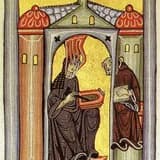
Hildegard of Bingen died at Rupertsberg monastery; later tradition reports visions of luminous streams crossing the sky at her death.
Hildegard of Bingen died on September 17, 1179, at the Rupertsberg monastery she had founded decades earlier, at approximately eighty-one years of age — a remarkably long life for the medieval period. She remained active in writing, correspondence, and governance of her community almost until the end of her life.
According to later hagiographic tradition, her death was accompanied by a striking celestial sign: witnesses reported seeing two brilliant, luminous streams of light crossing in the sky above the monastery, interpreted by her community as a divine testament to her sanctity. Such accounts, recorded in the vitae compiled by her associates, contributed to her enduring reputation for holiness in the centuries following her death.
Hildegard's death marked the end of an extraordinarily productive and multifaceted career spanning theology, music, natural science, medicine, and religious governance. Though formal canonization would not occur until centuries later, she was venerated locally as a saint almost immediately, and her writings, music, and scientific observations continued to circulate and influence subsequent generations. Her death at Rupertsberg closed one of the most remarkable intellectual and spiritual careers of any woman in the medieval West, whose legacy would only grow in recognition over the following centuries.