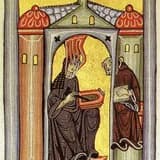
Hildegard completed Scivias, including the musical drama Ordo Virtutum, considered the first known morality play.
By around 1151, Hildegard completed her decade-long labor on Scivias, her monumental visionary trilogy's first installment. Embedded within this project was the Ordo Virtutum ("Play of the Virtues"), a musical drama in which allegorical Virtues battle for the human soul against the Devil.
The Ordo Virtutum is widely regarded by musicologists and theater historians as the earliest known morality play and one of the only surviving medieval dramas whose author can be identified by name — a remarkable distinction in an era when most religious drama was anonymous and liturgically embedded. Its music, composed entirely by Hildegard, features soaring monophonic melodies distinct from the chant repertoire of her contemporaries.
The completion of Scivias alongside this musical-dramatic work cemented Hildegard's reputation as a uniquely multi-talented visionary: theologian, composer, and dramatist in one. It demonstrated that a woman religious could produce sophisticated original works spanning multiple artistic and intellectual disciplines. The Ordo Virtutum continues to be performed and recorded today, and it is frequently cited in music history courses as a foundational moment in the development of Western musical theater, securing Hildegard's legacy far beyond the boundaries of her own convent and century.