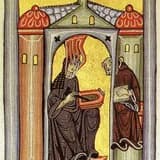
Hildegard began composing Scivias after a profound vision, launching the first work of her major theological trilogy.
In 1141, at approximately the age of forty-two, Hildegard experienced what she described as a divine command to "write down" the visions she had experienced since childhood. This marked the beginning of Scivias ("Know the Ways"), the first and most famous of her three great visionary theological works.
Hildegard described being overwhelmed by a vision of fire that illuminated her understanding of Scripture, prompting her — with the encouragement of her confessor Volmar and the nun Richardis von Stade — to begin dictating her visions in Latin. The work combines vivid visionary imagery with theological commentary covering creation, redemption, and the Church.
This moment is historically significant because it represents a woman claiming direct divine authorization to produce theological literature, a domain almost entirely reserved for male clergy in the twelfth century. Hildegard's insistence that her visions came from God, rather than from her own authority, allowed her writing to be taken seriously by Church authorities. The beginning of Scivias set in motion a decade of composition that would culminate in ecclesiastical approval and establish Hildegard as a major theological voice of her age.