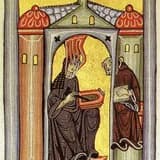
Pope Eugene III had portions of Hildegard's unfinished Scivias read at the Synod of Trier and approved her visionary writings.
On March 5, 1147, at the Synod of Trier, Pope Eugene III ordered that excerpts from Hildegard's still-unfinished Scivias be read aloud before the assembled bishops and clergy. After hearing the text, the pope gave his approval to her visionary writings and encouraged her to continue her work, effectively granting papal sanction to a woman's theological authorship.
This event was extraordinary for its era: formal ecclesiastical endorsement of theological writing was almost never extended to women, whose religious expression was typically confined to private devotion or obedience within convent walls. The pope's public approval elevated Hildegard's status from a locally respected abbess to a figure of trans-regional spiritual authority, legitimized by the highest office in the Latin Church.
The Trier approval opened doors for Hildegard's subsequent career: it enabled her to correspond openly with kings, bishops, and other prominent figures, to complete and circulate Scivias, and to pursue further theological and scientific writing without fear of accusations of heresy or presumption. It stands as one of the earliest documented instances of a woman receiving direct papal validation for theological authorship, a genuine milestone in the history of women's intellectual and religious life.