← All women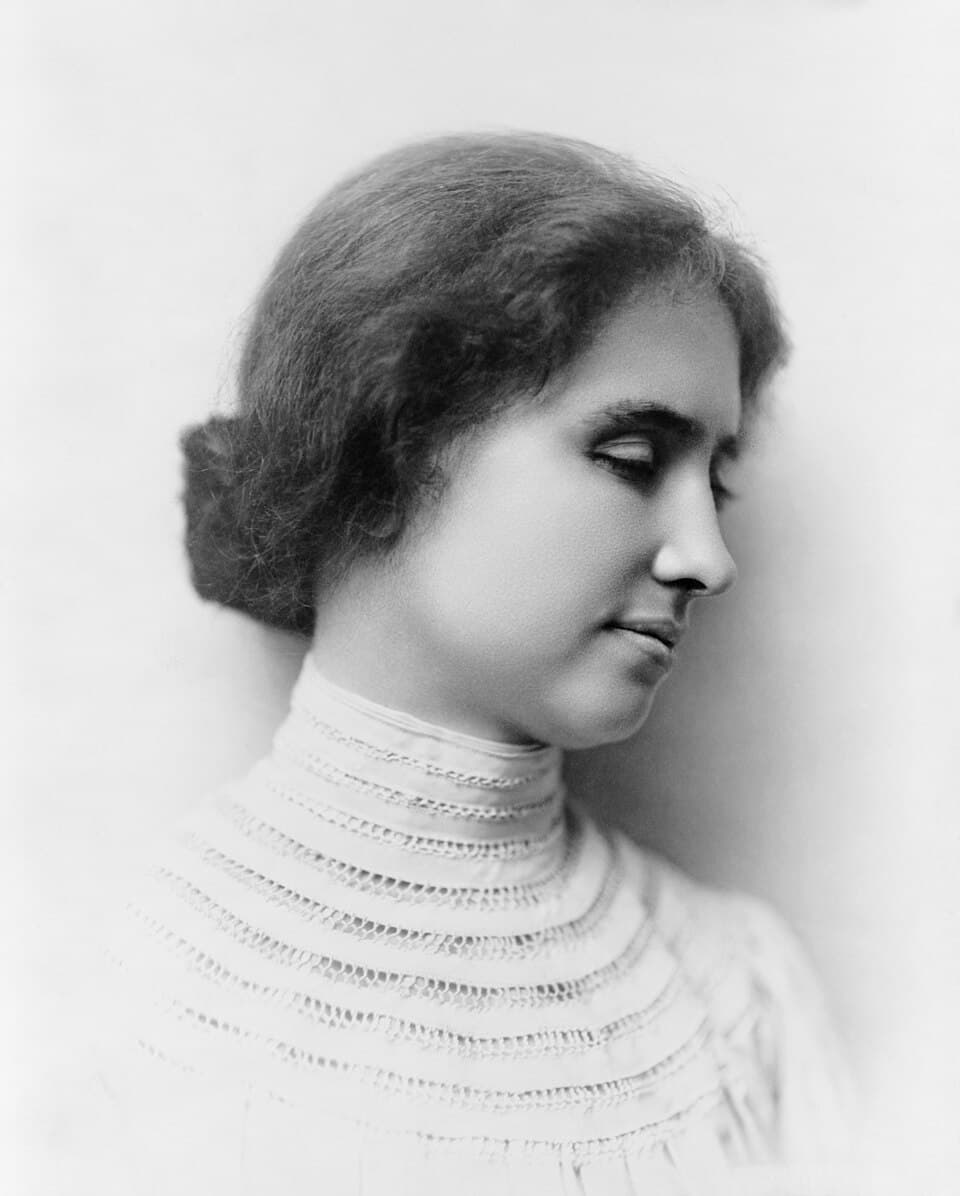
American · Activism · Literature
Helen Keller
June 27, 1880 – June 1, 1968
Early Life and Family Background
Helen Adams Keller was born on June 27, 1880, at Ivy Green, her family’s home in Tuscumbia, a small town in northern Alabama.[1][3][4][14] Her father, Arthur Henley Keller, was a former Confederate Army officer and the editor of a local newspaper, while her mother, Katherine (Kate) Adams Keller, came from a well‑educated Memphis family.[2][4] Helen was the older of two daughters in her parents’ marriage and had several half‑siblings from her father’s first marriage.[2][3] The family’s status as white, middle‑class Southerners in the post‑Reconstruction era deeply shaped Helen’s early environment, exposing her to both conservative social attitudes and the legacy of the American Civil War.
Helen was a healthy infant, but in February 1882, when she was about 19 months old, she contracted a sudden illness described at the time as "brain fever." Later accounts suggest it may have been scarlet fever or meningitis.[1][2][4] She survived, but the illness left her deaf and blind. Because she lost her sight and hearing before she had developed full spoken language, she emerged from the illness unable to communicate in conventional ways.[3][7] Over the next few years, she devised home signs and gestures to interact with her family, but frustration and isolation grew, and her behavior became increasingly unruly.
At the time, medical knowledge about sensory disabilities was limited, and educational opportunities for blind or deaf children were scarce. Many families had few options beyond institutionalization or keeping disabled relatives at home. The Kellers, however, were determined to find help. In 1886, they consulted Alexander Graham Bell, the inventor and long‑time advocate for education of deaf children, who advised them to contact the Perkins Institution for the Blind in Boston.[1][2][9] This decision would eventually connect Helen with the teacher who transformed her life.
Arrival of Anne Sullivan and the Breakthrough to Language
In January 1887, Arthur Keller wrote to Perkins director Michael Anagnos requesting a teacher for his daughter.[1][9] Anagnos chose Anne Mansfield Sullivan, a 20‑year‑old graduate of Perkins who had survived poverty, childhood eye disease, and time in an almshouse.[1][4][18] Sullivan arrived at the Keller home in Tuscumbia on March 3, 1887, beginning what would become one of the most famous teacher‑student relationships in history.[1][3][4][6]
Sullivan immediately introduced a structured educational regimen based on tactile sign language. She spelled words into Helen’s hand while associating them with objects and experiences, insisting that language should be meaningful rather than rote. Initially, Helen mimicked the hand signs but did not grasp that they represented words. The turning point came on April 5, 1887, at the family’s water pump. As water flowed over Helen’s hand, Sullivan spelled "w‑a‑t‑e‑r" into the other; Helen suddenly understood that the finger movements stood for the liquid she felt.[1][4][6][14] She later described this realization as the moment her "soul awakened," and she immediately demanded the names of everything around her.
This breakthrough demonstrated that a child who was both blind and deaf could acquire language through tactile methods and experiential learning. The episode became central to Keller’s first autobiography, The Story of My Life, and later dramatizations such as the play and film The Miracle Worker.[6][10][14] Educationally, Sullivan’s success challenged prevailing assumptions that deafblind individuals were incapable of abstract thought and literacy, and it helped inspire specialized approaches for teaching deafblind students.
Education at Perkins and Preparatory Schools
In September 1888, Anne Sullivan brought Helen to the Perkins Institution for the Blind in Boston.[1][4][9] There, Keller met other blind and deafblind students, including Laura Bridgman, whose earlier education at Perkins had informed Sullivan’s techniques.[1][4] Immersed in an environment designed for blind children, Helen studied reading, writing, arithmetic, and geography, using Braille and raised‑letter type. She also began learning French, German, and Latin, reflecting Sullivan’s high expectations for her academic potential.[1][9]
During the 1890s, Keller’s education continued to advance. She attended the Wright‑Humason School for the Deaf in New York City to improve her speech and lip‑reading skills and later enrolled at the Cambridge School for Young Ladies in Massachusetts, a preparatory school that trained her for college entrance examinations.[1][2][9] Her goal was ambitious: admission to Radcliffe College, then the women’s coordinate institution to Harvard University.
Keller’s schooling was not without controversy. In 1891 she wrote a short story titled "The Frost King" as a gift for Michael Anagnos. The story was published, but readers noticed similarities to an earlier children’s tale. Accusations of plagiarism followed, and Keller was deeply distressed.[1][2] Modern scholars generally view the episode as an instance of unconscious borrowing by a child exposed to stories through oral and tactile means, but the incident shaped attitudes toward Keller’s authorship and made her more cautious about creative writing.
Radcliffe College and Intellectual Formation
Keller formally entered Radcliffe College in the fall of 1900, accompanied by Anne Sullivan, who served as her constant interpreter.[1][3] Radcliffe offered no systematic accommodations; Keller relied on textbooks transcribed into Braille, lectures spelled into her hand, and occasional oral dictation to a typist.[1][6][10] She studied a broad liberal‑arts curriculum, including English literature, philosophy, history, and German, while also engaging with contemporary social and political thought.
On June 1, 1904, Keller graduated cum laude with a Bachelor of Arts degree, becoming the first deafblind person known to complete a college degree.[1][6][10][11] This accomplishment had symbolic and practical impact. In an era when women’s access to higher education was still contested, Keller’s success as a deafblind woman confronted both sexist and ableist assumptions about intellectual capacity. Her graduation also strengthened her credibility as an author and lecturer, making it harder for skeptics to dismiss her ideas as the product of mere inspirational sentiment.
During her college years, Keller began to articulate a distinct social and political philosophy. She read widely in radical literature, including works by H. G. Wells, William Morris, and socialist thinkers, and she absorbed arguments linking poverty and disability. These intellectual influences would later inform her passionate advocacy for labor rights, women’s suffrage, and socialism.
Writing Career and Major Works
Keller’s literary career began early and extended over more than six decades. Her first major book, the autobiography The Story of My Life, was published in 1903, while she was still in college.[2][3][10][14] The work combined her own narrative with commentary by editor John Macy and letters from Anne Sullivan. It became an international success, eventually translated into many languages and remaining in print into the 21st century.[6][10]
Over her lifetime, Keller authored more than a dozen books and roughly 400–500 essays and speeches.[6][11] Among her notable works are:
- "The World I Live In" (1908), exploring her sensory experience and inner life.[3][5]
- "Out of the Dark" (1913), expressing her socialist convictions and critiques of industrial capitalism.[3]
- "Midstream: My Later Life" (1929), a second memoir covering her adult activism.[3]
- "Teacher" (1957), a biography of Anne Sullivan highlighting their partnership.[3]
Her essays appeared in magazines and newspapers across the United States and abroad. Keller wrote on disability rights, women’s suffrage, labor conditions, pacifism, and racial inequality, often taking positions more radical than those of mainstream reformers. She argued that blindness and poverty were closely linked and criticized social systems that left workers vulnerable to disease and injury.[2][6][10]
In addition to print publications, Keller developed a substantial body of public speeches, delivered with assistance from interpreters. She appeared on lecture circuits, served in a vaudeville act to reach wider audiences, and later embraced radio and film as platforms to communicate her message.[11] Her writing and oratory positioned her not merely as an inspirational figure, but as a serious public intellectual engaged with the major political debates of her time.
Activism and Political Engagement
Keller’s activism extended far beyond disability issues. From the 1910s onward, she became increasingly involved in progressive and radical causes. She advocated for women’s suffrage, describing the vote as a crucial tool for women, including disabled women, to influence policy affecting education, labor, and health.[2][6] She supported the National Association for the Advancement of Colored People (NAACP) at a time when many white public figures avoided aligning with civil‑rights organizations.[6]
Politically, Keller identified as a socialist and joined the Socialist Party of America. She argued that capitalism produced conditions—overwork, unsafe factories, malnutrition—that contributed to disability and disease.[6][10] Her support for strikes and labor reforms, along with her outspoken pacifism, drew criticism from conservative commentators and led to monitoring by the U.S. government; the Federal Bureau of Investigation kept a file on her activities for years.[11]
In 1924, Keller formally joined the American Foundation for the Blind (AFB), beginning a relationship that would last for over four decades.[1][6][8][10] Working with AFB, she traveled extensively across the United States, meeting blind people in schools, workshops, and institutions, and lobbying legislators and philanthropists to fund specialized libraries, vocational training, and rehabilitation services. Her presence often helped secure passage of legislation and increased funding for blindness programs.
After World War I, Keller’s activism took on a more international dimension. In 1915, she helped co‑found the American Foundation for Overseas Blind, created to support war‑blinded veterans and civilians; this organization later became Helen Keller International and broadened its mission to include global eye health and nutrition.[1][6][13] From 1946 onward, she served AFB as counselor on international relations, undertaking extensive tours in Europe, Asia, Africa, and the Middle East.[1][6][8] She met heads of state and local activists, promoted training for blind teachers, and encouraged countries to adopt Braille and create rehabilitation programs.
Keller also played a role in civil‑liberties advocacy. She was a founding member of the American Civil Liberties Union (ACLU), aligning her disability rights work with broader struggles for free speech and political dissent.[2] Her career thus illustrates the intersection of disability activism with feminist, labor, and civil‑rights movements.
Awards, Honors, and Public Recognition
Keller received numerous honors over her lifetime in recognition of both her personal achievements and her public service. Universities awarded her honorary degrees, and organizations around the world celebrated her as a symbol of perseverance and social conscience.[3][5] Among her most significant honors was the Presidential Medal of Freedom, one of the highest civilian awards in the United States, which she received from President Lyndon B. Johnson in 1964.[1][3][6]
Internationally, Keller was welcomed as a goodwill ambassador. In 1948, during a tour of Japan sponsored by the U.S. government, she addressed audiences estimated at over two million people and is credited with bringing the first Akita dog to the United States as a gift from Japanese admirers.[8][11] Her visits frequently stimulated the creation or strengthening of local organizations serving blind and deaf people.
Organizations also honored her by embedding her name in their identities. The Helen Keller National Center for Deaf-Blind Youths and Adults and Helen Keller International reflect her lasting influence on specialized services and global health.[13] On the centennial of her birth in 1980, commemorative programs and publications further cemented Keller’s status as a central figure in disability history and women’s history.[1]
Personal Life and Relationships
While Keller’s public life was highly visible, her personal life was more private and constrained by social norms and her dependence on companions. She never married and had no children.[3][5] The most important relationship in her life was with Anne Sullivan, who served as her teacher, interpreter, companion, and friend from 1887 until Sullivan’s death in 1936.[1][3] Their collaboration was so close that some contemporaries questioned the extent of Keller’s intellectual independence; however, evidence from letters and manuscripts shows that Keller developed a distinctive voice and ideas even as she relied on Sullivan for communication support.
In 1905, Sullivan married John Macy, a literary critic who had helped edit The Story of My Life.[3] The trio lived and worked together for several years, but the marriage eventually deteriorated, in part because of the strain imposed by constant work and the unusual domestic arrangements. Sullivan and Macy separated, though they never formally divorced.[3] Keller continued to live with Sullivan and later with Sullivan’s assistant, Polly Thomson, who gradually took over many interpreting and companion duties.[1][3]
Keller expressed romantic feelings at least once. In the 1910s, she formed a close relationship with Peter Fagan, a young journalist who briefly served as her secretary. They reportedly discussed marriage, but Keller’s family strongly opposed the union, fearing the social implications and questioning whether a disabled woman should marry.[3] Facing familial pressure and legal guardianship constraints, the relationship ended. The episode is often cited by historians as evidence of the rigid control exercised over disabled women’s intimate lives in the early 20th century.
Legacy and Historical Impact
Helen Keller’s legacy is multifaceted. She is widely remembered as a symbol of triumph over disability, but scholars increasingly emphasize her role as a radical thinker and activist. By demonstrating that a deafblind child could learn language, attend college, and participate fully in intellectual and political life, Keller and Sullivan challenged foundational assumptions about disability.[6][10]
Keller’s advocacy contributed to the development of modern special education, vocational rehabilitation, and library services for blind people. Her work with the American Foundation for the Blind helped establish talking‑book programs, braille libraries, and training centers, which would later inform public policies such as the U.S. Rehabilitation Act and the creation of national library services for blind readers.[1][8][10]
Her political writings, though less celebrated than her inspirational narrative, influenced generations of activists. Keller’s insistence that disability is linked to social and economic structures anticipated later disability‑rights arguments about systemic barriers and the social model of disability. She connected blindness to industrial accidents, unequal access to medical care, and war, urging systemic change rather than mere charitable relief.[2][6][10]
In women’s history, Keller stands out as a disabled woman who claimed public authority in multiple domains—education, literature, politics—despite gendered expectations that women, especially those with disabilities, remain dependent and invisible. She spoke openly about birth control, women’s economic independence, and suffrage, aligning disability activism with feminist aims.[2][6]
Popular culture has both preserved and simplified her story. The dominant narrative often focuses narrowly on the water pump scene and portrays Keller primarily as a child, overshadowing her extensive adult career. Projects such as the PBS American Masters documentary and contemporary scholarship seek to restore her complexity as an adult intellectual, socialist, and international activist.[6][8]
Later Life and Death
In her later decades, Keller continued her global travels and advocacy, even as her health gradually declined. In 1946 she became the American Foundation for the Blind’s counselor on international relations, undertaking tours that took her to more than three dozen countries.[1][6][8] She met with government officials, educators, and local leaders, encouraging the establishment of schools, braille presses, and job programs for blind people.
During the 1950s and 1960s, Keller’s work increasingly focused on consolidating the institutional gains of previous decades. She remained a public figure, appearing in documentaries and interviews, and in 1964 she received the Presidential Medal of Freedom from President Lyndon Johnson in recognition of her contributions to humanity.[1][3][6]
Anne Sullivan died in 1936, and Polly Thomson, who had worked with them since 1914, became Keller’s principal companion until Thomson’s death in 1960.[1][3] After Thomson’s passing, Keller’s travel decreased, and she spent more time at Arcan Ridge, her home in Easton, Connecticut.[1][3]
Helen Keller died at Arcan Ridge on June 1, 1968, aged 87.[1][3][5] Obituaries emphasized her role as "teacher of the world" in recognizing the rights and potential of disabled people. In the decades since her death, institutions bearing her name, including Helen Keller International and the Helen Keller National Center, have continued to work in areas she championed: eye health, blindness services, and deafblind education.[1][13] Her life remains a touchstone in discussions of disability rights, intersectional feminism, and the politics of representation.
Dated achievements
8 indexed.
- Jun271880Activism
Birth of Helen Keller in Tuscumbia, Alabama
Helen Adams Keller is born in Tuscumbia, Alabama, to Arthur H. Keller and Kate Adams Keller.
View details Helen Keller Biography and Chronology – American Foundation for the Blind - Feb011882Activism
Illness in infancy resulting in deafblindness
At 19 months, Helen Keller’s February 1882 illness leaves her permanently deaf and blind.