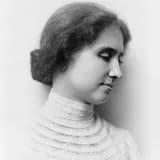
At the water pump on April 5, 1887, Keller realizes finger‑spelled words represent objects—her language breakthrough.
On April 5, 1887, at the water pump outside her Tuscumbia home, Helen Keller experienced her breakthrough to language. As cool water flowed over one of Helen’s hands, teacher Anne Sullivan repeatedly spelled "W‑A‑T‑E‑R" into the other. Suddenly, Helen grasped that the mysterious finger movements represented the names of things.
Keller later described this moment as the "birth" of her mind. She ran from object to object, demanding to know their words. Within hours she had learned dozens of new signs; within months she possessed hundreds, and her cognitive and emotional life transformed. Until then, she had lived in a chaotic sensory world, communicating only through crude home signs and gestures.
Historically, April 5, 1887 stands as one of the most cited episodes in disability and education history. The successful pairing of tactile sign with experiential learning demonstrated that a deafblind child could acquire language comparable in richness to that of hearing and sighted peers. It challenged entrenched 19th‑century assumptions that speech and vision were prerequisites for abstract thought.
The water‑pump breakthrough became a powerful symbol in popular culture, later dramatized in The Story of My Life and its stage and film adaptation The Miracle Worker. Beyond its symbolic value, the event had lasting practical impact: it encouraged educators to invest in individualized, multi‑sensory teaching methods and helped legitimize the notion that disabled children deserved rigorous academic training rather than custodial care.