← All women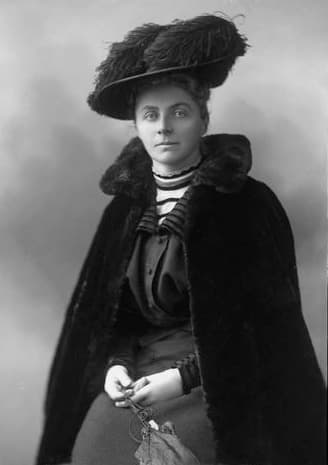
British, English · Activism · Politics
Emily Hobhouse
April 9, 1860 – June 8, 1926
Early life and background
Emily Hobhouse (9 April 1860 – 8 June 1926) was a British welfare campaigner, humanitarian activist and pacifist, best known for exposing the conditions in British concentration camps for Boer and African civilians during the Second Boer War in South Africa.[1][2][4][7][9] She was born in the rural parish of St Ive, near Liskeard in Cornwall, England, the daughter of the Anglican rector Reginald Hobhouse and his wife Caroline Trelawny Hobhouse.[1][2][3][4][7] Her father later became the first Archdeacon of Bodmin.[3][12]
Emily grew up in a comfortable, middle‑class clerical household with connections to the Cornish gentry through her mother’s Trelawny family.[3][10] She was educated primarily at home by governesses, with only brief periods at boarding school, a pattern typical for daughters of rural Anglican clergy in Victorian England.[7] The family atmosphere was strongly religious and socially conservative, but also imbued with an ethic of Christian duty and charity that would shape her later humanitarian commitments.[4][10]
When Emily was about twenty, her mother died, and she took on the responsibility of managing the household and caring for her father.[3][7] She remained at home until his death in 1895, a long period of domestic duty that limited her opportunities but also fostered habits of organizational work and pastoral care. The experience of being constrained within the narrow roles allowed to respectable unmarried women of her class later informed her sympathy for those without power in imperial and wartime contexts.[7][10]
Early travels and formative social work
After her father’s death, Hobhouse suddenly gained greater personal freedom but limited financial security.[7] Seeking meaningful work, she became interested in the plight of impoverished Cornish mining families who had emigrated to the United States and Mexico.[3][10] In the late 1890s she travelled to North America to assist these communities, an experience that gave her first‑hand exposure to migrant hardship, industrial poverty and the dislocation caused by global economic forces.[3][7]
These journeys helped transform her from a provincial clergyman’s daughter into an internationally engaged social reformer. She honed skills in fundraising, public speaking and practical relief work, while encountering political ideas that challenged the assumptions of the British establishment. By the time she returned to Britain in 1898, she had developed a broader sense of social justice that extended beyond parish charity to structural critique.[3][7][10]
South African Conciliation Committee and the road to war
In 1899 tensions between Britain and the Boer republics of the Transvaal and the Orange Free State escalated into the Second Boer War (also called the South African War).[1][2] After war broke out in October 1899, Hobhouse became involved in the South African Conciliation Committee, a London‑based group of liberal politicians, religious leaders and activists who opposed the government’s hard‑line policy and advocated a negotiated settlement.[4][10]
In 1899 she was appointed secretary of the South African Conciliation Committee, placing her at the heart of Britain’s anti‑war movement on South African issues.[4] The committee organized public meetings, issued pamphlets, and lobbied Parliament against the war. For a woman to serve as secretary of such a body was notable in a period when formal politics remained closed to women. Through this role, Hobhouse developed networks among liberal and Nonconformist circles and deepened her knowledge of South African affairs.[4][7][10]
The war quickly devastated civilian life in the Boer republics. As British scorched‑earth tactics destroyed farms and confiscated livestock, thousands of Boer women and children, and large numbers of African labourers and tenants, were displaced.[1][4] Reports began to reach Britain that the army had established camps to house these civilians. Hobhouse, working with sympathetic colleagues, became increasingly alarmed by fragmentary accounts of disease, hunger and overcrowding.[4][9]
Founding the South African Women and Children Distress Fund
In June 1900 Hobhouse helped organize a mass women’s meeting in London to protest the British army’s conduct and to raise money for relief.[4] Three months later she led in creating the South African Women and Children Distress Fund, designed to provide direct assistance to Boer families whose livelihoods had been destroyed.[4][9] The Fund gathered donations of money, clothing and supplies from sympathizers in Britain and abroad.
Hobhouse quickly realized that effective aid required detailed knowledge of conditions on the ground. She proposed travelling to South Africa herself to inspect the camps and distribute relief. Although travel by an unmarried woman into a war zone was unconventional and risky, she secured passage and limited permission from the military authorities to visit certain camps.[4][7][9]
Journey to South Africa and camp inspections
Hobhouse sailed from England and arrived in Cape Town on 7 December 1900.[1][4] From the outset the military treated her with suspicion, restricting her movements and requiring permits, but she managed to travel inland to the Orange Free State. On 22 January 1901 she conducted her first inspection of the Bloemfontein concentration camp, the largest of the civilian camps in that region.[4]
At Bloemfontein she encountered thousands of women and children living in canvas tents pitched on bare ground, often without floors, in extreme weather.[4][7] Sanitary arrangements were rudimentary, clean water was scarce, and latrines were insufficient. Food rations were meagre and nutritionally poor; many prisoners lacked clothing and blankets. Epidemics of measles, typhoid and dysentery swept through the camp, and children died in alarming numbers.[1][4][7]
Hobhouse carefully documented what she saw, keeping notes on living conditions, diet, medical provision and mortality. She spoke with camp mothers, listened to their complaints and grief, and visited the infirmaries.[4][7] Over succeeding weeks she inspected several other camps in the Orange Free State, building a broader picture of systemic neglect and administrative indifference. Her status as a woman allowed her access to family tents and private spaces, but also led some officials to dismiss her concerns as emotional exaggeration.[4][7]
Whistleblowing and the 1901 concentration camp report
Drawing on her South African observations and camp records, Hobhouse wrote a detailed memorandum that became known as her Report on the Camps. In June 1901 this approximately 40‑page report was published in Britain and laid before the government.[4][1][2] It described the camps’ overcrowding, lack of sanitation, inadequate food, and high death rates, especially among children, and argued that the system represented a moral failure and a misuse of British power.
Her report directly contradicted official assurances that the camps were humane measures for the protection of civilians. Hobhouse’s account shocked many readers in Britain and Europe, who had not previously grasped that their own government was detaining tens of thousands of women and children in conditions resembling those of military prisons.[1][2][4] Imperial supporters reacted angrily, accusing her of exaggeration and undermining the war effort. Military leaders, including Lord Kitchener, reportedly spoke of her with contempt, and she was vilified in sections of the press.[12][15]
Despite such opposition, the report had substantial impact. Public concern and parliamentary questioning helped push the government to appoint an official committee of inquiry, the Fawcett Commission, chaired by suffragist leader Millicent Garrett Fawcett, to investigate the camps.[4][7] The choice of an all‑female commission was itself unusual and reflected both the gendered nature of the issue—camps for women and children—and the credibility that Hobhouse and other women activists had gained as witnesses.
The Fawcett Commission’s findings broadly confirmed Hobhouse’s criticisms, leading to improvements in camp administration, better food rations, improved sanitation and water supplies, and enhanced medical care.[1][4][7][12] Over time, mortality rates fell significantly. While the camps still represented a coercive system of civilian internment, Hobhouse’s intervention had helped to save lives and to establish a precedent for independent scrutiny of wartime policies affecting non‑combatants.
Expulsion and continued advocacy
Hobhouse attempted to return to South Africa in 1901 to continue her inspections and relief work, but military authorities now viewed her as a troublesome critic.[3][4] On arrival she was refused entry beyond Cape Town and was ultimately ordered to leave the country.[4][7] This expulsion underscored the degree to which her efforts threatened the government’s management of the war.
Back in Britain, she continued to campaign on behalf of the camp inmates. She gave speeches, wrote letters to newspapers, lobbied politicians and raised funds, not only for Boer prisoners but also, increasingly, for African internees whose suffering was less visible in public debate.[4][7] She argued that the entire system of concentration camps was morally indefensible and that Britain’s international reputation was being damaged by its treatment of civilians.
The experience of being silenced and excluded by the authorities reinforced her radicalization. She moved further toward pacifism and internationalism, criticizing militarism and the imperial competition that had produced the war. Yet she continued to insist on reconciliation rather than revenge, envisioning a post‑war South Africa in which former enemies might coexist under more just conditions.[2][4][7]
Post‑war reconstruction and home industries work
After the Boer War ended in 1902, Hobhouse returned several times to South Africa to assist with reconstruction efforts.[3][4][9] She helped distribute relief to destitute families, supported education for camp survivors and worked to rebuild rural livelihoods. One of her most notable initiatives was the creation of a Home Industries scheme, through which she encouraged Boer women to revive traditional skills such as spinning, weaving and lace‑making and helped connect them to markets for their products.[9]
Hobhouse saw these projects as a way not only to alleviate poverty but also to restore dignity and independence to women who had lost husbands, homes and farms during the war. She cooperated with local leaders and sought to bridge the political and cultural divides left by the conflict. In this period she became widely admired in Afrikaner communities, where many women regarded her as a benefactor who had stood by them in their darkest days.[3][4][9]
Her standing in South Africa contrasted with her more ambiguous reputation in Britain, where sections of opinion still saw her as an eccentric or traitorous figure. Nonetheless, her post‑war work contributed to gradual shifts in imperial attitudes toward civilian welfare and aided the long process of social recovery in the devastated rural areas of the former Boer republics.[4][9]
National Women’s Monument and recognition in South Africa
As memories of the war’s civilian suffering remained vivid in Boer society, plans were developed to create a memorial to the women and children who had died in the camps. Hobhouse became a driving force behind fundraising and planning for what would become the National Women’s Monument in Bloemfontein.[4] She worked from Europe and Britain to gather contributions and publicize the project, emphasizing its importance as a site of mourning and as a symbol of the moral costs of war.[4][9]
The monument, designed by the sculptor Anton van Wouw and architect F. W. Hesse, was unveiled on 14 February 1905
Hobhouse’s central role in this project—despite being British and having opposed her own government’s policies—illustrates the depth of gratitude felt toward her by many former Boer opponents. She was sometimes described as the "Angel of Love" by Boer women, a title that reflected both her practical assistance and the empathy she had shown.[2][3][4] In later years she was made an honorary citizen of South Africa, and funds raised by Afrikaners enabled her to purchase a small house in Cornwall.[3] When the First World War broke out in 1914, Hobhouse, by now an established critic of militarism, emerged as a vocal pacifist.[1][2][7] She opposed the war publicly and privately, arguing that the suffering it would inflict on civilians outweighed any political or strategic gains. Her earlier experiences in South Africa had convinced her that modern warfare, with its reliance on economic blockade and industrial‑scale violence, could not be fought justly. In December 1914 she co‑founded the Swiss Relief Fund for Starving Children in Central Europe, based in Zurich, to aid children in countries affected by the war, including those on the enemy side.[7] Working from neutral Switzerland, she helped coordinate international donations, the purchase of food and clothing, and their distribution across front lines. This work placed her among the early pioneers of transnational child‑relief efforts, and the Fund later fed into the development of organizations such as Save the Children.[7] Hobhouse also engaged in broader peace activism, supporting attempts to negotiate humane treatment for prisoners of war and civilians, and aligning herself with feminist and pacifist currents that criticized secret diplomacy and military alliances.[7] Her anti‑war stance made her even more controversial in Britain, where patriotic sentiment and wartime censorship limited public space for dissenting voices. Nonetheless, she persisted in advocating that humanitarian principles take precedence over national animosities. Unlike many women of her class and generation, Hobhouse never married and had no children.[1][7] Earlier in life she had been engaged to John Carr Jackson, a Nonconformist clergyman and temperance advocate, but the engagement was eventually broken off, reportedly amid family disapproval and financial concerns.[6][7] Remaining single gave her a level of mobility and independence that facilitated her activism, even as it placed her outside the conventional Victorian ideal of womanhood. Her personal correspondence, preserved in archives such as the Digital Bodleian, reveals a thoughtful, sensitive and occasionally melancholic personality, deeply affected by the suffering she witnessed and by the hostility she encountered from opponents.[9] She maintained close friendships with like‑minded reformers and intellectuals, including figures in the British liberal, suffrage and peace movements. Financially she was often precarious, depending on modest family resources and later on support from South African admirers.[3][7] In the years after the First World War, Hobhouse’s health deteriorated.[2][7] She continued to correspond with friends and to follow international developments but was less able to travel or engage in public speaking. She divided her time between Britain and the Continent, and maintained strong links with South African supporters, who regarded her as a symbol of conscience and compassion.[3][4] Despite her earlier notoriety, she remained relatively marginalized in Britain’s official culture, which tended to celebrate military achievements rather than critics of war. However, among pacifists, feminists and humanitarian workers, she was increasingly seen as a precursor to emerging ideas of international human rights and civilian protection.[1][2][7] Emily Hobhouse died in London on 8 June 1926, aged 66.[1][2][4][6][7] Contemporary accounts suggest she died in modest circumstances, far from the public acclaim accorded to generals and politicians of her era.[14] Her passing, however, resonated strongly in South Africa, where many remembered her wartime advocacy and post‑war assistance. In recognition of her service, her ashes were transported to South Africa. On 13 October 1926, they were interred at the National Women’s Monument in Bloemfontein, among the people whose suffering she had done so much to publicize.[4][3][12] Few foreigners—and fewer women—have been honoured in this way by a nation that was once technically their enemy. Her tomb within the monument symbolized the extent to which she had been incorporated into Afrikaner collective memory as a protector and friend. Historians generally regard Emily Hobhouse as a pioneering figure in the history of modern humanitarianism and anti‑war activism.[1][2][7][9] Her exposure of the South African concentration camps was among the earliest and most influential instances of a civilian, and a woman, using systematic evidence and public campaigning to challenge government conduct in wartime. Her work contributed directly to the establishment of the Fawcett Commission and to reforms that reduced mortality in the camps.[1][4][7][12] More broadly, Hobhouse’s activism helped shape emerging norms about the treatment of civilians in war, particularly women and children. By insisting that Britain’s imperial power be subject to moral scrutiny, she anticipated later human rights critiques of colonial and total war practices. Her campaigns also highlighted the role that women could play in international politics long before they gained formal political rights, demonstrating that moral authority, organizational skill and public persuasion could influence policy from outside Parliament.[1][2][7] In South Africa she became an enduring symbol of compassion across national lines. The National Women’s Monument, her honorary citizenship, and the presence of her ashes in Bloemfontein all testify to the depth of gratitude felt by many Afrikaners.[3][4][12] At the same time, later scholars have examined the limitations of her perspective, noting that, like many of her contemporaries, she focused primarily on Boer suffering and did not always give equal attention to the experiences of African internees, whose oppression was intertwined with racial hierarchies in the colonial system.[1][4][7] In recent decades, renewed scholarly interest and public history projects—such as exhibitions, biographies, and digital archives of her letters—have "restored" Hobhouse to a more central place in the narratives of the Boer War and the origins of humanitarian politics.[9][14] Museums and heritage organizations in Cornwall and South Africa now present her life as an example of moral resistance to state violence. Her story has also been used to encourage reflection on contemporary issues of internment, refugee policy and the ethics of whistleblowing. Emily Hobhouse’s life illustrates the potential and the costs of dissent in times of war. Operating without official position, and constrained by gender and class expectations, she nonetheless succeeded in forcing one of the world’s most powerful empires to confront its own actions toward vulnerable civilians. Her legacy endures in the continuing efforts of activists, humanitarian organizations and scholars who seek to protect non‑combatants and hold governments accountable for their conduct in conflict.Opposition to the First World War and international relief work
Personal life
Later years and declining health
Death and burial
Legacy and historical impact
Dated achievements
10 indexed.
- Apr091860Science
Birth of Emily Hobhouse
Emily Hobhouse was born at St Ive, near Liskeard, Cornwall, England, daughter of Anglican rector Reginald Hobhouse and Caroline Hobhouse.
View details Emily Hobhouse | South African History Online - Oct101899Science
Appointed Secretary of the South African Conciliation Committee
Hobhouse became secretary of the London-based South African Conciliation Committee, opposing British government policy shortly after war broke out.