← All women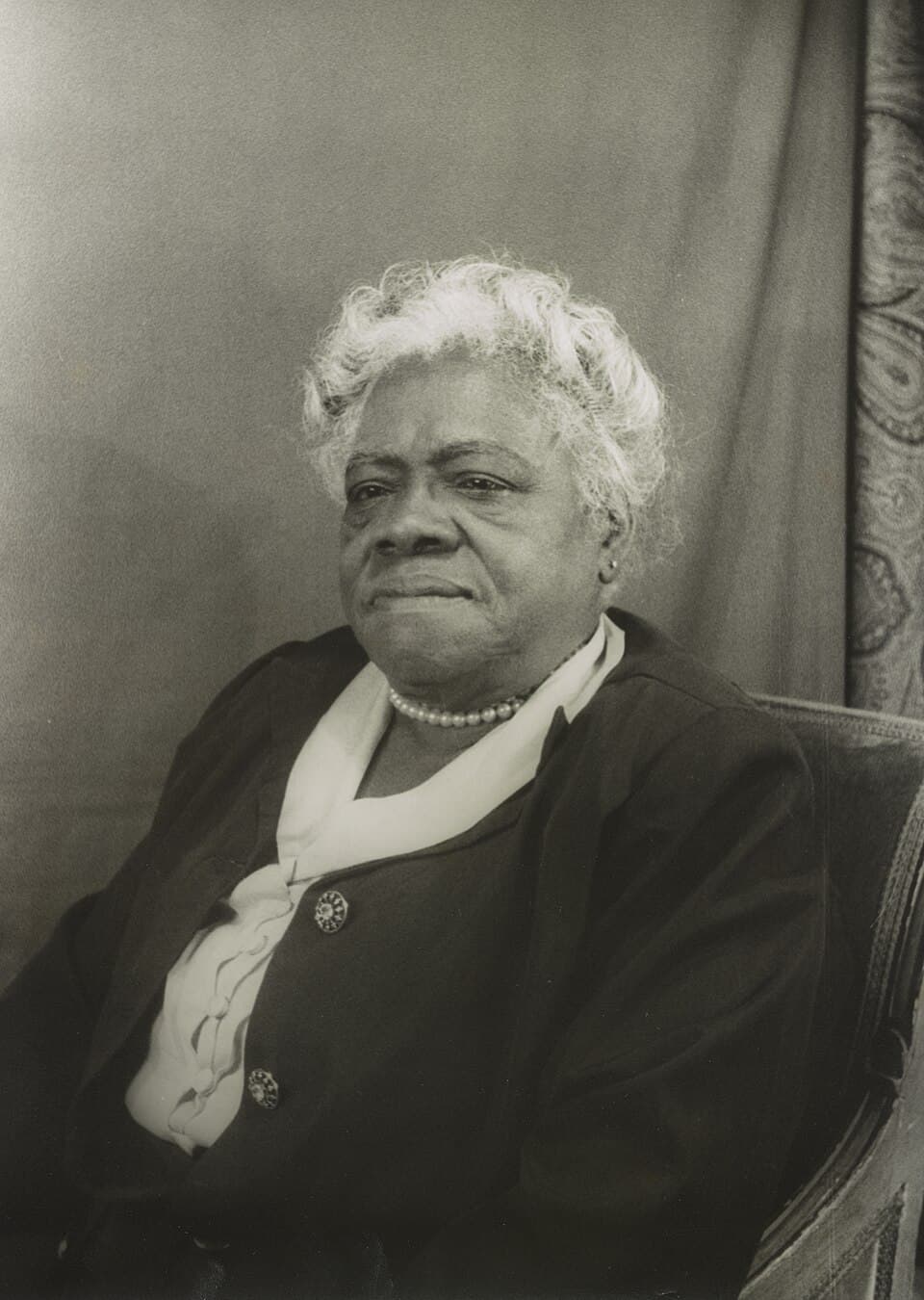
American · Activism · Politics · Arts · Medicine
Mary McLeod Bethune
July 10, 1875 – May 18, 1955
Early life and education
Mary McLeod Bethune (1875–1955) was born near Mayesville, South Carolina, to Samuel and Patsy McLeod, formerly enslaved parents who had built a modest life after emancipation. She was the fifteenth of seventeen children. Growing up in the aftermath of slavery and during the rise of Jim Crow shaped her lifelong commitment to education as a tool for personal freedom and collective advancement. As a child, Bethune worked in the cotton fields and learned early how severely race, poverty, and gender limited opportunity for Black families in the rural South.
Unlike many of her siblings, Bethune was able to attend school, an opportunity that changed the direction of her life. She studied at a mission school and later at Scotia Seminary in North Carolina, where she received training that emphasized both academics and Christian service. She also attended Dwight Moody’s Institute for Home and Foreign Missions in Chicago, hoping to become a missionary in Africa. Although that dream did not materialize, the education she received helped define her philosophy: Black advancement required disciplined learning, moral purpose, and institutions strong enough to survive beyond one person’s lifetime.
Early career and the founding of schools
After teaching in South Carolina and Georgia, Bethune moved to Florida, where she began the work that would make her nationally known. On October 3, 1904, she opened the Daytona Literary and Industrial Training School for Negro Girls in Daytona Beach with very limited resources. The school started small, but Bethune envisioned it as an institution that would provide girls with academic instruction, practical skills, and leadership training. In the segregated South, Black girls were routinely denied access to quality education, and Bethune’s school was a direct challenge to that exclusion.
Her commitment to education broadened in 1911 when she founded the Mary McLeod Hospital and Training School for Nurses. This institution addressed another gap created by segregation: Black patients were often barred from hospitals, and Black women had few pathways into professional nursing. The school offered training and medical service simultaneously, reflecting Bethune’s belief that education should meet community needs. In 1923, her Daytona school merged with the Cookman Institute and became a coeducational college, later known as Bethune-Cookman College, and eventually Bethune-Cookman University. That merger ensured the survival and growth of the institution she had built from almost nothing.
Rise as a national leader
By the 1920s, Bethune had become much more than a school founder. In 1924, she was elected president of the National Association of Colored Women’s Clubs, one of the most influential Black women’s organizations in the United States. The position elevated her into national leadership and connected her to a broad network of clubwomen who fought for education, public health, suffrage, and civil rights. Her work in the women’s club movement reflected a long tradition of Black women’s organizing that combined reform with racial justice.
During the 1930s, Bethune’s influence expanded dramatically. In 1935, she founded the National Council of Negro Women, bringing together Black women’s organizations into a national coalition. Also in 1935, President Franklin D. Roosevelt called her to Washington as a Special Advisor to the National Youth Administration. The following year, she was appointed Director of Negro Affairs within the NYA, making her widely recognized as the first Black woman to head a federal agency. In that role, she advocated for young Black Americans at a time when New Deal benefits often failed to reach them equitably. Her presence inside the federal government was itself a breakthrough, proving that Black women could hold executive authority in national policy-making.
Public service, civil rights, and international work
Bethune’s activism extended beyond the New Deal years. In 1940, she became vice president of the NAACP, a role she held for the rest of her life. Her leadership there reflected her ability to move across institutional boundaries while maintaining a consistent focus on race, education, and equality. She also worked with other civic and religious groups, building coalitions that linked local organizing to national reform.
In 1945, Bethune attended the United Nations Charter conference in San Francisco, where she was the only African American woman among the NAACP delegates noted in the source material. Her presence at the founding moment of the United Nations signaled the international dimensions of her work. She understood that Black freedom in the United States was part of a larger struggle for human rights, and she represented that perspective in a global diplomatic forum.
Her influence reached into the postwar era as well. In 1951, President Harry Truman appointed her to the Committee of Twelve for National Defense. In 1952, Truman also named her his personal representative at the inauguration of Liberian President William V. S. Tubman. That assignment carried special meaning for Bethune, who had long hoped to visit Africa. It also demonstrated the confidence national leaders placed in her judgment and stature.
Personal life
In 1898, Bethune married Albertus Bethune, a teacher. The marriage produced one child, Albert McLeod Bethune Sr., before the couple separated. Bethune later devoted herself primarily to her son and to her public work, a pattern that many women reformers of her era followed as they balanced family obligations with social activism. Her life did not fit conventional expectations for women of her time; instead of retreating into domesticity, she built institutions and public networks that extended her influence nationally.
Her personal relationships also reflected the support systems that sustained her work. Bethune relied on colleagues, donors, students, clubwomen, church networks, and political allies to keep her schools and organizations alive. These relationships mattered because Black women’s leadership in the early twentieth century was often sustained through informal coalitions, mutual aid, and faith-based activism rather than through established power structures.
Honors, legacy, and death
By the time of her death on May 18, 1955, Bethune was widely recognized as one of the most important Black educators and civil rights leaders of her era. She had helped shape the development of Black higher education, Black women’s civic leadership, and federal policy for minority youth. Her long career demonstrated how a Black woman born into the aftermath of slavery could reshape American institutions through vision, persistence, and strategy.
Her legacy is visible in Bethune-Cookman University, the National Council of Negro Women, and the generations of educators, administrators, and activists who followed her model. Bethune helped define a twentieth-century Black woman’s politics rooted in education, respectability, collective action, and public service. She was not only a founder and advisor but also a national symbol of possibility in a society structured to limit her at every turn.
Her historical importance endures because she combined institution-building with political activism in an era of intense racial segregation and gender discrimination. She created educational opportunities where few existed, entered federal government at a time when Black women were nearly absent from such roles, and used every position she held to widen the space available to others. For that reason, Mary McLeod Bethune remains central to the history of African American education, women’s activism, and American democracy.
Dated achievements
13 indexed.
- Jul101875Activism
Birth of Mary McLeod Bethune
Mary McLeod Bethune was born near Mayesville, South Carolina, on July 10, 1875, into a family of formerly enslaved parents.
View details National Women's History Museum biography of Mary McLeod Bethune - Oct031904Arts
Opened the Daytona school
Bethune opened the Daytona Literary and Industrial Training School for Negro Girls in Daytona Beach, Florida, on October 3, 1904.