← All women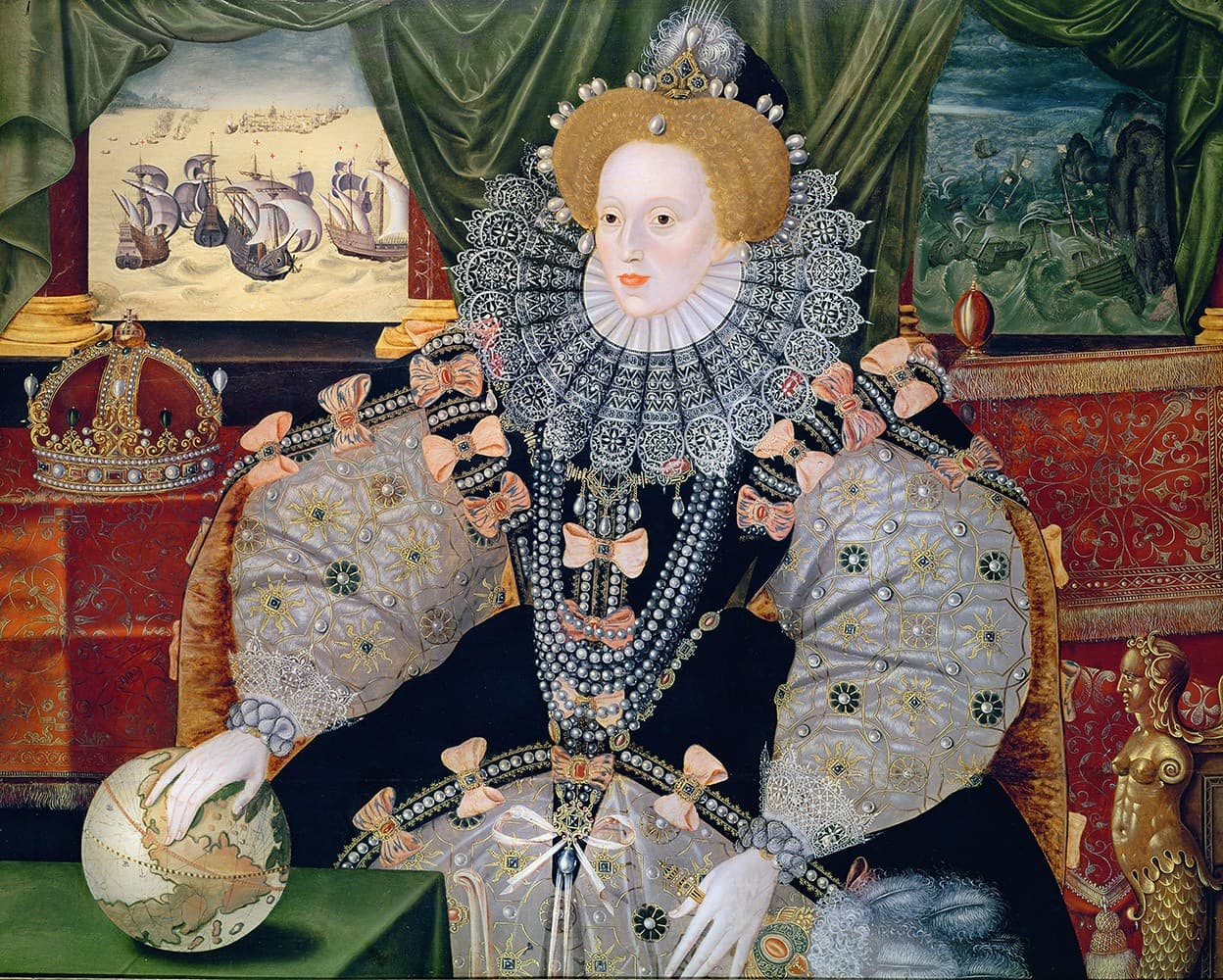
English, British · Politics · Arts
Elizabeth I
September 7, 1533 – March 24, 1603
Early Life and Background
Elizabeth I was born on 7 September 1533 at Greenwich Palace, near London, the daughter of King Henry VIII and his second wife, Anne Boleyn.[2][7][9] Her birth occurred during the turbulent years of the English Reformation, when Henry had broken with the papacy in his pursuit of a male heir. Many at court were disappointed that Anne produced a daughter rather than the long‑desired son, but Elizabeth was nonetheless proclaimed princess and heir presumptive, and a substantial household was established for her.[2][7]
Elizabeth’s early status was soon destabilised. In 1536, when she was barely three, Anne Boleyn was executed on charges of treason, adultery, and incest, and Parliament declared Elizabeth illegitimate.[2][7] Her position at court diminished, and her household was reduced, yet she remained a recognised member of the royal family. Henry’s subsequent marriages produced a son, Edward (the future Edward VI), and another daughter, Mary, but Elizabeth’s place in the succession would later be restored, though questions about her legitimacy lingered.
Despite these uncertainties, Elizabeth received a remarkably rigorous humanist education, influenced by the ideals of Renaissance scholarship that had spread among English elites.[2][7][10] Under the guidance of tutors such as Roger Ascham, she studied Latin, Greek, French, Italian, and later Spanish, as well as theology, history, rhetoric, and philosophy. Ascham praised her intellect and diligence, noting that she took as much pleasure in reading Cicero and Plato as others did in games.[2][10] Elizabeth also learned music, dancing, needlework, and the practical skills expected of noblewomen, but her scholarly training set her apart from most women of her time and prepared her for complex political life.
Her childhood was shaped by the changing religious landscape. Henry’s policies produced an official break with Rome but a doctrine that remained largely conservative, and Elizabeth’s environment combined traditional ceremonial with emerging reformist ideas. These early exposures to varied religious views would later influence her preference for moderate compromise over harsh doctrinal enforcement.[7][10]
Career Beginnings and Path to the Throne
Elizabeth’s path to the throne was long and fraught with danger. Under her half‑brother Edward VI (r. 1547–1553), England moved decisively toward Protestantism. Elizabeth, who had been restored to the succession by the 1544 Act of Succession, lived mostly on her estates, carefully cultivating a reputation for piety and modesty.[2][7] She was suspected at times of harbouring evangelical sympathies, but she avoided overt confrontation and maintained outward conformity to the official church.
Edward’s death in 1553 triggered a succession crisis. The attempt to place Lady Jane Grey on the throne collapsed within weeks, and Elizabeth’s Catholic half‑sister Mary became queen.[2][9] Under Mary I (r. 1553–1558), England returned to papal obedience, and Protestant dissent was harshly suppressed. Elizabeth, seen by many Protestants as their natural focus of hope, came under suspicion. In 1554, during Wyatt’s Rebellion against Mary’s proposed marriage to Philip of Spain, Elizabeth was arrested and briefly imprisoned in the Tower of London, though conclusive evidence of her involvement was lacking.[2][7] After interrogation and house arrest, she was eventually released, but the episode demonstrated the precariousness of her position.
Despite these tribulations, Elizabeth showed considerable political prudence. She avoided openly challenging Mary, publicly attended mass, and refrained from becoming a rallying point for rebellion, even though her existence posed a problem for a regime seeking to secure Catholic succession.[2][10] Mary’s marriage to Philip produced no child, and the queen’s health deteriorated. By 1558 it was clear that Elizabeth would inherit the crown unless extraordinary measures were taken against her.
On 17 November 1558, Mary I died, and Elizabeth acceded to the throne as Queen of England and Ireland.[2][7][9] The Privy Council swiftly proclaimed her queen the same day, reflecting a broad consensus among political elites that she was the most acceptable successor.[2][9] She was twenty‑five years old, inheriting a kingdom burdened by religious division, financial difficulties, and the lingering effects of war with France. Her accession marked the beginning of what would later be called the Elizabethan Age, a period remembered for relative stability, cultural brilliance, and England’s emergence as a major European power.[2][7][14]
Religious Settlement and Governance
One of Elizabeth’s earliest and most consequential tasks was to devise a sustainable religious policy. Her first Parliament opened on 25 January 1559 at Westminster and was soon dominated by debates over the future of the English church.[2][9] Elizabeth and her principal advisors—such as William Cecil—aimed to construct a settlement that restored Protestantism while avoiding the extremes that had fuelled unrest under Edward VI and Mary I.
The resulting Elizabethan Religious Settlement rested on two key statutes. On 29 April 1559, Elizabeth gave royal assent to the Act of Supremacy, which re‑established the Church of England’s independence from Rome and declared her Supreme Governor of the Church of England.[2][7] That same day she also assented to the Act of Uniformity, which mandated use of the revised Book of Common Prayer and required attendance at authorised services, imposing fines for recusants.[2][7]
These measures blended ideological and practical considerations. By adopting the title "Supreme Governor" rather than "Supreme Head," Elizabeth eased theological unease at the idea of a woman leading the church, while effectively concentrating ecclesiastical authority in the crown.[2][7] The Book of Common Prayer sought a middle way between more radical Protestant forms of worship and traditional Catholic ceremony, retaining certain vestments and rituals while clearly rejecting doctrines such as transubstantiation.[2][14]
In 1563, when Parliament reassembled on 12 January, further work consolidated this settlement and improved royal finances.[9] The Thirty‑Nine Articles, issued in the same year, set out the doctrinal basis of the Church of England, establishing a distinctly Anglican identity that combined reformed theology with a national ecclesiastical structure.[1][7] Elizabeth enforced outward conformity but showed a measure of reluctance toward persecuting private belief, preferring to avoid making "windows into men’s souls"—a phrase often associated with the spirit of her approach.[7][10]
Elizabeth’s governance relied heavily on the Privy Council and a network of regional officials, yet she maintained a firm grasp of major decisions. She used Parliament primarily for legislation and taxation, jealously guarding her prerogatives in matters such as marriage and succession.[7][10][11] Her style combined caution with shrewdness: she stalled when rushed, exploited ambiguity, and frequently used her personal authority, including royal progresses and public appearances, to cultivate loyalty and manage factional rivalries.
Foreign Policy, Mary, Queen of Scots, and the Armada
Elizabeth’s foreign policy was shaped by the interplay of religious conflict and dynastic rivalry. Early in her reign she cautiously disengaged from costly continental wars, accepting the loss of Calais to France but seeking to protect England’s security and trade.[7][10] At the same time, she began selectively supporting Protestant causes abroad.
On 6 January 1562, Elizabeth concluded the Treaty of Hampton Court with French Huguenot leaders, agreeing to send English troops and funds in return for control of the port of Le Havre.[2][9] The intervention was designed to aid co‑religionists and secure a strategic foothold, though it ended unsuccessfully when French forces retook Le Havre in 1563.[7][10] Nonetheless, the treaty illustrated her willingness to use military means in pursuit of both religious and geopolitical objectives.
A central challenge throughout her reign was the presence of her cousin Mary, Queen of Scots. On 16 May 1568, after defeat and forced abdication in Scotland, Mary fled to England and was detained on Elizabeth’s orders, beginning nearly nineteen years of confinement.[2][9] Mary was a Catholic with a strong claim to the English throne through descent from Henry VII, and many Catholics considered her the legitimate queen instead of Elizabeth, whose own legitimacy remained contested.[2][7]
Mary’s time in England saw her become the focal point of numerous plots, including the Ridolfi, Throckmorton, and Babington conspiracies, all aiming to depose Elizabeth and install Mary, often with foreign assistance.[9][14] After the discovery of the Babington Plot, incriminating correspondence suggested Mary’s consent to the plan. Reluctantly, Elizabeth allowed her councillors to proceed with a treason trial, and on 1 February 1587 she signed Mary’s death warrant.[2][9]
On 8 February 1587, Mary was executed at Fotheringhay Castle.[2][9] Elizabeth later claimed that she had not intended the warrant to be executed so swiftly, reflecting her awareness of the profound implications of killing an anointed queen.[7][10] The execution outraged Catholic Europe, especially Spain and France, but removed a major internal threat.
Tension with Philip II of Spain escalated due to religious antagonism, English support for Dutch rebels, and attacks on Spanish shipping by English privateers such as Francis Drake.[2][10][15] In 1588 Philip launched the Spanish Armada, intending to secure control of the Channel, facilitate invasion, and overthrow Elizabeth.
As the Armada approached, Elizabeth made a dramatic appearance at Tilbury on 29 July 1588, addressing assembled troops in a speech that declared she had "the body of a weak and feeble woman" but "the heart and stomach of a king, and of a king of England".[2][9][8] Her presence and words became emblematic of defiant national leadership under a female sovereign.
On 8 August 1588, English naval tactics—particularly the use of fireships—and stormy weather combined to inflict a decisive defeat on the Armada off Gravelines, forcing the battered Spanish fleet to attempt a hazardous return route around Scotland and Ireland.[2][5][9] The failure of the invasion preserved Elizabeth’s Protestant regime, dented Spain’s aura of invincibility, and contributed to England’s rising reputation as a sea power.[5][11][14]
Cultural Flourishing and Domestic Policy
Elizabeth’s reign coincided with a remarkable flowering of English drama, poetry, and music, and her court provided an important centre of patronage. The period saw the works of playwrights such as William Shakespeare and Christopher Marlowe, poets like Edmund Spenser, and courtiers‑writers including Sir Philip Sidney and Sir Walter Raleigh
The queen herself cultivated a sophisticated image, using portraiture, pageantry, and symbolism to project authority, virtue, and magnificence. She was depicted as the Virgin Queen, Gloriana, and Astraea, figures associated with purity, justice, and national renewal.[3][10][11] Her elaborate gowns, jewellery, and ceremonial appearances reinforced her majesty and compensated for the perceived weakness of her sex in the eyes of contemporaries. Domestically, Elizabeth’s government worked to stabilise finances, improve administration, and respond to social change. The later decades of her reign saw increasing poverty and vagrancy, and her councillors and Parliament developed measures that would culminate in the Elizabethan Poor Laws, established in statute in the 1590s and early seventeenth century.[2][7] These laws became a foundation for English social welfare policy, organising parish‑based relief and distinguishing between the "deserving" and "undeserving" poor.[1][16] In trade and exploration, Elizabeth granted charters to companies such as the Muscovy Company, which opened formal trading contacts with Russia in the 1560s, and supported ventures that expanded English maritime reach.[9][11] She authorised Sir Walter Raleigh’s colonial projects; in the 1580s he named the region "Virginia" in honour of the "Virgin Queen," underscoring how her personal image became intertwined with imperial aspirations.[2][10][15] Though early settlements like Roanoke ultimately failed, they foreshadowed later English colonisation of North America. In the sixteenth century, the modern concept of "awards" in the sense of international prizes did not exist. Elizabeth’s honours were those inherent in monarchy and the ceremonial life of the court. As queen, she was supreme head of state, the central figure in coronations, royal progresses, and diplomatic receptions.[2][7] She bestowed titles, knighthoods, and offices on loyal servants, using patronage both to reward and to control the nobility and gentry. Her recognition extended beyond formal structures. During her lifetime she was praised in sermons, dedications, and literary works that presented her as a providentially chosen ruler. Edmund Spenser’s The Faerie Queene, for instance, allegorised her as Gloriana, a symbol of ideal monarchy.[10][14] Foreign observers commented on her intelligence, linguistic abilities, and political skill, sometimes comparing her favourably to male monarchs. Posthumously, Elizabeth’s reputation remained high. Seventeenth‑ and eighteenth‑century historians often contrasted her successful reign with the perceived failures of later Stuart kings.[10][12] In the nineteenth century, Victorians revived her image as a model of patriotic leadership, and during the world wars of the twentieth century, "Good Queen Bess" was invoked as a symbol of national resilience when Britain again faced existential threats.[10][16] Such enduring commemoration serves as a form of historical recognition, marking her as one of the most celebrated women in political history. Elizabeth’s personal life has fascinated scholars and popular audiences alike. She became known as the "Virgin Queen", a title that signalled both her unmarried status and the political narrative she fostered—that she was wed to England itself.[2][7][6] Throughout her reign, marriage negotiations with various princes and nobles, including Philip II of Spain, Archduke Charles of Austria, and François, Duke of Anjou, were used as diplomatic tools, but ultimately she chose not to marry. Her refusal had significant political implications. Marriage to a foreign prince could have entangled England in unwanted alliances or subjected policy to external influence; marriage to an English noble risked elevating one faction above others and provoking jealousy.[7][10] Remaining single allowed Elizabeth to retain autonomy and use the prospect of marriage as a bargaining chip without sacrificing sovereignty. Elizabeth’s relationships with male courtiers were often intense and politically charged. Robert Dudley, Earl of Leicester, was her close companion in the early part of her reign, and rumours abounded about their intimacy.[2][10] The mysterious death of Dudley’s wife, Amy Robsart, in 1560 fed speculation, but Elizabeth never married him, aware of the political dangers. Later, Robert Devereux, Earl of Essex, became another favoured courtier. His impetuous behaviour, particularly in Ireland, and eventual rebellion led to his execution on 25 February 1601, a painful episode for the ageing queen.[2][9] Elizabeth did not have children, and her childlessness was a major issue in succession planning. She steadfastly refused to name an heir during most of her reign, fearing that doing so would invite plots and weaken her own authority.[2][7] This decision contributed to anxiety among contemporaries but also ensured that all political attention remained focused on her until the end of her life. Personally, Elizabeth combined charm and wit with a formidable temper. She was known for sharp rebukes to councillors who displeased her, yet she could also show affection and reward loyal service generously.[10] Her household life included entertainment, music, and intellectual conversation, and she took evident pleasure in languages, responding to foreign ambassadors in their own tongues.[2][10] The later years of Elizabeth’s reign were marked by mounting challenges. Economic strains, harvest failures, and war‑related expenses contributed to inflation and unrest, while factional tensions at court grew as ambitious men sought favour in a long‑established regime.[7][9] Religious tensions persisted, with some Protestants pressing for further reform and some Catholics resisting conformity. Elizabeth herself aged visibly. She became more cautious and sometimes indecisive, delaying difficult choices. The execution of Essex in 1601 symbolised both the breakdown of a once‑close relationship and broader dissatisfaction among sections of the elite.[2][9] Nevertheless, she continued to engage in royal progresses and public ceremonies, maintaining her image as a still‑vigorous monarch. On 30 March 1601, she delivered her celebrated Golden Speech to the House of Commons, thanking members for their loyalty, acknowledging grievances, and asserting that she valued the love of her subjects above riches.[2][9] This address, near the end of her reign, reaffirmed her emotional bond with the nation and has been remembered as a testament to her political eloquence and self‑presentation. By early 1603, Elizabeth’s health deteriorated. She reportedly became melancholic, standing for long periods rather than lying down, and engaging in reflection on her life and reign.[2][10] On 24 March 1603, she died at Richmond Palace, Surrey.[2][7][1][9] Although she had not publicly named an heir, preparations had long been in place for the accession of James VI of Scotland, a Protestant male with strong hereditary claims. Her body was carried in a large funeral procession to London, and on 28 April 1603 she was buried in Westminster Abbey.[2][9] She was later reinterred in a combined tomb with her half‑sister Mary I, under an effigy that emphasises Elizabeth’s memory. The inscription and monument encapsulate the religious and dynastic complexities of the Tudor sisters, one Catholic and one Protestant, whose reigns profoundly shaped England. Elizabeth I’s reign, often dated from 1558 to 1603, is widely regarded as one of the most significant in English history.[1][7][14][15] Under her rule, England asserted itself as a major European power in politics, commerce, and the arts. The Elizabethan Religious Settlement established a durable Protestant national church that balanced doctrinal reform with liturgical continuity, influencing Anglican identity and church–state relations for centuries.[2][7][14] Her successful management of foreign threats, particularly the defeat of the Spanish Armada, ensured the survival of Protestant England and projected an image of national resilience.[2][5][9] Her cautious but supportive approach to exploration and colonisation, including backing ventures that named "Virginia" in her honour, helped set the stage for later British imperial expansion.[2][10][15] Culturally, the Elizabethan era became synonymous with a "golden age" of English literature and theatre, anchored by figures such as Shakespeare, Marlowe, Spenser, and Sidney.[2][5][14] While these achievements cannot be solely credited to Elizabeth, her patronage of courtly entertainments, tolerance of the theatre, and maintenance of relative domestic peace created fertile ground for artistic innovation. From the perspective of women’s history, Elizabeth’s significance is profound. As a queen regnant in a patriarchal society that often doubted women’s ability to rule, she navigated gender expectations by blending traditionally masculine attributes of authority and military leadership with feminised imagery of chastity, motherhood, and virtue.[3][10][11] Her famous Tilbury speech explicitly acknowledged stereotypes about female weakness while claiming the "heart and stomach of a king," articulating a powerful, gender‑aware vision of sovereignty.[2][9][8] Elizabeth’s decision not to marry allowed her to avoid the subordination associated with early modern marriage and to maintain full control of policy. She turned her unmarried status into a political symbol, casting herself as the Virgin Queen wedded to her realm, and thereby redefined the relationship between monarch and nation in ways that resonated long after her death.[6][10] Her reign left complex legacies: economic difficulties and Irish conflicts troubled its final years, and some contemporaries criticised her caution and frugality.[7][9] Yet the overall impact of her rule—religious consolidation, political stability, maritime expansion, and cultural efflorescence—has led many historians to count her among England’s greatest monarchs.[3][10][14] In later centuries, she became a touchstone of national identity, invoked whenever Britain faced external danger, and a key figure in debates about women’s political leadership. Elizabeth I thus occupies a central place in both English and global history: as a ruler who steered her country through reformation, foreign threats, and social change; as a patron and symbol of a rich cultural era; and as a woman who, against considerable odds, demonstrated that female monarchy could be effective, enduring, and transformative.Awards, Honours, and Recognition
Personal Life, Marriage, and Relationships
Later Life, Decline, and Death
Legacy and Historical Impact
Dated achievements
17 indexed.
- Sep071533Politics
Birth of Elizabeth at Greenwich Palace
Born at Greenwich Palace near London, daughter of Henry VIII and Anne Boleyn, into the turbulent world of the English Reformation.
View details Elizabeth I – Wikipedia - Nov171558Politics
Accession to the throne of England and Ireland
On Mary I’s death, Elizabeth acceded to the throne as Queen of England and Ireland, inaugurating the Elizabethan Age.