← All women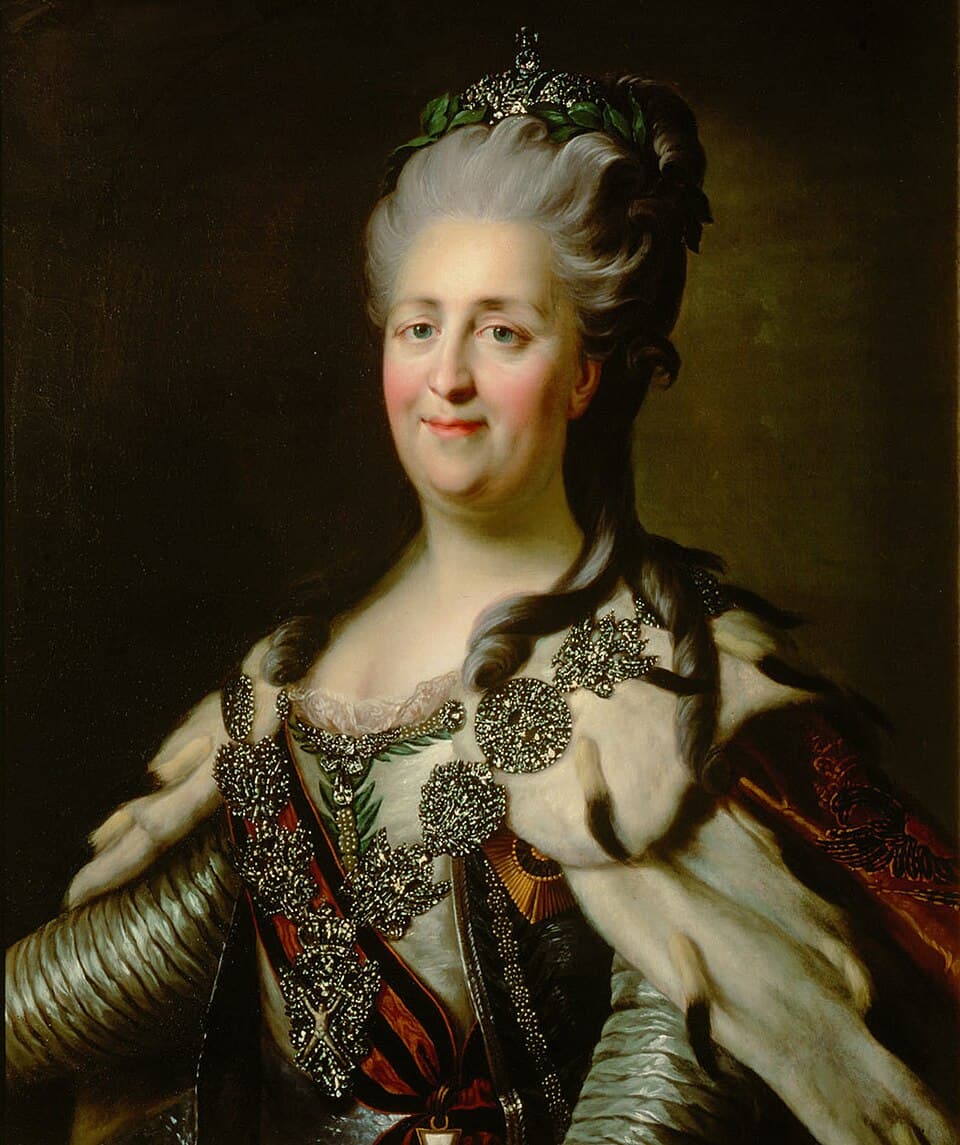
Prussian, Russian · Politics
Catherine the Great
May 2, 1729 – November 17, 1796
Early Life and Background
Catherine II of Russia, known as Catherine the Great, was born Sophie Friederike Auguste von Anhalt-Zerbst on 2 May 1729 (21 April Old Style) in Stettin, Prussia, now Szczecin in Poland.[1][3] She was the daughter of Christian August, Prince of Anhalt-Zerbst, a minor German prince and Prussian military officer, and Johanna Elisabeth of Holstein-Gottorp, whose family ties connected her to the Russian imperial house.[1][6] Although of noble birth, Sophie’s family was not wealthy; her father’s position was modest, and the family moved frequently due to his duties.[4][6]
Sophie’s education was typical for a German princess of the time yet marked by her intellectual curiosity. She received instruction in French, German, religion, and etiquette, and she read historical and philosophical works that later informed her interest in Enlightenment ideas.[5][6] Her mother was ambitious and focused on securing advantageous marriages, sometimes at the expense of a warm relationship with her daughter.[6] These early experiences taught Sophie the importance of status, reputation, and strategic adaptation—skills she later used at the Russian court.
Despite limited prospects as a minor German princess, Sophie’s life changed through dynastic politics. Her mother’s kinship with the Holstein-Gottorp line and the Romanovs made Sophie a potential match for the heir to the Russian throne, Grand Duke Peter, who was also of Holstein-Gottorp descent.[3] This possibility laid the groundwork for her eventual move to Russia and transformation into Catherine II.
Arrival in Russia and Court Integration
In 1744, Empress Elizabeth of Russia invited Sophie to Russia as a prospective bride for her nephew and designated heir, Grand Duke PeterJanuary 1744
On 28 June 1744, Sophie formally converted from Lutheranism to the Russian Orthodox Church and was christened Ekaterina (Catherine) Alekseyevna.[2][6] This conversion was a crucial step in her assimilation, signaling loyalty to Russian traditions and aligning her with the religious foundation of imperial authority. Catherine’s zeal in mastering Russian and Orthodox rituals earned her favor at court and demonstrated her capacity for calculated self-reinvention. On 21 August 1745, she married Grand Duke Peter of Holstein-Gottorp in St Petersburg.[2][6] The marriage was politically motivated and personally difficult. Peter, later Emperor Peter III, was widely seen as immature and eccentric, with a strong attachment to Prussia and limited understanding of Russian affairs.[3][9] Catherine’s relationship with him was unhappy; they were emotionally estranged, and both took lovers. Nonetheless, the marriage positioned Catherine within the Romanov succession, making her a future empress consort. Catherine’s marriage to Peter was marked by tension, infidelity, and mutual disdain. She later described Peter as childish and unsuited to rule.[3][9] At court, Catherine endured surveillance and criticism, particularly from Empress Elizabeth, who controlled many aspects of her life. However, Catherine used this period to cultivate alliances among nobles, officers, and intellectuals, and she read extensively in history, law, and philosophy.[7][11] In October 1754, Catherine gave birth to a son, Paul Petrovich, later Emperor Paul I, securing the Romanov succession.[3] While some historians debate the paternity, the child was officially recognized as Peter’s. Empress Elizabeth largely took charge of Paul’s upbringing, limiting Catherine’s direct maternal influence, yet Catherine’s status at court improved because she had produced a male heir.[3][9] Catherine’s personal life included several significant relationships, most notably with Sergei Saltykov, Grigory Orlov, and later Grigory Potemkin
Empress Elizabeth died in 1761, and Peter ascended the throne as Peter III.[3] His short reign was marked by unpopular policies, including a sudden peace with Prussia during the Seven Years’ War and perceived favoritism toward Prussian interests.[3][9] Many nobles and officers opposed him, and Catherine feared for her own position. On 9 July 1762, Catherine, supported by members of the Imperial Guard, including Grigory Orlov, led a coup d’état in St Petersburg.[1][9] She secured the support of key regiments, had Peter arrested, and was proclaimed Empress Catherine II.[1][5] The coup was relatively bloodless but represented a major constitutional rupture; Catherine’s claim rested on her status as empress consort and mother of the heir rather than explicit succession law. On 17 July 1762, Peter III died at Ropsha under suspicious circumstances, officially reported as the result of a hemorrhagic colic but widely suspected to involve foul play or negligence.[1][6] His death removed a potential rallying point for opposition and consolidated Catherine’s authority. She was formally crowned Empress of All Russia later that year, and her reign would last until 1796, making her the longest-ruling female leader in Russian history.[3][12] Catherine envisioned herself as an "enlightened" monarch and committed to reforming Russia’s laws and administration.[3][11] Early in her reign, she confiscated and secularized a large portion of the Russian Orthodox Church’s lands, transferring monastic estates to the state in measures completed by 1764.[3] This reform weakened ecclesiastical economic power and helped stabilize the imperial treasury. She also founded institutions aimed at social welfare, including Russia’s first state orphanage and other public-health initiatives in St Petersburg in 1764.[11] These efforts reflected her belief that the state should play a role in improving the conditions of its subjects, though they were limited in reach. Catherine’s most ambitious legal project was her Nakaz, or Instruction, drafted in the mid‑1760s. Drawing on the writings of Montesquieu, Beccaria, and other Enlightenment thinkers, the Nakaz advocated equality before the law, condemned torture, and discussed the nature of monarchy and liberty.[3][10] To deliberate on a new law code informed by this document, she convened a Legislative Commission. On 30 August 1767, Catherine opened the Legislative Commission in Moscow, assembling representatives from various estates and regions across the empire.[1] It was the first broadly representative national assembly in Russian history, though serfs and many marginalized groups remained excluded.[1] The Commission discussed criminal law, administrative issues, and social policy, but it ultimately failed to produce a complete new code, partly due to the enormity of the task and the outbreak of war. Nevertheless, it provided valuable information on the empire’s conditions and reinforced Catherine’s image as a consultative, rational ruler. Catherine’s engagement with Enlightenment ideas extended to public health. Smallpox was a major scourge in 18th‑century Russia, killing large numbers of people, including members of the elite. On 12 October 1768, Catherine underwent smallpox inoculation by English physician Thomas Dimsdale, becoming one of the first people— and the first monarch— in Russia to receive such treatment.[1][7] Her successful recovery and subsequent advocacy persuaded many nobles and subjects to accept inoculation. Catherine ordered inoculation for her son Paul and promoted broader campaigns, integrating medical innovation into imperial policy.[7] Her willingness to risk her life for a medical procedure that remained controversial underscores her commitment to Enlightenment approaches and effective governance. Education was another central concern. In 1764, she founded the Smolny Institute for Noble Maidens in St Petersburg, widely regarded as the first state‑financed higher education institution for women in Europe.[1][11] The institute provided formal schooling for girls of the nobility, including instruction in languages, literature, and moral education, seeking to create enlightened wives and mothers who could contribute to civilized society. Catherine promoted a broader system of schools through her education statute of the 1780s, encouraging primary education and teacher training.[3][11] She corresponded with leading philosophes such as Voltaire and Diderot beginning around 1764, discussing politics, religion, and reform, and using these exchanges to fashion her image as a rational, benevolent sovereign.[4][11] Catherine was a major patron of the arts and culture. She expanded the imperial collection of paintings, statues, and books, acquiring works from across Europe. Her purchases and commissions formed the core of what would become the Hermitage, one of the world’s great art museums.[11] She invited artists, architects, and scholars to Russia, seeking to make St Petersburg a leading cultural capital. Catherine herself wrote plays, operas, children’s stories, and memoirs, demonstrating literary ambition alongside political power.[11] She supported the Imperial Academy of Arts and encouraged the development of Russian literature and journalism. Her court fostered salons and intellectual circles, reflecting the cross‑fertilization between Russian and Western European culture. The founding of the Imperial Public Library in St Petersburg in September 1764 further symbolizes her commitment to knowledge infrastructure.[3] Intended as a central repository for books and manuscripts, it later grew into the national library of Russia, supporting research and education at a national scale. Catherine undertook significant economic reforms to modernize Russia’s finances and administration. Secularization of church lands increased state revenues and allowed redistribution to nobles and state projects.[3] She encouraged the development of manufacturing, trade, and mining, and reorganized provincial administration through a series of ukases that created new governorships and districts.[3][6] In 1768, the Assignation Bank was formally established to manage the issuance of paper money, and in November 1769 it began operations in St Petersburg and Moscow, issuing Russia’s first government paper currency.[1][3] Assignation rubles were intended to facilitate large transactions and reduce the strain on metallic currency. While they provided greater flexibility in state finance, they also introduced new challenges, including inflation and speculation. Catherine’s economic policies generally favored the nobility, granting them extensive privileges and expanding their control over land and peasants. Over her reign, nobles received millions of new serfs. On 18 August 1795, she granted an extraordinary 100,000 serfs in a single day to favored nobles, symbolizing the scale of her patronage and the deepening entrenchment of serfdom.[1] Catherine’s most important social legislation came in the form of charters that defined the status of major estates. On 14 November 1773, she issued a manifesto "On granting freedom and liberty to the entire Russian nobility," confirming and extending noble privileges, including exemption from obligatory state service.[1] This measure strengthened her alliance with the aristocracy but widened social disparities. On 21 April 1785, she promulgated the Charter to the Nobility, a detailed statute codifying noble rights to personal security, property, and corporate organization through noble assemblies.[1][3] The same day, she issued the Charter to the Towns, which classified urban residents into corporate categories (merchants, artisans, etc.) and granted municipalities structures for self‑government.[1][3] Together, these charters created a more systematic social hierarchy, giving formal legal shape to the nobility and urban estates. These reforms exemplify Catherine’s approach: she rationalized governance, creating clearer legal frameworks, while reinforcing autocracy and estate privilege. Serfs, who made up the majority of the population, remained outside the charters’ protections and subject to noble authority, underscoring the limits of her Enlightenment-inspired policies. Catherine’s reign was marked by major territorial expansion and active foreign policy. She fought two significant wars against the Ottoman Empire, achieving key victories that secured Russian access to the Black SeaTreaty of Küçük Kaynarca in 1774 granted Russia the right to protect Orthodox Christians in the Ottoman domains and provided ports and territory on the Black Sea.[3][13] In 1783, Catherine oversaw the annexation of Crimea, consolidating Russia’s position in the south and further strengthening its naval presence.[3][9] That same year, the Treaty of Georgievsk placed the eastern Georgian kingdom under Russian protection, extending Russian influence into the Caucasus.[3][9] In Poland, Catherine participated in the Partitions of the Polish-Lithuanian Commonwealth alongside Prussia and Austria. The Second Partition in 1793 and the Third Partition in 1795 brought vast territories and millions of new subjects under Russian rule, effectively ending Poland as an independent state.[3][13] These partitions had lasting consequences for Eastern Europe and cemented Russia’s status as a major continental power. Catherine’s foreign policy combined strategic expansion with a rhetoric of protection and order. She presented Russian intervention as a defense of Christianity and stability, while using diplomacy and military might to secure advantageous borders. Catherine’s reign also witnessed serious internal unrest. The most significant was the Pugachev Rebellion of 1773–1775, a massive uprising led by Yemelyan Pugachev, a Cossack who claimed to be the resurrected Peter III.[3][18] The revolt drew support from Cossacks, peasants, and some non‑Russian minorities who resented serfdom, taxation, and central authority. Pugachev’s forces captured several towns along the Volga and threatened government control in the region. The rebellion exposed deep social grievances, particularly among serfs suffering under intensified noble exploitation encouraged by Catherine’s policies. After significant military operations, government forces defeated the uprising, and Pugachev was captured and executed.[3] The rebellion shocked Catherine and led her to reassess certain policies, particularly regarding provincial administration and military readiness. However, she did not move decisively to alleviate serfdom, fearing noble opposition and instability. The episode underscores the limits of her reforms and the growing tensions that would shape Russian history in the 19th century. In her later years, Catherine continued to legislate and correspond with intellectuals but faced challenges from the French Revolution and shifting European dynamics.[3] She initially welcomed the Revolution’s early phases but turned against it as it radicalized, seeing it as a threat to monarchical order.[3][11] She supported coalitions against revolutionary France, emphasizing the need to preserve traditional structures. Catherine’s governance style blended personal involvement with delegation. She read reports, annotated documents, and issued numerous ukases, while relying on capable administrators such as Potemkin to carry out regional policies.[3][6] She cultivated an image of maternal rule, presenting herself as the "mother" of her people, yet she remained firmly autocratic, believing that a strong, centralized monarchy was essential for a sprawling empire. By the mid‑1790s, Catherine’s health began to decline, though she remained active in writing and governance. On 16 November 1796, she suffered a severe stroke at Tsarskoye Selo.[11][15] Found collapsed and unresponsive, she was moved to her bed but never regained consciousness, falling into a coma that effectively ended her ability to rule. On 17 November 1796, Catherine died at Tsarskoye Selo at the age of 67.[3][10][15] Her death ended a 34‑year reign, the longest of any female ruler in Russian history.[3][12] She was buried in the Cathedral of Saints Peter and Paul in St Petersburg, alongside other members of the Romanov dynasty.[5][14] The throne passed to her son Paul I, whose reign was shorter and more turbulent. Paul reversed some of Catherine’s policies and attempted to limit female succession, reflecting his ambivalence toward his mother’s legacy.[3] Catherine’s unfinished projects, including potential modifications of serfdom and succession law, remained unresolved, influencing subsequent debates in Russian politics. Catherine the Great’s legacy is complex and multifaceted. She is widely regarded as one of Russia’s most significant rulers, male or female, and as a central figure in the history of Enlightened absolutism.[3][11] Under her reign, Russia expanded territorially, gained access to the Black Sea, and became a leading European power. Her reforms modernized administration, promoted education, and advanced public health, notably through advocacy of smallpox inoculation.[7][11] She fostered the arts, built cultural institutions, and laid the foundation for the Hermitage and the Imperial Public Library.[3][11] Her correspondence with Voltaire and other philosophes made her a symbol of enlightened rulership, even as she sometimes acted against their more radical ideas. At the same time, Catherine’s rule entrenched serfdom and aristocratic privilege. Her charters and grants to nobles deepened social stratification, and her reluctance to reform serfdom left millions of peasants in harsh conditions.[3] This contradiction between Enlightenment ideals and autocratic, estate-based realities is central to historical assessments of her reign. In the context of women’s history, Catherine stands out as one of the most powerful women of the early modern period. She ruled in her own name for decades, directed military campaigns, shaped foreign policy, and authored major legislative texts. Her success challenged conventional gender roles and demonstrated that women could exercise sovereign authority at the highest level. Yet Catherine’s story also illustrates the constraints and compromises faced by women in power. She used dynastic marriage, strategic alliances, and carefully crafted imagery to secure her position, and she operated within structures that upheld inequality, including those affecting women of lower estates. Her reign remains a vital case study in how gender, power, and ideology intersected in 18th‑century Europe. Today, Catherine the Great is remembered as an "iron empress", a patron of the arts and learning, and a ruler whose achievements and contradictions continue to provoke debate among historians and the public alike.[11][17]Personal Life, Marriage, and Children
Seizure of Power and Coronation
Domestic Policy and Legal Reform
Public Health, Education, and the Enlightenment
Cultural Patronage and the Arts
Economic and Financial Reforms
Nobility, Towns, and Social Structure
Foreign Policy, War, and Expansion
Revolt and Social Tension: The Pugachev Rebellion
Later Reign and Governance Style
Health, Stroke, and Death
Legacy and Historical Impact
Dated achievements
17 indexed.
- May021729Politics
Birth of Catherine the Great
Princess Sophie Friederike Auguste von Anhalt-Zerbst is born in Stettin, Prussia, later becoming Empress Catherine II of Russia.
View details Catherine the Great - Wikipedia - Jan011744Politics
Sophia arrives in Russia to be inspected as a royal bride
Sophie of Anhalt-Zerbst arrives in Russia in January 1744 to be considered by Empress Elizabeth as a bride for Grand Duke Peter.