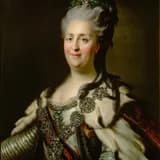
Empress Catherine II dies at Tsarskoye Selo on 17 November 1796 at age 67, ending the longest reign of any female ruler in Russian history.
Catherine the Great died on 17 November 1796 at Tsarskoye Selo, having never regained consciousness after the severe stroke that struck her the previous day. She was 67 years old and had ruled the Russian Empire for nearly 34 years, the longest reign of any female sovereign in Russian history and one of the longest of any Russian monarch.
Her death marked the end of an era often referred to as Russia's Golden Age, during which the empire had expanded its borders dramatically through wars and partitions, absorbed vast new territories including Crimea and large portions of Poland, developed important legal, educational, and cultural institutions, and positioned itself as a central player in European diplomacy and Enlightenment intellectual life.
Catherine was succeeded by her son Paul I, whose troubled and short reign (he was assassinated in 1801) reversed several of his mother's policies, reflecting the complicated relationship between mother and son that had persisted since his infancy. Catherine was buried at the Peter and Paul Cathedral in St Petersburg, the traditional burial site of the Romanov dynasty.
Her legacy is vast and contested: she is remembered as a brilliant, complex ruler who expanded Russian territory and prestige, patronized the arts and Enlightenment ideas, and pioneered public health measures like smallpox inoculation, while also entrenching serfdom and autocratic rule. Modern historians and popular culture alike continue to grapple with her dual image as both an enlightened reformer and a ruthless, effective autocrat — a duality that defines her enduring historical significance.