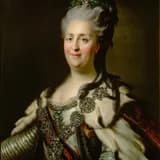
Catherine establishes the Imperial Public Library in St Petersburg in September 1764, a foundation stone of Russia's national library system.
In September 1764, Catherine the Great founded the Imperial Public Library in St Petersburg, an institution conceived to bring Enlightenment ideals of knowledge and education to the Russian Empire. The library was built around an extraordinary founding collection: the confiscated library of the Polish nobleman Józef Andrzej Załuski, seized amid Russia's political interventions in Poland, comprising hundreds of thousands of volumes and manuscripts.
Catherine, who maintained an extensive correspondence with Enlightenment thinkers such as Voltaire and Diderot and prided herself on being an "enlightened despot," saw the creation of a great public library as both a genuine intellectual project and a powerful statement of Russia's cultural ambitions on the European stage. She sought to position St Petersburg as a rival to Paris and other centers of learning.
The library grew over subsequent decades into what is today the Russian National Library, one of the largest libraries in the world and Russia's oldest public library. Its founding under Catherine reflects her broader pattern of establishing lasting cultural and educational institutions — including the Smolny Institute and the Hermitage collection — that extended far beyond her lifetime and cemented Russia's reputation as a center of Enlightenment culture despite the autocratic nature of her rule.