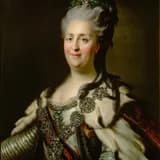
Catherine leads a successful coup against her husband Peter III and is proclaimed sole Empress of Russia on 9 July 1762.
On 9 July 1762, Catherine executed one of history's most audacious palace coups. With the backing of the Imperial Guard regiments — many of whose officers were her allies and, in some cases, lovers — she rode into St Petersburg in a guard's uniform and had herself proclaimed sole ruling Empress Catherine II, deposing her husband, Emperor Peter III, who had reigned for only six months.
Peter's brief and erratic rule had alienated the military, church, and nobility alike: he had withdrawn Russian forces from a victorious war against Prussia, threatened to secularize church property abruptly, and displayed open contempt for Russian customs. Catherine, by contrast, had spent nearly two decades cultivating loyalty among the elite, the clergy, and the guards by embracing Russian culture and religion.
The coup succeeded almost bloodlessly within the capital, and Peter was swiftly arrested and forced to abdicate. Catherine's assumption of power was remarkable not only for its audacity but because she ruled in her own right, not as a regent or consort — a rare feat for a woman in 18th-century Europe, let alone a German-born princess with no direct blood claim to the Russian throne. Her thirty-four-year reign that followed would transform Russia's culture, borders, and standing among the great powers of Europe.