← All women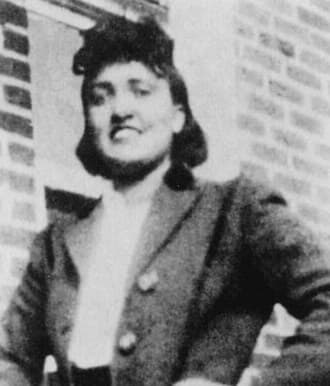
American · Science · Medicine · Activism
Henrietta Lacks
August 1, 1920 – October 4, 1951
Early Life and Background
Henrietta Lacks was born Loretta Pleasant on August 1, 1920, in Roanoke, Virginia (though some sources, including Britannica and certain NIH reviews, cite August 18, 1920, as her birth date). She was the ninth of ten children born to Eliza and Johnny Pleasant. After her mother died giving birth to her tenth child, and with her father unable to care for the large family, young Henrietta was sent to live with her grandfather, Tommy Lacks, on a tobacco farm in Clover, Virginia—land that had once been a slave plantation worked by their ancestors.
At her grandfather's home, Henrietta shared a small log cabin with her cousin David "Day" Lacks, who had also been sent to live there. The two grew up together, working long hours in the tobacco fields, a common circumstance for poor Black families in the rural, segregated South during the early twentieth century. Formal education was limited; Henrietta left school after the sixth grade to work full-time on the farm.
Henrietta and David's relationship grew from childhood companionship into romance, and the couple had their first child together in 1935, when Henrietta was just fourteen. They married on April 10, 1941. Shortly after their marriage, the couple relocated to Turner Station, a Black community near Baltimore, Maryland, so that David could take a job at Bethlehem Steel's Sparrows Point plant, which was booming due to wartime production demands. This move reflected the broader Great Migration pattern of Black families leaving the rural South for industrial opportunities in Northern and border cities.
Family Life in Turner Station
In Turner Station, Henrietta and David built a life together and eventually had five children: Lawrence, Elsie, David Jr. ("Sonny"), Deborah, and Joseph (later known as Zakariyya). Their daughter Elsie suffered from epilepsy and cerebral palsy and was eventually institutionalized at the Hospital for the Negro Insane in Crownsville, Maryland, where she would later die in 1955—a tragedy compounded by the inadequate and often abusive care Black patients with disabilities received in segregated institutions of the era.
By all accounts, Henrietta was a vibrant, warm woman known in her community for her cooking, her love of dancing, and her generosity toward neighbors and family. She was known to keep a beautifully manicured garden and took great pride in caring for her children and extended family members who often stayed with the Lacks household.
Diagnosis and Medical Treatment
In early 1951, after the birth of her fifth child, Henrietta began experiencing abnormal vaginal bleeding. Concerned, she traveled to Johns Hopkins Hospital in Baltimore—one of the only hospitals in the region that treated Black patients, though in segregated wards—for an examination. On February 5, 1951, she was formally admitted, and doctors discovered a malignant tumor on her cervix, later diagnosed as an aggressive form of adenocarcinoma.
During this visit, a biopsy sample was taken from her tumor for diagnostic purposes. Critically, without informing Henrietta or seeking her consent, a portion of this tissue sample was also given to Dr. George Otto Gey, head of tissue culture research at Johns Hopkins, who had spent years unsuccessfully attempting to culture human cells that would survive and reproduce indefinitely outside the body. This practice—using patient tissue for research without explicit consent—was not illegal under the medical norms of the time, though it would become a defining ethical controversy decades later.
Henrietta began radiation treatment, the standard therapy for cervical cancer at the time, receiving her first radium treatment on February 8, 1951. Remarkably, by February 9, 1951, Gey's laboratory technicians observed that Henrietta's tumor cells were not only surviving in culture but dividing and multiplying at an unprecedented rate—doubling roughly every 24 hours, far surpassing any human cell sample previously studied. This marked the birth of what would become known as the HeLa cell line, named using the first two letters of her first and last names.
The Birth of an Immortal Cell Line
What made Henrietta's cells so extraordinary was a mutation linked to the human papillomavirus (HPV), which had triggered her cancer, that caused her cells to produce an abnormally high amount of an enzyme called telomerase. This enzyme prevented the cells' telomeres from shortening with each division, effectively bypassing the natural aging and death process (later termed the "Hayflick limit") that normally limits cell division. As a result, HeLa cells could divide indefinitely, becoming the first "immortal" human cell line ever created.
Henrietta's cancer, meanwhile, continued to progress despite treatment. She underwent a second course of radiation therapy on March 29, 1951. Her condition worsened over the following months, and on August 8, 1951, she was readmitted to Johns Hopkins Hospital in severe pain; examination revealed her cancer had metastasized extensively throughout her body.
Henrietta Lacks died on October 4, 1951, at the age of 31, from uremic poisoning caused by her advanced cancer. An autopsy performed on October 12, 1951, revealed tumors had spread to nearly every organ in her body. Additional tissue was taken during this autopsy, again without her family's knowledge or consent, further propagating the HeLa cell line.
Rapid Spread and Scientific Impact
By November 2, 1951, Gey's laboratory had already begun shipping samples of HeLa cells to other research institutions, believing strongly in open scientific collaboration rather than personal or commercial monopoly over the discovery. On November 6, 1951, Gey appeared on national television to announce the creation of an immortal human cell line, holding up a vial of cells before the cameras—though he did not publicly name Henrietta, and for years she was referred to under pseudonyms such as "Helen Lane" or "Helen Larson" to obscure her true identity.
The impact of HeLa cells on medical science over the following decades was staggering. In 1952, they were used at scale in the development and testing of Jonas Salk's polio vaccine, allowing researchers to test vaccine efficacy on human cells for the first time and dramatically accelerating the vaccine's development. By 1955, HeLa cells became the first human cells successfully cloned, a landmark achievement in cell biology that established techniques still used in laboratories worldwide.
Over subsequent decades, HeLa cells traveled to laboratories on every continent and were used in an extraordinary range of scientific milestones: they were sent into space during early NASA missions to study the effects of zero gravity on human cells; they contributed to research underlying multiple Nobel Prize-winning discoveries, including work on telomerase and HPV's role in cervical cancer; and they played crucial roles in developing treatments for cancer, understanding HIV/AIDS, mapping the human genome, and—decades later—developing vaccines against COVID-19 in 2020.
The Family's Discovery and the Ethics Reckoning
For over twenty years after Henrietta's death, her family remained entirely unaware that her cells had been taken, cultured, and distributed globally. It was not until the 1970s that researchers contacted the Lacks family—not to inform them out of ethical obligation, but to request blood samples to help study the genetic markers of the HeLa cell line, causing confusion and distress among family members who did not understand why they were being asked for samples related to a mother and wife who had died decades earlier.
The full story of Henrietta Lacks and her family became widely known only after journalist Rebecca Skloot published her acclaimed 2010 book, The Immortal Life of Henrietta Lacks, following a decade of research and relationship-building with Henrietta's surviving children, particularly her daughter Deborah Lacks Pullum. The book became a New York Times bestseller and was adapted into an HBO film in 2017 starring Oprah Winfrey as Deborah Lacks, bringing Henrietta's story to a global audience and reigniting critical conversations about medical ethics, informed consent, and racial injustice in scientific research.
Awards, Honors, and Recognition
In the decades following the publication of Skloot's book, Henrietta Lacks received numerous posthumous honors recognizing her profound, if involuntary, contribution to science. Johns Hopkins University established scholarships, symposia, and a building named in her honor. She has been inducted into the Maryland Women's Hall of Fame, and numerous institutions have created awards and lectureships bearing her name.
The most prominent international recognition came on October 13, 2021, when the World Health Organization held a ceremony in Geneva, Switzerland, honoring Henrietta Lacks with the WHO Director-General's Award, presented to her descendants by Director-General Dr. Tedros Adhanom Ghebreyesus. This ceremony explicitly acknowledged both her immense contribution to global health and the racial and ethical injustices embedded in how her cells were obtained and used.
In 2023, the Lacks family reached a settlement with Thermo Fisher Scientific, one of many biotechnology companies that had profited from commercializing HeLa cells, marking a significant step toward financial acknowledgment of the value generated from Henrietta's cells.
Legacy and Historical Impact
Henrietta Lacks' legacy is dual and complex. On one hand, her cells—taken without her knowledge or consent—became arguably the single most important tool in twentieth and twenty-first century biomedical research, contributing to the development of vaccines, cancer treatments, genetic mapping, and countless other advances that have saved millions of lives worldwide. On the other hand, her story stands as a stark and enduring symbol of medical racism, exploitation, and the historical disregard for the autonomy and dignity of Black patients in American medicine.
Her case fundamentally shaped modern bioethics, contributing to the development of informed consent standards and policies governing the use of human biological materials in research. Today, "Henrietta Lacks" and "HeLa" are known worldwide, and her story continues to be taught in medical schools, ethics courses, and history curricula as a critical case study in the intersection of race, poverty, gender, and scientific progress. Her family's decades-long fight for acknowledgment and justice has also become a powerful narrative of resilience and advocacy, ensuring that the woman behind the cells is remembered not merely as a biological source, but as a full human being whose life, family, and story deserve recognition and respect.
Dated achievements
12 indexed.
- Aug011920Medicine
Birth of Henrietta Lacks
Henrietta Lacks (née Loretta Pleasant) was born in Roanoke, Virginia; she later became the unwitting source of the HeLa cell line.
View details Henrietta Lacks - Wikipedia - Feb051951Medicine
Admission to Johns Hopkins and tumor biopsy
Lacks was admitted to Johns Hopkins Hospital for cervical cancer; a biopsy of her tumor was taken and cells collected without her knowledge or consent.