← All women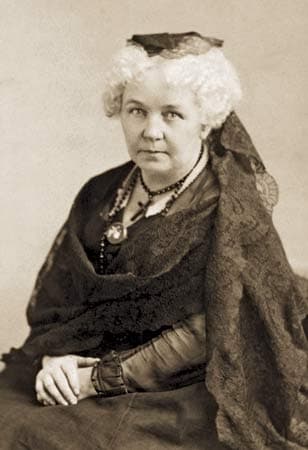
American · Politics · Activism
Elizabeth Cady Stanton
November 12, 1815 – October 26, 1902
Early Life and Background
Elizabeth Smith Cady was born on November 12, 1815, in Johnstown, New York, into a prominent, conservative Federalist family.[1][4][5][2] Her father, Daniel Cady, was a distinguished lawyer, judge, and landowner who served in the New York legislature and the U.S. House of Representatives.[1][10][2] Her mother, Margaret Livingston Cady, came from the influential Livingston family, linking Elizabeth to New York’s landed elite.[1][4][2] Stanton was one of eleven children, though several siblings died young.[1][2]
Growing up in a large house on Johnstown’s town square with servants and social standing, Stanton nonetheless confronted the constraints placed on girls.[10] She attended a local boys’ school, studying Latin, Greek, and mathematics, subjects rarely offered to girls at the time.[4][1] She later enrolled at Troy Female Seminary, founded by Emma Willard, and graduated in 1832, receiving one of the most advanced formal educations available to American women.[4][7]
A formative influence on Stanton’s thinking came from observing her father’s law practice. She listened to him explain how coverture—the legal doctrine that a married woman’s identity merged into her husband’s—deprived women of property rights and control over children.[1][14][15] When she proudly told her father she had removed references to "female" from law books by cutting them out, he responded that "it is the law," impressing upon her the depth of women’s legal subordination.[15] The death of her brother Eleazar Cady, her father’s favored son, also affected her; she later recalled his grief and his belief that "I wish you had been a boy," highlighting gendered expectations.[2][15]
Stanton’s early exposure to legal inequality and her strong academic training prepared her to become one of the nineteenth century’s most incisive critics of the law’s treatment of women. Her family’s connections also introduced her to reform circles through her cousin, the abolitionist and reformer Gerrit Smith, whose household hosted debates on slavery and social change.[7][13]
Entry into Reform and Marriage
In 1840, Elizabeth Cady married Henry Brewster Stanton, an abolitionist and orator active in antislavery politics.[2] The wedding was unconventional: she omitted the word "obey" from the marriage vows, signaling her rejection of traditional marital hierarchies.[2][15] The couple eventually had seven children, a large family that shaped her practical experience of domestic life even as she pursued public reform.[2]
Shortly after their marriage, Elizabeth accompanied Henry to London, where he served as a delegate to the World’s Anti‑Slavery Convention.[1][2][9] At the convention, women delegates, including American reformer Lucretia Mott, were excluded from full participation and forced to sit in a segregated gallery.[2][9] Stanton’s exposure to this injustice—discrimination against women within a movement for human rights—was pivotal. She and Mott vowed to organize a meeting to address the rights of women when they returned to the United States.[1][2][9]
After returning to New York, Stanton settled in Seneca Falls, a canal town in the Finger Lakes region, where she juggled raising children with growing frustration over women’s lack of legal rights.[1][4] Her experiences with pregnancy, childbirth, and domestic responsibilities informed her critique of laws that gave husbands control over family property and granted fathers superior custody rights. Through conversations with neighbors and correspondence with reformers, she began to envision a broader movement for women’s rights.[1][15]
Seneca Falls and the Birth of the Women’s Rights Movement
In July 1848, Stanton, Lucretia Mott, Martha Coffin Wright, Mary Ann McClintock, and Jane Hunt organized what became the Seneca Falls Convention, the first women’s rights convention in the United States.[1][2][9] The meeting opened on July 19, 1848, bringing together approximately 300 women and men to discuss women’s civil, social, and religious rights.[1][2] Stanton drafted the convention’s organizing call and took the lead in shaping its agenda.
Central to the convention was Stanton’s Declaration of Sentiments, read and debated on July 20, 1848.[1][5][2] Modeled on the U.S. Declaration of Independence, it altered the famous phrase to assert that "all men and women are created equal" and listed grievances against laws and customs that denied women the vote, restricted their property rights, excluded them from higher education and professions, and subjected them to double standards in morality and religion.[2][1][14] The convention adopted the Declaration after debate, with 100 signatories—68 women and 32 men.[2]
Most controversial was Stanton’s resolution calling for woman suffrage. Many attendees feared the demand was too radical, but abolitionist Frederick Douglass spoke in its support, and the resolution passed.[2][1][6] Reference works identify this as the first organized demand for woman suffrage in the United States, marking a decisive step in linking women’s rights to political citizenship.[1][9][6]
The Seneca Falls Convention, and Stanton’s leadership there, are widely regarded as the formal beginning of the organized American women’s rights movement.[1][4][12] Newspaper reactions were largely hostile, mocking both the idea of women voting and the broader claims to equality. Yet the publicity ensured that the Declaration of Sentiments and the convention’s resolutions reached a national audience, setting a pattern for later organizing.
Expansion of the Movement: Conventions and Collaboration
Following Seneca Falls, Stanton continued to advocate for women’s rights in regional and national forums. In October 1850, she helped organize the First National Woman’s Rights Convention in Worcester, Massachusetts, which opened on October 23 and continued on October 24.[1] This convention drew participants from multiple states and addressed a wide range of issues, including property rights, education, occupational access, and divorce.[1]
The Worcester meeting demonstrated that women’s rights activism had grown beyond local gatherings into a coordinated national movement. It also introduced new leaders and expanded networks that would sustain the movement through the decade.[1][2] Stanton’s ideas, disseminated through speeches and resolutions, helped unify the movement’s agenda and reinforce the connection between legal reform and broader social change.
In 1851, a woman’s rights convention held in Akron, Ohio, on May 11 became famous for Sojourner Truth’s "Ain’t I a Woman?" speech, which linked racial and gender oppression.[1] Though Stanton was not present, her earlier work at Seneca Falls and Worcester had helped create the organizational template for such conventions.
Stanton’s relationship with Susan B. Anthony, whom she met in the early 1850s, proved transformative. Anthony, a skilled organizer and strategist, and Stanton, a powerful writer and theorist, formed a partnership that would dominate the woman suffrage movement for the next half‑century.[1][7][9] They began collaborating intensively by the mid‑1850s, with Stanton drafting speeches and articles that Anthony delivered across the country.[1][2]
On October 20, 1852, Stanton and Anthony participated in the New York State Woman’s Rights Convention in Syracuse, continuing to build state‑level activism focused on married women’s property and custody rights and suffrage.[1] Their work contributed to reforms in New York law in the 1860s, which expanded married women’s control over property and improved their legal position in divorce and custody disputes.[9]
Stanton, Abolition, and the Civil War Era
Throughout the 1850s and 1860s, Stanton remained involved with abolitionism and broader reform causes. Her cousin Gerrit Smith’s home served as a hub for antislavery activity, and her husband Henry Stanton was a prominent abolitionist politician.[7][13] During the Civil War, Stanton’s focus shifted largely to the campaign against slavery, aligning with many reformers who believed that abolition had to be secured before broader rights could be won.[7][12]
The end of the Civil War and the debates over Reconstruction and the Fourteenth and Fifteenth Amendments brought new tensions. Stanton and Anthony opposed the adoption of a Fifteenth Amendment that granted voting rights to Black men but not to women, arguing that any expansion of suffrage should include both race and sex.[2][12][15] Their stance, and some of Stanton’s rhetoric about educated white women versus "uneducated" male voters, drew criticism from fellow reformers and has been judged by many historians as reflecting racial prejudice.
Despite these conflicts, Stanton continued to insist that women’s political equality could not be postponed indefinitely. The Reconstruction debates cemented her belief that suffrage was the keystone right, necessary to secure other reforms in law and society.[2][12]
The Revolution and Organized Suffrage Campaigns
In 1868, Stanton and Anthony launched The Revolution, a weekly newspaper first published on January 9, 1868, in New York City.[1] Stanton served as editor and principal writer, while Anthony managed finances and distribution.[1][7] The paper promoted woman suffrage, equal pay for equal work, liberalized divorce laws, and labor and social reforms, often in sharply worded editorials.
The Revolution gave Stanton a continuous platform to refine her arguments and address national audiences. It criticized both major political parties for ignoring women’s claims and challenged churches and courts that upheld patriarchal norms.[1][15] Financial difficulties and controversies over some of its positions eventually led Anthony to transfer it to other hands, but its influence on the suffrage movement’s discourse was substantial.
On May 15, 1869, Stanton and Anthony founded the National Woman Suffrage Association (NWSA), with Stanton becoming its first president.[1][2] NWSA focused on obtaining a federal constitutional amendment for woman suffrage and adopted a broad reform agenda including changes to marriage and divorce laws.[1][2] It often took bolder positions than the rival American Woman Suffrage Association (AWSA), which favored a state‑by‑state approach and maintained closer ties to existing political parties.
Stanton’s leadership in NWSA cemented her role as the movement’s chief philosopher. She wrote speeches, resolutions, and pamphlets outlining the association’s goals and critiquing legal systems that denied women full citizenship. Her work during this period emphasized that voting rights were a necessary but not sufficient condition for true equality.[1][2]
Major Writings and Intellectual Contributions
Throughout her life, Stanton was a prolific writer. Beyond speeches and newspaper articles, she produced several major works that shaped feminist thought.
In 1878, a woman suffrage amendment drafted by Stanton was introduced in Congress on January 10.[9] Senator Aaron Sargent’s proposal used language that closely anticipated the eventual Nineteenth Amendment: it prohibited the United States or any state from denying or abridging the right to vote on account of sex.[2][9] Britannica notes that this proposal was reintroduced in every subsequent Congress until women won the vote in 1920.[9] Stanton’s authorship of the draft illustrates her role not only as an activist but as a constitutional thinker.
From the late 1870s into the 1880s, Stanton, Anthony, and Matilda Joslyn Gage undertook the massive project of compiling History of Woman Suffrage. The first volume was published on November 1, 1881, documenting the movement’s history from its origins through the early years of organized activism.[1] Stanton contributed narrative chapters and editorial framing, presenting the movement’s story from the perspective of its leading organizers.[1][2]
The multi‑volume work collected convention proceedings, resolutions, and biographical sketches, preserving sources that might otherwise have been lost.[2][15] While later scholars have critiqued its omissions—particularly its limited coverage of women of color and working‑class activism—it became the standard reference for suffrage history for decades and reinforced Stanton’s image as the movement’s founding philosopher.[1][15]
Stanton’s most controversial work was The Woman’s Bible, first published in a complete edition on December 15, 1881.[1] In this two‑part work, Stanton and a committee of women commentators re‑examined biblical passages relating to women and challenged traditional interpretations that justified female subordination.[2][1]
She argued that male clergy had distorted religious texts, using them to sanction inequality and deny women authority in church and home.[2][15] The Woman’s Bible encouraged women to read scripture critically and to separate spiritual belief from patriarchal religious structures. Many suffragists, fearing public backlash, condemned the book, and the National American Woman Suffrage Association formally distanced itself from it.[2][15] Nonetheless, the work anticipated later feminist theology and remains a landmark in the critique of religion’s role in gender oppression.
In addition to these major works, Stanton wrote her autobiography, Eighty Years and More, published in the 1890s, which recounted her life and the movement’s evolution.[2] She also composed essays on topics ranging from dress reform to reproductive rights and marriage, often pushing beyond the positions of more cautious contemporaries.[16][15]
Personal Life and Family
Elizabeth and Henry Stanton’s marriage was both a partnership and a site of tension. Henry’s political and legal career required frequent travel, leaving Elizabeth to manage the household and children in Seneca Falls and later in New York City.[2][4] While supportive of abolition, Henry was less enthusiastic about her public activism on women’s rights, reflecting the era’s gender expectations.
The couple had seven children, and Stanton often wrote and organized from her home, balancing motherhood with movement work.[2] She insisted that her experiences raising children informed her critiques of custody and guardianship laws that favored fathers and treated mothers as legally secondary.[2][9]
In 1862, the Stanton family moved to New York City, where Elizabeth continued her activism while engaging with urban intellectual circles.[4] Her later years saw more independence from domestic responsibilities, allowing her to travel and lecture, though health problems eventually curtailed her journeys.[4][12]
Later Life, Movement Divisions, and Death
By the late nineteenth century, the suffrage movement had diversified. In 1890, NWSA and AWSA merged to form the National American Woman Suffrage Association (NAWSA), reflecting a desire for unity and a combined strategy that pursued both state and federal reforms.[2] Stanton served as NAWSA’s first president but soon clashed with more conservative leaders over the scope of the agenda and the role of religious critique.
Her publication of The Woman’s Bible and her outspoken views on divorce and reproductive rights troubled many suffragists who wished to present a more conventional image to the public.[2][15][16] By the mid‑1890s, NAWSA formally disavowed The Woman’s Bible, and Stanton’s direct influence on organizational strategy diminished, even as she remained venerated for her pioneering work.[2]
Despite declining health, Stanton continued to write essays and deliver lectures, often by correspondence, on women’s rights, education, and religion.[4][12] She traveled to Europe, engaged with international suffrage activists, and reflected on the connections between women’s struggles in different countries.[16]
Stanton died of heart failure in New York City on October 26, 1902.[5][9][10][2] She was 86 years old. Her death came eighteen years before the ratification of the Nineteenth Amendment in 1920, which finally guaranteed women the right to vote nationwide—an outcome she had long envisioned but did not live to see.[2][9][13]
Legacy and Historical Impact
Elizabeth Cady Stanton is widely regarded as one of the founding philosophers of the American women’s rights movement.[1][15][12] Unlike some contemporaries who focused primarily on suffrage, Stanton articulated a comprehensive vision of women’s equality that encompassed legal, political, economic, and religious spheres.[1][2][15]
Her Declaration of Sentiments remains a foundational text in U.S. feminist history, taught and analyzed as a revolutionary reinterpretation of the nation’s founding ideals.[1][2][9] By explicitly including women in the language of natural rights, she challenged the assumption that citizenship and equality were inherently male. Her insistence on suffrage at Seneca Falls introduced an agenda that would dominate the movement for decades.
Stanton’s organizational leadership, particularly through the National Woman Suffrage Association and The Revolution, helped build a durable infrastructure for activism.[1][2] She and Susan B. Anthony formed a partnership that shaped strategic thinking about campaigns, alliances, and public messaging. While Anthony excelled in travel, organizing, and coalition-building, Stanton’s writing provided the movement with its intellectual backbone.
Her role as an historian of the movement through History of Woman Suffrage ensured that early activists’ experiences were preserved, albeit through a particular lens.[1][2] The multi‑volume work has been both celebrated as a crucial source and critiqued for its selective narrative, yet it is indispensable for understanding the movement’s first generations.
Stanton’s criticisms of religion, especially in The Woman’s Bible, placed her at the radical edge of Victorian feminism.[2][15] Though divisive in her own time, her arguments presaged later scholarship that examined how religious doctrines shape gender roles. Her willingness to confront both church and state made her a controversial figure but also an enduring symbol of uncompromising feminist critique.
Her legacy is complex. Historians acknowledge that some of Stanton’s rhetoric during the Reconstruction era reflected racial prejudice and prioritized white women’s claims over those of Black men, a stance that has prompted critical reassessment.[2][12][16] At the same time, her conceptualization of rights, autonomy, and citizenship laid intellectual foundations for twentieth‑century feminism and broader human rights discourse.
Stanton’s influence extends through institutions and commemorations. The National Park Service interprets her life at the Women’s Rights National Historical Park, which includes the Wesleyan Chapel in Seneca Falls.[4][12] Biographical entries in encyclopedias, women’s history organizations, and scholarly works continue to highlight her central role in launching and shaping the women’s rights movement.[1][2][9][18]
In contemporary assessments, Stanton is often described as brash, uncompromising, and fiercely intelligent, a figure who spent more than fifty years challenging legal and social norms.[8] Her insistence that women are entitled to full rights of citizenship—not merely protective laws or moral respect—helped redefine the boundaries of American democracy.
From her 1815 birth in Johnstown to her death in 1902, Elizabeth Cady Stanton’s life spanned a period of profound transformation in the United States. While the federal vote for women came after her time, many reforms she championed—such as improved property laws for married women and expanded educational opportunities—were realized during her lifetime. Her legacy endures as a reminder that fundamental changes in law and culture often begin with the audacity to declare that existing systems are unjust and must be remade.
Dated achievements
15 indexed.
- Nov121815Science
Birth of Elizabeth Cady Stanton
Elizabeth Cady Stanton was born in Johnstown, New York.
View details Today in History - November 12, Library of Congress - Jul191848Science
Seneca Falls Convention Begins
Stanton co-organized and opened the first women's rights convention in the U.S. at Seneca Falls, New York.