← All women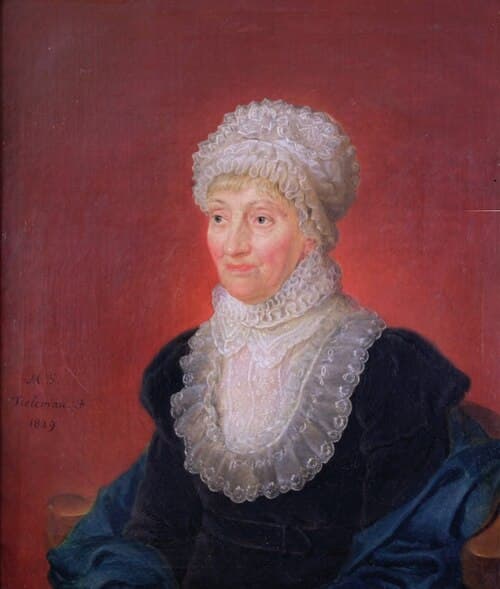
German, British · Science · Exploration
Caroline Herschel
March 16, 1750 – January 9, 1848
Early Life and Background
Caroline Lucretia Herschel was born on 16 March 1750 in Hanover, in the Electorate of Hanover, then part of the Holy Roman Empire.[1][2][4] She was the eighth of ten children of Isaac Herschel, an oboist in the Hanoverian military band, and Anna Ilse Moritzen.[2][14][17] The family’s livelihood was tied to music, and Caroline’s early environment was shaped by rehearsals, performances, and the practical demands of a large household of modest means.
Caroline’s childhood was marked by illness and limited educational opportunities. At about ten years of age she contracted typhus, which stunted her growth; as an adult she was reported to be only about 1.3 metres (four feet three inches) tall.[2][17] In the social context of 18th‑century Germany, this physical disability led family members to assume that she would not marry and would instead remain in domestic service, perhaps as a household help to one of her brothers. Her mother, in particular, opposed efforts to broaden her education beyond what was considered appropriate for a girl destined for housework.[2][4]
Despite these constraints, her father encouraged her intellectual curiosity. Isaac Herschel gave some of his children, including Caroline, basic instruction in reading and music, and he allowed them to glimpse his interest in more abstract subjects.[2] Caroline later recalled his support as crucial, providing a counterweight to the restrictive expectations of her mother and society. However, she did not receive formal schooling in mathematics or science, and there was no clear path for a girl of her background to enter the learned world.
The death of her father in 1767 deepened her domestic responsibilities.[2] For several years Caroline managed household tasks in Hanover, overseeing chores and supporting her mother. Meanwhile, her elder brother William Herschel, who had left Hanover to pursue a musical career in England, began to establish himself as a composer, organist, and music teacher in Bath. This widening gap between William’s life in England and Caroline’s constrained existence in Hanover set the stage for a crucial turning point in her biography.
Move to England and Career Beginnings
In 1772, William invited Caroline to join him in Bath, England, promising to train her as a singer and offer her a more independent life.[2][4][17] Despite her mother’s reluctance, Caroline accepted and undertook the journey to England—an unusual step for a young woman of her station. In Bath she initially worked as William’s housekeeper but soon began rigorous musical training. Under William’s guidance she developed into a capable soprano, performing in his concerts and teaching singing to pupils.[2][4]
William’s interests, however, were evolving. By the mid‑1770s he had become increasingly fascinated by telescopes and the night sky. He began grinding and polishing mirrors, constructing powerful reflecting telescopes in his spare time.[4][16] Caroline gradually became involved in these activities, helping cast and polish mirrors, assemble instruments, and keep records of observations. Her role at this stage was primarily supportive, but it exposed her to practical astronomy and the technical art of telescope making.
The turning point in William’s career—and indirectly in Caroline’s—came in 1781, when he discovered the planet Uranus (originally named Georgium Sidus) during systematic sweeps of the sky.[4] This discovery brought William to the attention of the British royal court. In the same year, King George III appointed him King’s Astronomer and granted him a royal pension.[4][16] William moved from Bath to Datchet, and later to Slough near Windsor, to be closer to the court and to pursue his astronomical work full‑time.
Caroline accompanied him, transitioning from a musical career to full‑scale involvement in astronomy.[2][4] Initially she took charge of household management, but William soon trained her to assist at the telescope. She learned to note the time, record positions, and enter data in observing logs as William described objects in the eyepiece. This meticulous clerical and computational work was critical to transforming raw observations into scientifically useful records.[2][12]
Development as an Astronomer
As William’s surveys of the heavens intensified, Caroline’s responsibilities expanded. She became responsible for copying observing notes, checking calculations, and preparing lists of objects for follow‑up study.[2][12] Her duties required competence in arithmetic and familiarity with the celestial coordinate system, knowledge she acquired largely through practice rather than formal instruction.
By the early 1780s, Caroline was undertaking independent observations. William built her a small Newtonian reflector, with which she could sweep portions of the sky on her own.[4][12] On 26 February 1783, she made her first recorded astronomical discovery, identifying a nebula not included in Charles Messier’s catalogue and independently observing Messier 110 (NGC 205), a companion galaxy to Andromeda.[4][7] This event marked her transition from assistant to discoverer, demonstrating that she could recognise and document new celestial objects.
Encouraged by this success, Caroline continued systematic sweeps, often under difficult conditions and with limited instrumental power compared to the massive reflectors William used. Her observational programme required patience, careful logging, and the ability to distinguish genuine celestial phenomena from instrumental artefacts or momentary visual impressions.[2][12]
Comet Discoveries and Scientific Contributions
Caroline Herschel’s most celebrated contributions to astronomy were her discoveries of comets. On the night of 1 August 1786, while scanning the sky from Slough with her own telescope, she detected a faint, moving object that was soon confirmed as a new comet, later designated C/1786 P1 (Herschel).[4][12] This observation made her the first woman to discover a comet, an achievement widely reported in contemporary scientific circles.[3][7][15]
Over the period from 1786 to 1797, Caroline discovered a total of eight comets, including the periodic comet 35P/Herschel–Rigollet, which still bears her name.[4][5][12] She also independently rediscovered at least one previously known comet. Each discovery involved multiple nights of observation and careful positional measurements to establish the comet’s path. These were not chance sightings but products of systematic research.
Her comet discoveries were communicated to leading astronomers and published in reputable outlets. Caroline became the first woman to publish scientific findings in the Philosophical Transactions of the Royal Society when her work on comets was communicated through William and other intermediaries.[4] Although she did not become a Fellow of the Royal Society, her inclusion in its flagship journal was a significant step toward the recognition of women’s scientific work.
Beyond comets, Caroline contributed to the cataloguing of nebulae and star clusters. Working alongside William, she helped compile extensive lists of deep‑sky objects, recording positions and assisting in the classification of nebulae according to their appearance and brightness.[2][12][16] Her accurate recording and organisational skills were essential to the Herschels’ ambitious project of mapping the structure of the heavens.
In 1798, Caroline produced the "Index to Flamsteed’s Observations of the Fixed Stars", a major reference work that corrected and extended the catalogue of British Astronomer Royal John Flamsteed.[2][3][7] Her index added more than 560 stars and reconciled Flamsteed’s original observations with the published catalogue, making this essential resource far more usable for contemporary astronomers. Although the exact day of publication is not clearly documented, the work itself is widely regarded as a landmark in astronomical cataloguing.
Professional Status and Royal Pension
Caroline’s role in astronomy was formally recognised when she began to receive a personal income for her scientific work. In 1787, King George III granted her an annual pension of £50 in her capacity as William’s assistant.[1][9][12] The precise date of this grant is not specified in accessible primary sources, but the pension itself is significant: it made her the first known professional female astronomer, and she is often described as the first woman to receive a regular salary for scientific labour.[1][3][9][13]
Previously, she had relied on William’s support and the shared resources of their household. With her own pension, Caroline gained a measure of financial independence and formal recognition from the state. Her duties under this arrangement included nightly observing, recording positions, handling calculations, and overseeing logistical aspects of telescope construction and maintenance.[2][12] In effect, she held a government‑funded scientific post, a rare status for any woman in the 18th century.
Some accounts note that Caroline’s recognition as a professional astronomer was closely tied to William’s appointment as royal astronomer in 1781, suggesting that her paid work began around the time the Herschels moved to Datchet and Slough.[1][3] However, the specific terms of her compensation are most explicitly documented for 1787. Either way, historians treat her as a pioneering figure in the professionalisation of women’s scientific activity.
Awards, Honours, and Recognition
Caroline Herschel’s contributions were ultimately recognised by several major scientific institutions. After William’s death in 1822, she returned to Hanover and undertook the demanding task of reorganising his nebular observations into a coherent zone catalogue.[2][16] This work systematised thousands of entries and made the Herschel surveys far more accessible for future research.
In recognition of this achievement, the Royal Astronomical Society (RAS) awarded her its Gold Medal on 8 February 1828, making her the first woman to receive the society’s highest honour.[4][16] The medal acknowledged not only her recent cataloguing work but also her long record of comet discoveries and observational support.
On 29 January 1835, the RAS elected Caroline Herschel and Mary Somerville as Honorary Members, the first women to attain this status.[4] Because women were not admitted as ordinary fellows, honorary membership was the society’s way of acknowledging their contributions while maintaining existing rules. Caroline’s election at age 84 reflected widespread esteem for her lifetime of work.
Her reputation extended beyond Britain. On 30 December 1846, the Prussian Academy of Sciences awarded her its Golden Medal of Science, again making her the first woman to receive this decoration.[4][9] This recognition from a major continental academy signalled that her significance was understood across national boundaries.
Throughout her life and posthumously, Caroline was praised as a pioneer. Modern institutions including UNESCO, the Max Planck Society, and the Royal Museums Greenwich highlight her as a model of a woman scientist who overcame social and institutional obstacles to make lasting contributions to astronomy.[3][9][13]
Personal Life and Relationships
Caroline Herschel never married and had no children.[2][4] Her personal life was strongly shaped by her close relationship with her brother William, with whom she lived for many years in Bath, Datchet, and Slough. She often framed her work as service to William, describing herself modestly as his assistant even as she gained her own scientific reputation.[2][12]
When William married Mary Pitt in 1788, Caroline’s role in the household shifted, and she initially found it difficult to adjust to the new domestic arrangements.[2][4] Over time, however, she developed a cordial relationship with her sister‑in‑law and formed a strong bond with her nephew John Herschel, who would himself become a distinguished astronomer.
Caroline’s letters and memoirs reveal a personality combining sharp intelligence, discipline, and self‑deprecating humour. She was aware of her exceptional trajectory from overlooked girl in Hanover to respected astronomer in England and Germany, yet she consistently emphasised the support she received from William and others as decisive in enabling her career.[2][12]
Later Life and Death
After William’s death in 1822, Caroline returned to Hanover, where she lived for the remainder of her life.[2][16] In her seventies, she undertook the demanding task of re‑cataloguing William’s nebular observations, work that led to the RAS Gold Medal in 1828.[4][16] Once that project was complete, she progressively withdrew from active research but remained informed about developments in astronomy, especially through correspondence with John Herschel.
Caroline’s later years were marked by honour and reflection. She treasured the medals and diplomas granted by scientific societies and kept detailed records of her family’s achievements. Visitors and correspondents treated her as a living link to the heroic age of telescopic discovery.[2][4]
On 9 January 1848, Caroline Herschel died in Hanover at the age of 97.[1][2][4][9] She was buried in the Neustädter Kirche cemetery, where her grave bears a simple inscription referencing her work with her brother and her own contributions to science. Her death closed a remarkably long life that had seen profound changes in science, politics, and society.
Legacy and Historical Impact
Caroline Herschel is widely regarded as one of the most important women in the history of astronomy.[1][3][12] Her discovery of eight comets, starting with the landmark detection of C/1786 P1 Herschel on 1 August 1786, placed her among the foremost comet hunters of her era.[4][5][7] Her careful cataloguing of nebulae and star clusters, and her correction and extension of Flamsteed’s star catalogue, provided essential tools for 19th‑century astronomers and laid groundwork later built upon by John Herschel and others.[2][16]
Equally significant is her role as a professional woman scientist. The royal pension granted in 1787 made her the first known woman to be salaried specifically for astronomical work, and likely the first woman to hold a government‑funded scientific position in Britain.[1][3][9] Her awards—the RAS Gold Medal in 1828, honorary membership in 1835, and the Prussian Academy’s Golden Medal of Science in 1846—marked crucial moments when major institutions publicly recognised a woman’s scientific achievements.[4][9][16]
Historians and science educators emphasize the barriers she faced: limited early education, prevailing notions that women were unsuited to scientific reasoning, and exclusion from formal memberships in learned societies.[1][3][10] Caroline overcame these obstacles through talent, perseverance, and the opportunities created by family connections, particularly her collaboration with William. Her story illustrates both the importance of individual agency and the structural constraints that shaped women’s access to science.
In contemporary culture, Caroline Herschel serves as an inspiration for women in STEM fields. Museums and educational organisations feature her telescopes, observing notebooks, and medals as artefacts illustrating women’s contributions to the development of astronomy.[3][8][10][20] Space agencies and science writers highlight her achievements when discussing comet research, the history of astronomical catalogues, and the gradual inclusion of women in scientific institutions.[14][16]
Her legacy is not only in specific discoveries but also in the example she set: that a woman with limited formal education, working initially in supporting roles, could become a respected scientist whose work shaped the practice of observational astronomy. As such, Caroline Herschel occupies a central place in editorial almanacs and timelines of women’s history, symbolising the long, still ongoing process by which women have gained recognition within the scientific community.
Dated achievements
8 indexed.
- Mar161750Science
Birth of Caroline Herschel
Caroline Lucretia Herschel was born in Hannover, Germany, the daughter of a musician who encouraged her early education.
View details Caroline Herschel - Wikipedia - Feb261783Science
First independent astronomical discovery: a nebula and Messier 110
Herschel made her first independent discovery, finding a nebula not in the Messier catalogue and identifying Messier 110, a companion to the Andromeda Galaxy.