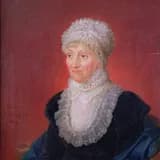
Herschel made her first independent discovery, finding a nebula not in the Messier catalogue and identifying Messier 110, a companion to the Andromeda Galaxy.
On 26 February 1783, Caroline Herschel achieved her first independent astronomical discovery while using a telescope constructed by her brother William. She identified a nebula that had not been catalogued by Charles Messier, and in the same period she independently observed Messier 110 (NGC 205), a satellite galaxy of the Andromeda Galaxy.
This achievement marked Caroline's transition from being merely William's assistant—recording his observations, polishing mirrors, and managing household affairs—to becoming an active, independent observer in her own right. Working with a small Newtonian reflector William had built especially for her, sometimes called her 'small sweeper,' Caroline began systematically scanning the night sky for previously unknown objects.
The discovery of this nebula demonstrated her growing skill and confidence with the telescope, as well as her sharp eye for detail against the backdrop of thousands of stars. It was an early sign of the remarkable observational career that would follow, in which she would go on to discover multiple comets and catalogue numerous star clusters and nebulae.
This moment is historically significant as one of the first instances of a woman making an original astronomical discovery in the modern era, at a time when women were almost entirely excluded from formal scientific practice and institutions across Europe.