← All women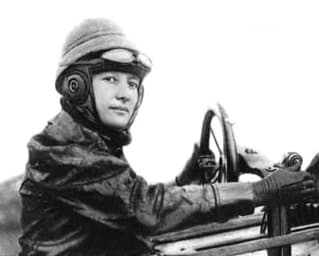
French · Sports · Aviation · Medicine · Exploration
Marie Marvingt
February 20, 1875 – December 14, 1963
Early Life and Background
Marie Félicie Élisabeth Marvingt was born on 20 February 1875 in Aurillac, in the Cantal department of central France.[1][3][11] Her family soon moved to Metz, then part of the German Empire following the Franco‑Prussian War.[9] Growing up in a bilingual, militarized border city shaped both her cultural outlook and her familiarity with military life. Her father, Félix Marvingt, is described in later sources as an enthusiastic supporter of his daughter’s physical education, encouraging her to swim, cycle, climb, and take part in endurance activities at a time when such pursuits were considered unfeminine.[1][2][6]
Marvingt’s mother died when Marie was young, and the resulting emotional and practical challenges further strengthened her independence.[12][18] By her teens she was already demonstrating exceptional endurance, reportedly taking part in long‑distance cycling and canoeing trips and learning to swim in rivers rather than formal pools.[6][12] This combination of paternal support, borderland environment, and early loss contributed to a personality characterized by resilience, risk‑taking, and determination.
Although detailed records of her formal schooling are scarce, sources agree that she acquired enough education to work later as a journalist and lecturer, and to train as a surgical nurse.[1][10][14] Her ability to move between technical medical work, sports competition, and public commentary would become a hallmark of her adult career.
Sporting Beginnings and Endurance Feats
Marvingt’s public career began in endurance sport. She excelled in swimming, cycling, mountaineering, winter sports, shooting, and other disciplines, often competing directly against men.[1][2][6][10] In the late 19th century, athletic competition for women was rare and frequently criticized as unhealthy or improper. Marvingt’s many victories directly challenged these norms.
One early highlight, recorded by year, came in 1890, when she reportedly took first place in a 400‑km canoe race from Nancy to Koblenz, a feat later described as the first time a woman had won such a race, though the exact date is not known.[12] Throughout the 1890s she continued to participate in demanding physical challenges, developing a reputation as a formidable sportswoman in eastern France.
In mountaineering, she became especially prominent. Around 1903, sources credit her as the first woman to climb the Dent du Géant in the Alps.[12] Between 1903 and 1910 she climbed many major peaks in the French and Swiss Alps, including difficult routes from Chamonix such as the Aiguille des Grands Charmoz and the Grépon Pass, sometimes in a single day.[1][7][15] By 1910 she was widely acknowledged as the first woman to have climbed most of the principal Alpine peaks.[1][15]
Marvingt also distinguished herself in swimming. Around 1905–1906, she became the first Frenchwoman to swim the length of the Seine through Paris, an achievement noted in French and German accounts, although the precise day has not been identified.[1][3][6] This long‑distance urban river swim reinforced her image as a woman whose capacities matched or exceeded those of male endurance athletes.
Her winter‑sports career flourished in the years around 1908. Competing in Chamonix, Gérardmer, and the Ballon d’Alsace, she won numerous medals in skiing (cross‑country, downhill, jumping), speed and figure skating, luge, and bobsledding.[6][18] The breadth of her participation led contemporary observers and later historians to describe her as one of the most versatile athletes in French history.[2]
Cycling and the Tour de France
In 1908, Marvingt attempted to enter the Tour de France, which had been founded only a few years earlier. Denied official entry because she was a woman, she nevertheless rode the full course unofficially, following behind the male competitors and completing every stage.[12] Contemporary reports and later retrospectives have emphasized that she finished the entire route, a grueling feat even for professional male cyclists, at a time when women’s competitive cycling was barely acknowledged.
This unofficial Tour completion did not receive formal race recognition, but it became an important part of her legend. It demonstrated both her physical stamina and her willingness to confront institutional barriers. Her Tour de France ride prefigured later campaigns by women to enter major cycling races and is often cited as a vivid example of early 20th‑century women athletes challenging male‑only rules.
Ballooning: From Passenger to Pilot and Record‑Setter
Marvingt’s interest in the sports of the air began in 1901, when she first ascended as a passenger in a free‑flight balloon.[1][9] The experience deeply impressed her and marked the start of her involvement with aeronautics. Over the next several years she studied ballooning techniques and gradually moved from passenger to pilot.
On 19 July 1907, she piloted a free balloon for the first time, taking control of the aircraft rather than flying under another pilot’s direction.[1] This step advanced her technical skills and signaled her intention to be an active participant in aviation rather than a passive observer.
By 1907 she had become the first French woman to obtain a balloon pilot’s license, though the exact date of the license issuance is not documented.[8][9] Her qualifications allowed her to compete in balloon races and undertake longer flights. On 24 September 1909, she made her first solo flight as a balloon pilot, flying alone and assuming full responsibility for navigation and flight safety.[1]
Marvingt’s most celebrated ballooning achievement came on 26 October 1909, when she piloted the balloon "Étoile Filante" ("The Shooting Star") from the European Continent to England, crossing the North Sea/English Channel.[8][1][3] This flight made her the first woman to pilot a balloon from the Continent to England. English‑language sources emphasize the English Channel, while German accounts highlight the North Sea, but both agree on the date and her status as a pioneer.[1][3][8]
Operating a balloon over open water required expert knowledge of winds, altitude management, and navigation, as well as a readiness to face serious danger. Marvingt’s successful crossing brought her international attention in aeronautical circles and reinforced her reputation as a daring yet skilled pilot.
Marksmanship and Military Recognition
Alongside her aeronautical achievements, Marvingt distinguished herself in rifle shooting. In 1907, she won an international military shooting competition using a French Army carbine and was awarded the Palmes du Premier Tireur by the French Minister of War.[9][7] She is reported to be the only woman ever to receive this distinction.
The award placed her within a traditionally masculine sphere of military marksmanship and underscored her ability to excel in disciplines associated with warfare. Given prevailing French attitudes about women and weapons, Marvingt’s recognition by the Ministry of War was a notable departure from convention and foreshadowed her later combat aviation role.
Transition to Powered Aviation
As heavier‑than‑air flight developed, Marvingt moved from ballooning into powered aviation. She learned to fly monoplanes and other early aircraft, training in environments where crashes were common and safety technologies rudimentary.[1][5]
On 10 June 1910, she obtained a fixed‑wing pilot’s license, becoming the third woman in the world to earn such a credential, after Baroness Raymonde de Laroche and Marthe Niel.[8][9] French and international aviation organizations recognized her license, situating her in the small group of women who were authorized to fly airplanes at a time when the profession was overwhelmingly male.
Later in 1910, she set formally recognized women’s aviation records. On 27 November 1910 she flew for 53 minutes and covered 42 km, establishing the first officially recorded women’s records for time aloft and distance.[8][1] These records provided measurable proof of her capabilities and helped demonstrate that women pilots could meet rigorous performance standards.
There is some disagreement among sources about her licensing sequence: one account lists her as the second woman to earn a license on 8 November 1910, while others place her as the third on 10 June 1910.[5][15][8] The more detailed aeronautical sources, including Women in Aviation International, support the June date and third‑place ranking, and this interpretation has become the prevailing view.
World War I: Nurse, Driver, and Combat Pilot
With the outbreak of World War I in 1914, Marvingt sought to apply her skills to the war effort. She had trained as a surgical nurse and volunteered for service; she also worked as an ambulance driver.[1][6][9] Her medical training and driving experience brought her into direct contact with the wounded and informed her later ideas about medical evacuation.
Marvingt’s ambition, however, extended to combat aviation. Sources describe how she initially disguised herself as a man to fly a bombing mission, after being refused official combat roles because she was a woman.[7][9] In 1915, she flew bombing missions over German‑held territory near Metz, becoming the first woman combat pilot.[1][7][9][10] Although the exact day of her mission is not recorded in readily accessible sources, her pioneering status is widely acknowledged.
For her wartime aviation and nursing service she received the Croix de Guerre, one of France’s principal military decorations for bravery.[7][9][10] Her experience as both combat pilot and medical professional placed her at the intersection of two spheres where women’s participation had been highly restricted: front‑line warfare and technical medicine.
Inventing and Promoting the Air Ambulance
Marvingt’s most enduring contribution to global medicine and aviation was her role as an inventor and advocate of air‑ambulance services. As early as 1910, before World War I, she proposed the creation of airplane ambulances.[8][6] By 1912, she had designed a practical aircraft specifically intended for medical evacuation and worked to raise public funds to have it built by the Deperdussin factory.[8]
Her design integrated space for stretchers, medical staff, and equipment, reflecting her dual expertise in aviation and surgery.[6][16] After the war, she continued to promote the concept internationally, lecturing, writing articles, and collaborating with physicians and aviation organizations to advance air‑medical services.[6][7]
Marvingt’s advocacy contributed to the eventual institutionalization of air‑ambulance systems in France and other countries. Later organizations devoted to aviation medicine and airborne rescue, such as groups in the "Les Amies de l’Aviation Sanitaire" network, have highlighted her early work as foundational.[16] She is widely cited as the "mother of the air ambulance."[6][7][8]
Journalism, Writing, and Public Image
Beyond her practical activities, Marvingt worked as a journalist and writer. She wrote articles about aviation, mountaineering, and sports, and gave lectures in France and abroad.[1][10][14] Her writings helped popularize both women’s participation in physical culture and the idea of medical aviation.
Her public image crystallized around the nickname "la fiancée du danger"—"the fiancée of danger"—which appears in sources from the early 20th century and has been revived by modern biographers.[12][15][18] The nickname reflects the combination of daring and professionalism that characterized her career.
Marvingt’s life also intersected with the Esperanto movement; she is listed in some accounts as an Esperantist, indicating engagement with internationalist cultural currents.[14] Through journalism and public speaking, she connected her personal exploits to broader conversations about modernity, technology, and women’s roles.
Awards, Honors, and Recognition
Over the course of her long career, Marvingt received numerous medals and decorations. A summary on Early Aviators notes that she was awarded more than 34 medals and distinctions, making her "the most decorated woman in the history of France".[4] These honors recognized achievements in skiing, bobsledding, skating, rifle shooting, ballooning, and aviation.[8][6]
In 1910, she was awarded a unique gold medal "for all sports" by the French National Sports Federation (sometimes referred to as the French Academy or Federation of Sports).[8][9] This medal, granted "for all sports," is described as the only multi‑sport medal ever awarded in France, recognizing her extraordinary versatility and dominance across disciplines.
Her combat and nursing service during World War I earned her the Croix de Guerre, acknowledging acts of bravery under fire.[7][9][10] She also received honors from aeronautical organizations for her balloon and aviation records.
Personal Life
Compared with her public achievements, relatively little is documented about Marvingt’s private life. Sources emphasize that she did not marry and did not have children, a fact highlighted by commentators who link her life story to modern childfree women’s experiences.[12] Her independence and focus on career, adventure, and humanitarian projects set her apart from conventional female roles in late 19th‑ and early 20th‑century France.
Her social circle appears to have included other athletes, mountaineers, aviators, and medical professionals. She worked closely with military officers, engineers, and physicians in developing air‑ambulance concepts and taking part in wartime service.[6][7][16] Details of specific long‑term relationships are sparse in accessible sources, suggesting that contemporaries and later writers concentrated primarily on her public persona.
Later Life
In the interwar years and during and after World War II, Marvingt continued to promote aviation, sports, and medical air transport. She remained active as a lecturer and may have continued to fly, though at more modest levels as age advanced.[6][7][15] Her expertise in skiing led her to experiment with equipment design; one account credits her with inventing an early metal or aluminum ski, though details of patents or formal recognition are limited.[6]
She also maintained her nursing qualifications and stayed involved with medical and humanitarian initiatives linked to aviation. Her later work often focused on institutionalizing systems that she had first proposed decades earlier, particularly in the field of air‑ambulance services.[6][16]
On 14 December 1963, Marie Marvingt died in Laxou, near Nancy, at the age of 88.[1][3][11][18] Accounts from aviation history sites and genealogical studies note that she died in a hospice outside Nancy.[18][4] By then, she was recognized among specialists as a pioneering figure in both women’s sport and medical aviation, though her name was less familiar to the broader public.
Legacy and Historical Impact
Marvingt’s legacy spans at least three major fields: women’s sport, aviation history, and medical evacuation.
In sport, she stands as one of the earliest examples of a woman who systematically competed across multiple disciplines, including endurance swimming, cycling, mountaineering, skiing, skating, shooting, and martial arts, often against male competitors.[2][6][10] Her completion of the Tour de France route, her Alpine first ascents, and her Seine swim collectively undermined stereotypes about women’s physical limitations and helped lay the groundwork for broader female participation in competitive sport.
In aviation, she is remembered as a balloon record‑setter, one of the first licensed female airplane pilots, and the first woman combat pilot.[1][8][10][11][15] Her Channel/North Sea crossing in a balloon, her officially recognized women’s flight records, and her wartime missions all demonstrate that women were present in the earliest phases of aviation’s development, working not just as passengers but as pilots and innovators.
Most significantly for medicine, Marvingt is widely credited as the inventor or founding advocate of the air ambulance. Her pre‑war designs, wartime experience, and post‑war advocacy contributed to the eventual creation of systematic air‑medical services.[6][7][8][16] Today, helicopter and fixed‑wing air ambulances are essential components of emergency medicine worldwide, and historical surveys of aviation medicine frequently cite Marvingt as an early visionary.
Her life also serves as a powerful case study in women’s history, illustrating how one individual could cross multiple boundaries—gender, professional, national—and use modern technology to redefine what was possible for women. Scholars and popular writers have increasingly recovered her story, as seen in modern articles, radio features, and biographies.[6][7][12][15][18]
Marie Marvingt thus occupies an important place in the almanac of women’s history: she was a world‑class athlete, a pioneering aviator, a decorated combatant, and a humanitarian innovator whose ideas shaped modern medical practice in the skies.
Dated achievements
9 indexed.
- Feb201875Aviation
Birth of Marie Marvingt
Birth of Marie Marvingt in Aurillac, France, marking the start of a groundbreaking career in sport, aviation, and medical innovation.
View details Marie Marvingt - Wikipedia - Jul191907Aviation
First flight piloting a free balloon
Marie Marvingt pilots a free balloon for the first time, moving from passenger to pilot and beginning her career as an aeronautical pioneer.