← All women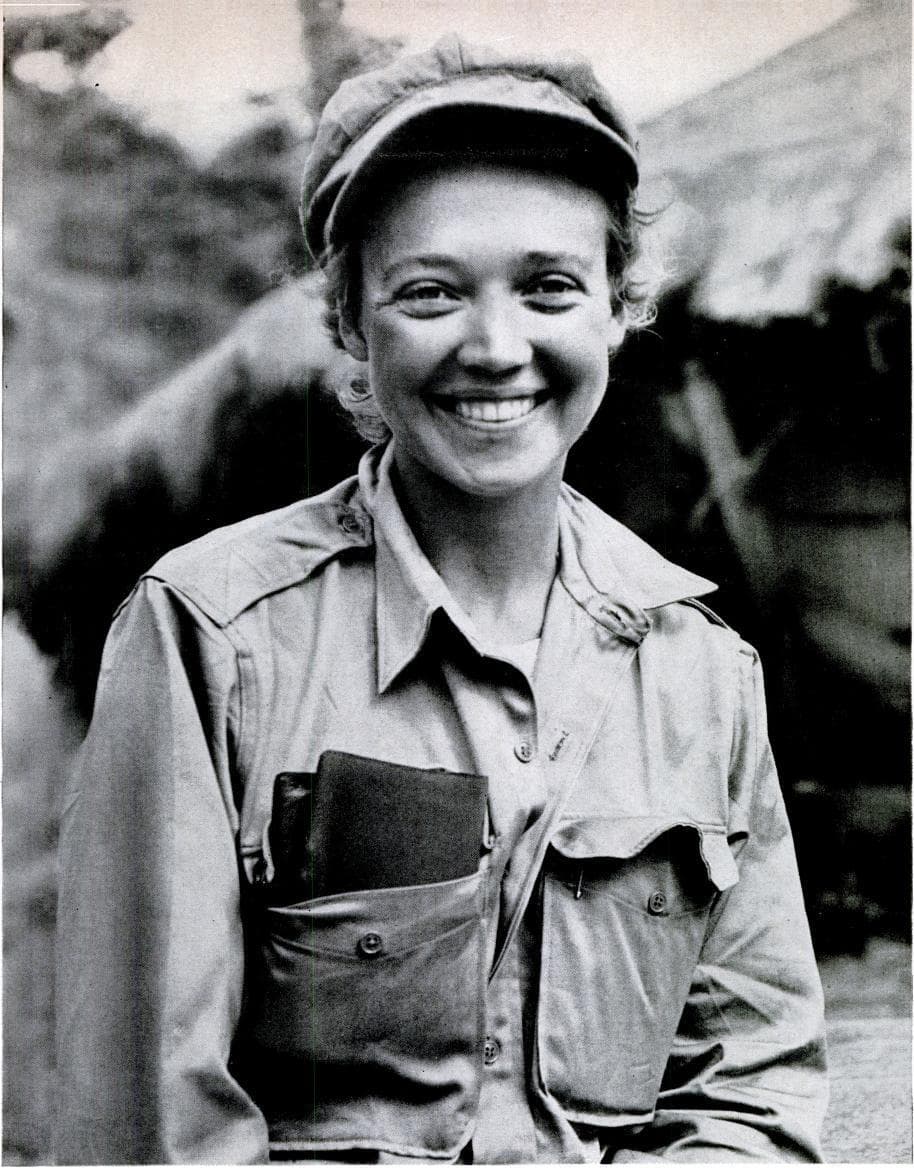
American · Literature · Politics
Marguerite Higgins
September 3, 1920 – January 3, 1966
Early Life and Background
Marguerite Higgins Hall was born on September 3, 1920, in the British Crown Colony of Hong Kong, the only child of Lawrence Daniel Higgins and Marguerite de Godard Higgins.[1][6][10][12] Her father, an American businessman and World War I veteran, managed steamship freight and worked in shipping, while her mother, a French teacher, had been a war bride.[6][12][15] This bicultural, transnational family background exposed Higgins early to languages, travel, and international affairs.
In 1923, the Higgins family relocated from Hong Kong to the United States, settling in California.[7] Higgins grew up in an environment that valued education and ambition. Her mother encouraged intellectual curiosity, while her father’s career in global shipping familiarized her with the idea that distant events mattered at home. Biographical accounts describe her as precocious, determined, and fascinated by writing and debate.[4][10][12]
Higgins enrolled at the University of California, Berkeley, where she studied French and journalism.[1][4][7][12][15] She worked on the student newspaper, The Daily Californian, gaining early practical experience in reporting and editing.[7] She graduated with honors—sources differ slightly on the exact year, citing 1940 or 1941—but agree that she completed her degree before moving to New York for graduate study.[4][7][12][15] Berkeley’s intellectually charged atmosphere and her involvement in student journalism helped shape her professional aspirations.
Determined to become a professional reporter, Higgins moved to New York to attend Columbia University’s Graduate School of Journalism, completing a master’s degree in 1942.[1][4][7][12] At Columbia she refined her reporting skills, learned the norms of metropolitan newsrooms, and began building contacts that would prove vital in her career. Her performance impressed faculty and editors, and she was soon recommended for positions in the New York press.[4][12]
Career Beginnings and World War II Reporting
After earning her master’s degree, Higgins was hired by the New York Herald Tribune, initially as a cub reporter.[1][4][6][8][12][15] She began in general assignment reporting around 1942, covering local stories and features. The Herald Tribune, one of New York’s leading newspapers, was known for its international focus and sophisticated readership, making it an ideal platform for a young journalist with global ambitions.
As World War II intensified, Higgins lobbied editors for overseas assignments. By the mid-1940s she was accredited as a war correspondent and sent to the European theater.[1][2][4][8][10][12][15] She reported on the Allied advance across France and Germany, focusing on both military developments and civilian experiences. Her breakthrough came when she covered the liberation of Nazi concentration camps, including Dachau and, in some accounts, Buchenwald.[1][5][10][12][15]
At Dachau in 1945, Higgins arrived with American troops as they liberated thousands of prisoners.[1][12][15] She was among the first journalists to enter the camp and speak directly with survivors, reportedly telling some that they were free.[1][10][12][15] Her graphic descriptions of the corpses, emaciated survivors, and the machinery of mass murder shocked readers and contributed to early public understanding of the Holocaust. This reporting demonstrated her ability to confront horror with clear-eyed detail and moral urgency.
Following the war’s end, Higgins remained in Europe to cover reconstruction and the emerging Cold War. By 1947 she had become the Herald Tribune’s Berlin bureau chief, a rare leadership role for a woman journalist.[4][6][10][12] From Berlin she reported on the divided city, the onset of the Soviet–Western confrontation, and daily life amid ruins. Her reporting mixed analysis of international politics with attention to ordinary Germans navigating occupation and scarcity.
Higgins’s early career was marked by determination to escape stereotypical "women’s beats." She resisted assignments limited to homes or society pages, insisting on political and military stories. Editors were initially skeptical, and army officials were wary of women near the front, but her persistence, productivity, and willingness to take risks gradually eroded institutional resistance.[6][10][15]
The Korean War and Breakthrough in War Correspondence
In 1950, Higgins’s career entered its defining phase when she was assigned to Asia as the Herald Tribune’s Tokyo bureau chief.[4][6][10][12][15] Stationed in Japan just as the Korean Peninsula erupted into war, she quickly moved to cover the unfolding conflict, becoming one of the earliest reporters on the scene and the only woman correspondent initially at the front lines.[1][2][3][6][10]
When Higgins arrived in Korea, U.S. Army regulations and commanders attempted to bar women correspondents from combat zones, citing logistical and security concerns.[1][6][10][15] Higgins protested, arguing that she was fully capable of handling front-line conditions and that exclusion on the basis of sex violated principles of press freedom and professional equality. She appealed directly to General Douglas MacArthur, who overruled the ban and declared that she had "earned the right" to be there.[1][6][10][15] This decision effectively opened the theater to other women correspondents as well.
Higgins reported from key battles, including the desperate defense of the Pusan perimeter, the amphibious landing at Incheon, and the subsequent recapture of Seoul.[1][3][6][10][15] On September 15, 1950, she went ashore with United Nations forces during the Incheon landing, filing dramatic eyewitness dispatches that conveyed the scale of the operation and the intensity of combat.[3][6] She also covered the grueling retreat from the Chosin Reservoir as Chinese forces entered the war, documenting the hardships faced by U.S. Marines and South Korean troops in subzero conditions.[1][10]
Her Korean War reporting combined battlefield narrative with analysis of strategy and diplomacy, explaining the conflict’s broader implications for Cold War geopolitics. Higgins interviewed commanders, rank-and-file soldiers, and civilians, capturing the war’s complexity. Her work was syndicated widely and helped shape American and international perceptions of the war’s progress and stakes.[1][4][10]
Major Works and Books
Higgins translated her wartime experience into several influential books. In 1951 she published War in Korea, one of the earliest book-length accounts of the conflict.[1][4][10][12] The book offered a detailed narrative of the war’s first year, blending frontline reporting with analysis of political decision-making in Washington, Seoul, and Tokyo. It drew on her extensive battlefield observations and interviews, providing readers with a comprehensive, accessible overview.
In 1955 she published Red Plush and Black Bread, a study of life in the Soviet Union based on travels and reporting while serving as the Herald Tribune’s Moscow bureau chief.[1][3][4][10][12] The book contrasted the luxurious privileges enjoyed by Communist Party elites (“red plush”) with the hardships experienced by ordinary citizens (“black bread”). Higgins described the surveillance state, restrictions on travel, and everyday strategies for coping with shortages and repression. Her work became a notable contribution to Western understanding of the USSR during the early Cold War.
Higgins later turned to memoir with News Is a Singular Thing, published in 1959.[1][4][10][12] The book recounted her experiences across multiple theaters—Europe, Korea, and beyond—reflecting on the nature of journalism, the challenges of covering war, and the tensions between professional drive and personal life. It offered insight into newsroom politics and the obstacles she faced as a woman insisting on equal treatment.
These books extended the impact of her reporting beyond the daily news cycle. They were widely reviewed and translated, influencing both public discourse and scholarly understanding of mid-century conflicts and societies.
Awards, Honors, and Recognition
Higgins’s Korean War coverage garnered some of the highest honors in American journalism. On May 7, 1951, she was announced as a co-recipient of the Pulitzer Prize for International Reporting for her frontline dispatches from Korea.[1][6][8][9][10] She became the first woman to win the Pulitzer Prize in that category and the first female war correspondent to receive a Pulitzer.[1][6][9][16] While earlier women, such as novelist Edith Wharton, had won Pulitzers in other categories, Higgins’s award broke a specific barrier in international and war reporting.
The Pulitzer citation praised her "outstanding coverage" of the Korean War, including reports from the Pusan perimeter and Incheon.[1][10] The prize symbolized institutional recognition that a woman could produce war reporting equal to or better than that of male colleagues. It also validated her insistence on equal access to combat zones.
In 1951, the Associated Press named Higgins its Woman of the Year, highlighting her prominence as a foreign correspondent and her Korean War reporting.[4][10] The honor reflected both professional respect and widespread public fascination with a woman who had defied gender expectations to operate at the heart of global conflict.
On April 21, 1952, the results of the 1951 George Polk Awards were formally announced, and Higgins was listed as the recipient of the George Polk Award for Foreign Reporting for her coverage behind enemy lines in Korea and other countries.[1] The Polk Awards honored courage and excellence in journalism, and her selection reinforced her status as one of the world’s leading foreign correspondents.
Decades later, her contributions continued to be recognized. On September 2, 2010, the government of South Korea posthumously bestowed on Higgins the Order of Diplomatic Service Merit, Heungin Medal, acknowledging her distinguished service as a Korean War correspondent and her role in informing international opinion about the conflict.[20] The decoration, one of South Korea’s highest honors for contributions to foreign relations, testified to the enduring significance of her work for the country’s diplomatic history.
Higgins has also been commemorated in philatelic and museum contexts. The U.S. Postal Service featured her among "Women on Stamps" for her Pulitzer-winning reporting.[20] Mystic Stamp and philatelic publications mark her birth date and career, underscoring her status as a historic figure in journalism.[15][16] Her papers are preserved at Syracuse University, providing a rich archival record of her dispatches, correspondence, and personal documents.[6]
Cold War Reporting and Later Career
After the Korean War, Higgins continued to cover major international developments. In 1953 she was appointed Moscow bureau chief for the New York Herald Tribune.[4][6][10][12] Some accounts note that she was among the first American correspondents allowed into the Soviet Union after Joseph Stalin’s death, and one of the first foreign reporters permitted to travel widely across the USSR, though precise dates of this access are not consistently documented.[3][4][10][12] From Moscow she reported on post-Stalin power struggles, daily life under Communism, and the atmosphere of suspicion directed at foreign journalists.
Her dispatches from the Soviet Union combined political analysis with vivid portraits of ordinary citizens, emphasizing the contrast between official propaganda and lived reality. This work underpinned her 1955 book Red Plush and Black Bread, which helped shape Western readers’ perceptions of the USSR.[1][3][4][10][12]
By the late 1950s Higgins had shifted to a more diplomatic focus, serving as the Herald Tribune’s diplomatic correspondent in Washington.[4][6][10][12] She covered foreign policy debates, UN negotiations, and Cold War crises, including tensions in Europe and Southeast Asia. Her reporting brought together battlefield experience and policy analysis, making her a respected voice on international affairs.
In 1963, amid changes in the newspaper industry, Higgins left the Herald Tribune and became a syndicated foreign affairs columnist for Newsday.[4][6][8][10][12] Her columns, carried in multiple papers, examined global issues such as the Congo crisis, the Cuban Missile aftermath, and escalating conflict in Vietnam. She continued to travel frequently, believing that firsthand observation was essential to credible commentary.
Vietnam War Reporting and Final Illness
Higgins made multiple trips to South Vietnam in the mid-1960s to cover the expanding American military involvement and the complex political situation in Saigon.[1][4][6][10][12] She visited bases, accompanied patrols, and interviewed commanders, Vietnamese officials, and civilians. Her reporting explored the war’s challenges, including insurgency, rural pacification, and questions about U.S. strategy.
While on assignment in Vietnam in 1965, Higgins contracted leishmaniasis, a tropical parasitic disease transmitted by sand flies.[1][6][10][16] Biographical sources note that this occurred late in the year, and by December 31, 1965, she was gravely ill and evacuated to the United States for treatment.[16] The disease attacked her internal organs and proved difficult to treat with the medical knowledge available at the time.
On January 3, 1966, Higgins died at Walter Reed Army Medical Center in Washington, D.C., at the age of 45, from complications of leishmaniasis arising from her Vietnam reporting.[1][4][6][8][10][12][17] She was buried in Arlington National Cemetery, one of the few civilian journalists accorded that honor, reflecting the national esteem in which her contributions were held.[6]
Personal Life
Higgins’s personal life was intertwined with her professional ambitions. In 1942 she married Stanley Moore, a philosophy professor, but the marriage ended in divorce in 1948.[4][12] Her demanding schedule, frequent travel, and determination to pursue front-line assignments made sustaining relationships difficult.
On October 6, 1952, she married Major General William Evans Hall of the U.S. Air Force in a civil ceremony in Washington, D.C.[1][4][12] Hall was a decorated bomber pilot from World War II. The couple eventually had three children.[4][10][12] Higgins continued her international reporting while raising a family, often leaving home for extended periods in conflict zones. This dual role was unusual at the time and highlighted the challenges faced by professional women who were also mothers.
Biographical accounts suggest that Higgins was charismatic, ambitious, and sometimes controversial.[4][10][18] Colleagues admired her courage and productivity but occasionally criticized what they saw as self-promotion or close relationships with military officials. She cultivated access to commanders and policymakers, believing it necessary for accurate reporting, even as she sought to maintain journalistic independence.
Legacy and Historical Impact
Marguerite Higgins is widely regarded as one of the most influential war correspondents of the twentieth century. Through front-line coverage of World War II, the Korean War, and the Vietnam War, she demonstrated that women could perform the most demanding and dangerous forms of journalism.[1][4][6][8][10][16]
Her successful appeal to Douglas MacArthur to overturn a ban on women correspondents in Korea became a landmark moment in the struggle for gender equality in the press.[1][6][10][15] By insisting on equal access to combat zones and then producing distinguished coverage, she undermined arguments that women were unsuited to war reporting.
Higgins’s Pulitzer Prize for International Reporting in 1951 and subsequent honors helped institutionalize this change. Editors who had previously relegated women to "soft" news were forced to confront evidence that a woman war correspondent could earn the field’s highest accolades.[1][4][6][8][9][10][16] For aspiring women journalists, her career served as both inspiration and precedent.
Her books—War in Korea, Red Plush and Black Bread, and News Is a Singular Thing—extended her influence beyond daily news, shaping public and scholarly interpretation of key conflicts and societies.[1][3][4][10][12] They are frequently cited in studies of the Korean War, Cold War media, and the history of foreign correspondence.
Higgins’s papers at Syracuse University, her inclusion in women’s history walking tours at Arlington National Cemetery, and commemorations by institutions such as the Smithsonian’s National Postal Museum reflect sustained interest in her life and work.[6][20] Contemporary biographies and articles continue to reassess her legacy, examining both her achievements and controversies.[13][18]
In the broader narrative of women’s history, Higgins occupies a crucial place as a pioneer who opened combat reporting and high-level foreign affairs coverage to women. Her life illustrates the costs and rewards of challenging gender barriers in a high-risk profession and underscores the importance of recognizing women’s contributions to the documentation of war and diplomacy.
Assessment
Marguerite Higgins’s career combined exceptional courage, narrative talent, and strategic use of institutional channels to secure access and recognition. She leveraged her education, professional networks, and sheer persistence to enter spaces that had been closed to women, then used her reporting to demonstrate that such exclusions were indefensible.
Her experiences raise enduring questions about the relationship between journalists and power, the balance of independence and access, and the personal costs of frontline reporting. For women in journalism, her story remains a testament to the possibility of reshaping professional norms—and a reminder of the physical and emotional toll that such pioneering work can entail.
Today, Higgins is remembered not only as a celebrated reporter and author but also as a figure whose life helped redefine what women could do in the public sphere. Her legacy lives on in the many women war correspondents and foreign affairs reporters who have followed her path into conflict zones and diplomatic corridors around the world.
Dated achievements
9 indexed.
- Sep031920Literature
Birth of Marguerite Higgins in Hong Kong
Marguerite Higgins Hall was born in Hong Kong, then a British colony, the only child of Lawrence and Marguerite de Godard Higgins.
View details Marguerite Higgins - Wikipedia - Sep151950Literature
Reports the Incheon Landing during the Korean War
As New York Herald Tribune correspondent, Higgins went ashore with U.S. forces during the Incheon amphibious landing and reported from the front lines.