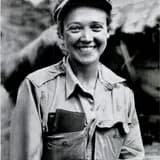
Higgins died at Walter Reed Army Medical Center in Washington, D.C., from complications of leishmaniasis contracted in Vietnam, aged 45.
Marguerite Higgins died on January 3, 1966, at Walter Reed Army Medical Center in Washington, D.C., at the age of 45, from complications of leishmaniasis, the tropical parasitic disease she had contracted months earlier while reporting from Vietnam for Newsday. Her death came just as the Vietnam War, which she had been actively covering, was escalating into the central American foreign policy crisis of the decade.
Higgins's death was widely reported and mourned across the journalism profession, given her status as one of the most celebrated correspondents of her generation. She was buried with full military honors at Arlington National Cemetery, a recognition of her extensive service reporting on American military engagements from World War II through Korea and Vietnam, and reflecting her marriage to Major General William Evans Hall.
Her death, resulting directly from an illness contracted through her insistence on frontline, ground-level reporting, underscored the genuine physical dangers she had accepted throughout a quarter-century career—dangers that she had confronted specifically to prove that women correspondents deserved the same access and respect as their male counterparts.
Higgins left behind a substantial journalistic legacy, including multiple books, a Pulitzer Prize, and a reputation as a trailblazer who had fought institutional barriers—including outright bans on women in combat zones—to establish herself as one of the preeminent war correspondents of the twentieth century. Her life and career continue to be studied as a foundational example for women in journalism.