← All women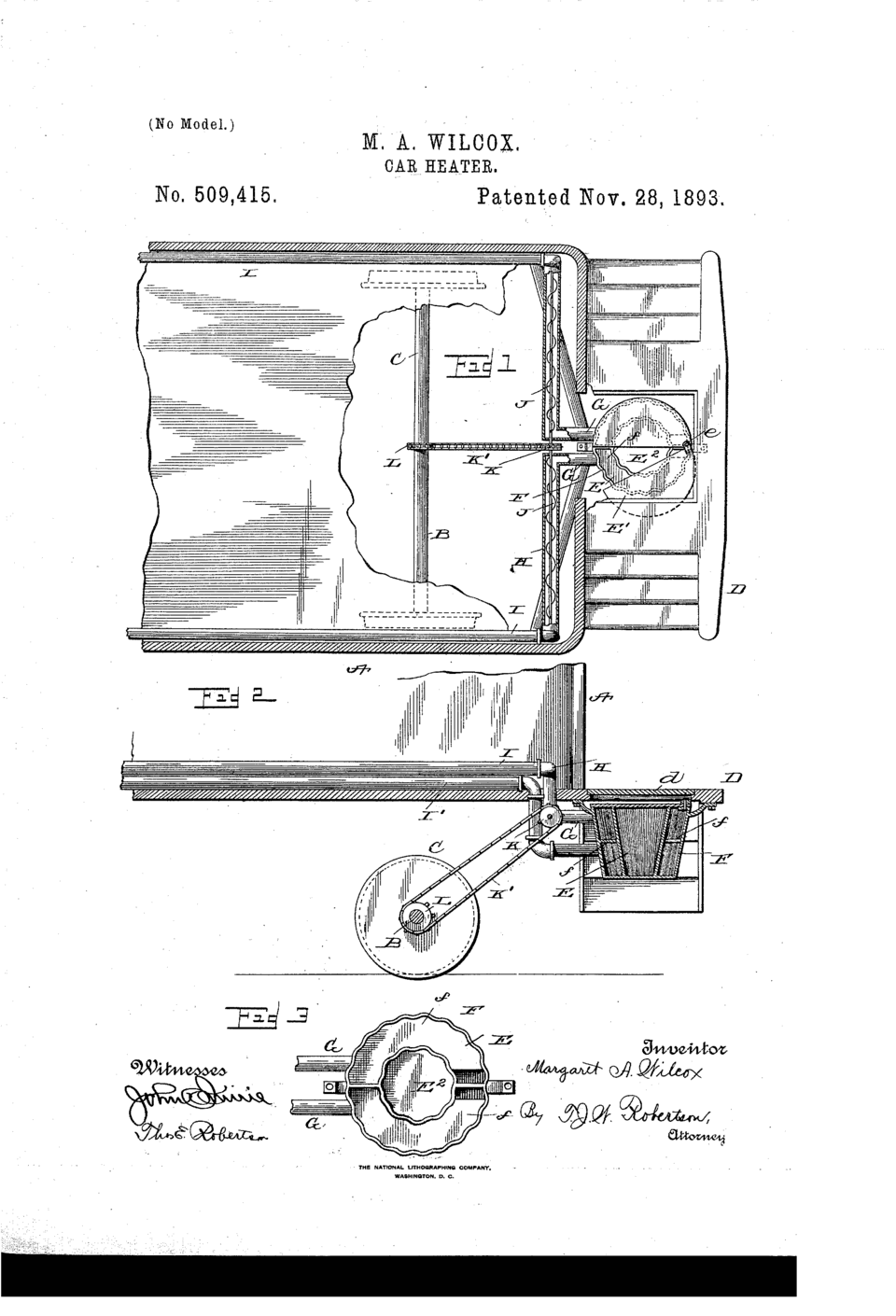
American · Science · Aviation
Margaret A. Wilcox
February 8, 1838 – March 30, 1912
Early life and background
Margaret A. Wilcox was born on February 8, 1838, though some historical sources record only the year 1838. Later references commonly identify her as an American inventor and mechanical engineer associated with Chicago, Illinois, and several accounts also describe her as having connections to Los Angeles in her final years. Like many women inventors of the nineteenth century, Wilcox’s early life is only fragmentarily documented in surviving public sources. The available record is far richer for her patent activity than for details such as schooling, family background, or formal engineering training. That imbalance itself is historically revealing: women’s technical work was often preserved in patent records while their personal biographies were left less fully documented.
Wilcox came of age during a period of rapid industrial growth in the United States. The mid-nineteenth century was an era in which steam power, mechanized production, and expanding rail networks transformed everyday life. Yet women had limited access to the institutions that trained engineers and promoted inventors. A woman who wished to design machinery had to navigate social expectations that placed her primarily in the domestic sphere. Wilcox’s later career suggests that she nevertheless developed a strong command of mechanical principles and an ability to identify everyday problems that could be solved through engineering.
Because fewer personal records survive for Wilcox than for many male inventors, historians generally reconstruct her significance through her patents and the contemporary contexts in which they appeared. The surviving evidence indicates that she was working within both home-appliance innovation and transportation technology. That combination helps explain why she has been remembered as a practical inventor rather than a speculative one. Her work focused on devices that addressed ordinary needs: washing, cooking, heating, and travel comfort.
Career beginnings and development
Wilcox’s inventive career is documented through a sequence of U.S. patents beginning in 1890. The earliest date widely associated with her patent activity is October 21, 1890, when she was granted U.S. Patent No. 426,486 for a combined clothes and dishwashing machine. That patent already shows a central theme of her work: the consolidation of labor-intensive household tasks into more efficient mechanical systems. In an age before electric dishwashers and automated laundry machines, such an invention represented an attempt to reduce the burden of repetitive domestic labor.
Her next major documented step came on October 29, 1891, when she filed the application for what became U.S. Patent No. 482,772, a combined cooking and hot-water-heating stove. The patent was granted on September 20, 1892. This device again reveals her concern with using fuel efficiently and serving multiple domestic functions with one machine. Instead of treating cooking and heating as separate systems, Wilcox designed an apparatus that integrated them. In a nineteenth-century home, where fuel economy mattered and labor was constant, such a machine could have practical value even when it was technologically ambitious.
These early patents place Wilcox among a small number of women who were able to secure legal recognition for mechanical inventions in the United States. Patenting required not only a novel idea but the ability to describe it in technical terms and defend it as a workable design. For a woman in the 1890s, that meant entering a highly male-dominated legal and engineering environment. Wilcox’s success suggests both technical competence and persistence.
The railway-car heater and transportation innovation
Wilcox is best known for the invention commonly described as one of the earliest car-heating systems. On November 28, 1893, she was granted U.S. Patent No. 509,415 for a railway-car heater. This is the invention most often associated with her name in later histories of transport technology. The concept was straightforward but important: use heat generated by the vehicle’s own machinery and distribute it into the passenger area to improve comfort during cold weather.
The significance of the patent lies not only in the mechanical idea but in its place in the history of enclosed vehicle interiors. In the late nineteenth century, rail travel was widespread, but comfort standards were still evolving. Heating a passenger compartment from an onboard or engine-adjacent source anticipated later developments in automotive climate control. Although modern systems differ in design, Wilcox’s patent is often remembered as a foundational step toward interior vehicle heating.
Wilcox’s achievement is also notable because transportation engineering was an overwhelmingly male field. Women were rarely credited as inventors of systems connected with vehicles, locomotion, or mechanical infrastructure. By obtaining a patent for a railway-car heater, Wilcox crossed a significant barrier of gendered expectations. Her name appears in later women’s-history, transportation-history, and inventors’ compilations because her work demonstrates that women were present in the development of technologies usually narrated as male achievements.
Later reproductions of the patent image and subsequent historical references have reinforced the importance of the date November 28, 1893. The patent became the anchor for her reputation, and later writers frequently describe her as the inventor of the car heater. While the practical implementation of her design may not have been adopted exactly as she imagined it, the historical claim is not about commercial dominance alone. It is about conceptual priority: Wilcox articulated a method for warming vehicle interiors at a time when such a feature was far from standard.
Contemporary and later discussions also connect her invention to the broader story of automotive comfort. As cars replaced rail travel and internal-combustion engines became common, the need for cabin heating became a normal engineering problem. Wilcox’s patent is therefore remembered as an early precursor to systems that would later become standard in automobiles and other vehicles. Her contribution helps illustrate how one inventive idea can influence a technological lineage even if the original product itself is not widely manufactured.
Later patents and continued invention
Wilcox did not stop inventing after 1893. The patent record shows a sustained career into the twentieth century, including a dough mixer granted on December 19, 1893, a spring-loaded exercise swing granted on June 5, 1906, a bake pan granted on October 1, 1907, and a hot-water house heater granted on November 23, 1909. These later patents demonstrate both continuity and range.
The dough mixer and bake pan continue her interest in domestic technology, suggesting that she remained attentive to the practical problems of cooking and food preparation. The exercise swing shows that she also explored recreational and bodily-movement devices, broadening the picture of her mechanical imagination. The hot-water house heater returned to the theme of heating, a subject central to her best-known work. Across these patents, Wilcox appears as an inventor who repeatedly pursued efficiency, convenience, and comfort in everyday life.
She secured at least seven U.S. patents between 1890 and 1909, a notable record for any inventor of the period and particularly significant for a woman working in fields dominated by men. The patent dates indicate a sustained engagement with mechanical design over nearly two decades. Rather than being a one-time novelty figure, Wilcox should be understood as a serious and prolific inventor whose work touched both domestic and transportation technologies.
Recognition and historical interpretation
Wilcox’s best-known achievement, the 1893 railway-car heater, has earned her recognition in women’s history, transportation history, and general invention histories. Modern articles and educational profiles frequently highlight her as a pioneer because her work anticipated the central logic of later vehicle heating systems. She is often cited as an example of a woman inventor whose contribution was both technically useful and historically underappreciated.
That recognition is important because women inventors have often been omitted from standard narratives of engineering progress. When women did appear, they were frequently treated as exceptions rather than participants in a broader technical culture. Wilcox’s patent record complicates that view. It shows a woman who was not only inventive but also persistent, legally successful, and capable of working across multiple device categories.
Her story also resonates because it bridges the domestic and the industrial. Many nineteenth-century women inventors worked in household technologies, but Wilcox moved between kitchens, heating systems, and transport interiors. That range reflects the interconnectedness of everyday life and mechanical innovation. Heating a home, washing clothes and dishes, cooking efficiently, and warming railcars are all part of a larger history of comfort engineering. Wilcox’s work belongs to that history.
Personal life
Publicly available sources provide limited detail about Wilcox’s private life, and reliable accounts are more focused on her patents than on marriage, children, or family relationships. Some later references identify her with the surname Gilbert at birth or by marriage, but the documentary record commonly used in historical summaries centers on her professional identity as Margaret A. Wilcox. Because the surviving evidence is sparse, a cautious historical profile should avoid speculative claims about relatives or domestic circumstances not supported by clear documentation.
What can be said with confidence is that her professional life was unusual for a woman of her generation. Whether she balanced inventing with family responsibilities, managed a workshop, collaborated with associates, or worked through business arrangements that remain poorly documented, the patent record confirms that she was active in technical authorship. In that sense, her personal life is historically important mainly because the surviving evidence reveals how little of women’s lived experience was preserved when it did not fit conventional public categories.
Later life and death
Wilcox died on March 30, 1912. Sources commonly place her death in Los Angeles. Her passing closed the career of an inventor whose work spanned the late nineteenth and early twentieth centuries, a time of rapid change in home technology, rail travel, and the emergence of the automobile. By the end of her life, many of the problems she had tackled—interior heating, fuel efficiency, domestic labor-saving—had become central concerns in industrial design.
Her death did not end her significance. In later decades, historians and popular writers revived interest in her patent for the railway-car heater, especially as women’s contributions to engineering became a subject of greater scholarly attention. The renewed focus on Wilcox reflects a broader re-evaluation of women inventors who were overlooked in their own era. She is now remembered not only for a specific device but also for demonstrating that women were active participants in the creation of modern mechanical life.
Legacy
Margaret A. Wilcox’s legacy rests on both innovation and historical visibility. She was an inventor who secured multiple U.S. patents, including one of the earliest car-heating systems, and she did so at a time when women were rarely expected to participate in mechanical engineering. Her career offers a compelling example of how practical invention could reshape daily life while also challenging gendered assumptions about technical expertise.
Her work on heating is especially enduring. Modern vehicles rely on climate-control systems that assume passengers should be protected from cold and heat alike. That expectation was not self-evident in the nineteenth century. Wilcox’s patent helped establish the idea that enclosed transport should be thermally regulated for human comfort. In that sense, her contribution extends beyond a single machine to a whole technological mindset.
At the same time, her domestic inventions remind us that the history of invention is also the history of labor. By designing devices for washing, cooking, mixing, baking, and heating, Wilcox addressed tasks that structured everyday domestic life. Her patents therefore sit at the intersection of household labor, engineering ingenuity, and the gradual mechanization of daily routines. For women’s history, that combination makes her a particularly valuable figure: a technically accomplished woman whose work illuminates both the possibilities and the constraints of her era.
Dated achievements
11 indexed.
- Feb081838Science
Birth of Margaret A. Wilcox
Margaret A. Wilcox was born on February 8, 1838.
View details Margaret A. Wilcox - Wikipedia - Oct211890Medicine
Patent granted for combined clothes and dishwashing machine
U.S. Patent No. 426,486 was granted to Wilcox for a combined clothes and dishwashing machine.