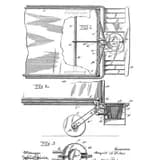
U.S. Patent No. 426,486 was granted to Wilcox for a combined clothes and dishwashing machine.
On October 21, 1890, Margaret A. Wilcox was granted U.S. Patent No. 426,486 for a combined clothes and dishwashing machine, one of the earliest documented patents in her inventive career. The device reflects the practical problem-solving that characterized much of Wilcox’s work: reducing repetitive household labor by combining functions into a single mechanical apparatus.
In the late nineteenth century, domestic labor remained physically demanding and time-consuming, and women inventors often targeted household chores because those were the areas where they could most directly observe inefficiencies and unmet needs. Wilcox’s patent belongs to that tradition of mechanical innovation aimed at saving labor, time, and fuel. Although this invention is less famous than her car heater, it is historically important because it shows that her inventive identity was not limited to transportation; she was already working across domestic technologies before her later breakthrough in vehicle heating.
The patent also illustrates the barriers women faced in technical fields at the time. Securing a U.S. patent in her own name required navigating a system still dominated by men, in an era when women’s mechanical ingenuity was often dismissed or treated as exceptional. Wilcox’s early success established her as a serious inventor and set the stage for a prolific sequence of patents over the next two decades.