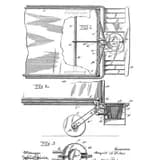
Wilcox received U.S. Patent No. 509,415 for a railway-car heater, widely regarded as one of the earliest car-heating systems.
On November 28, 1893, Margaret A. Wilcox received U.S. Patent No. 509,415 for a railway-car heater, the invention that made her name historically memorable. This patent is widely cited as one of the earliest car-heating systems and is the achievement most closely associated with her legacy as an inventor.
The invention was significant because it addressed a real and persistent hardship of nineteenth-century travel: cold, uncomfortable railcars in winter. Wilcox’s design sought to use heat generated by the engine or locomotive system and direct it into the passenger compartment, an idea that anticipated later vehicle climate-control systems. While the specific implementation evolved over time, the underlying concept—reclaiming waste heat to improve passenger comfort—proved enduring.
Its importance also lies in the barriers Wilcox overcame. Engineering and patenting were male-dominated professions, and women inventors were frequently underestimated or excluded from technical authority. By securing this patent in her own name, Wilcox demonstrated mastery of a complex mechanical problem at a time when few women were publicly recognized as transportation innovators. Her car-heating patent became a lasting reference point in histories of automotive comfort and women’s invention, linking her work to the broader evolution of transport technology.