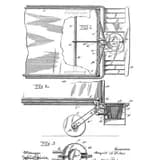
U.S. Patent No. 509,987 was granted to Wilcox for a dough mixer.
On December 19, 1893, Margaret A. Wilcox was granted U.S. Patent No. 509,987 for a dough mixer. Though far less famous than her railcar heater, the patent is important because it demonstrates the breadth of her mechanical interests and her continued productivity in the same year as her transportation breakthrough.
The dough mixer belongs to the family of domestic labor-saving devices that Wilcox repeatedly pursued. In the late nineteenth century, kitchen work remained physically intensive, and inventions that improved mixing, heating, washing, or cooking could have significant practical value. Wilcox’s design reflects her recurring focus on mechanisms that reduced repetitive manual effort in everyday life.
Historically, this patent also strengthens the picture of Wilcox as a prolific inventor rather than a one-invention figure. Women inventors were often remembered, if at all, for a single novelty; Wilcox’s patent record shows a broader and more sustained technical practice. The fact that she was able to secure multiple patents in 1893 underscores both her inventiveness and her persistence in a field where women faced structural skepticism. The dough mixer thus forms part of the larger pattern of Wilcox’s career: practical, multifunctional, and consistently aimed at improving domestic and transport systems through engineering.