← All women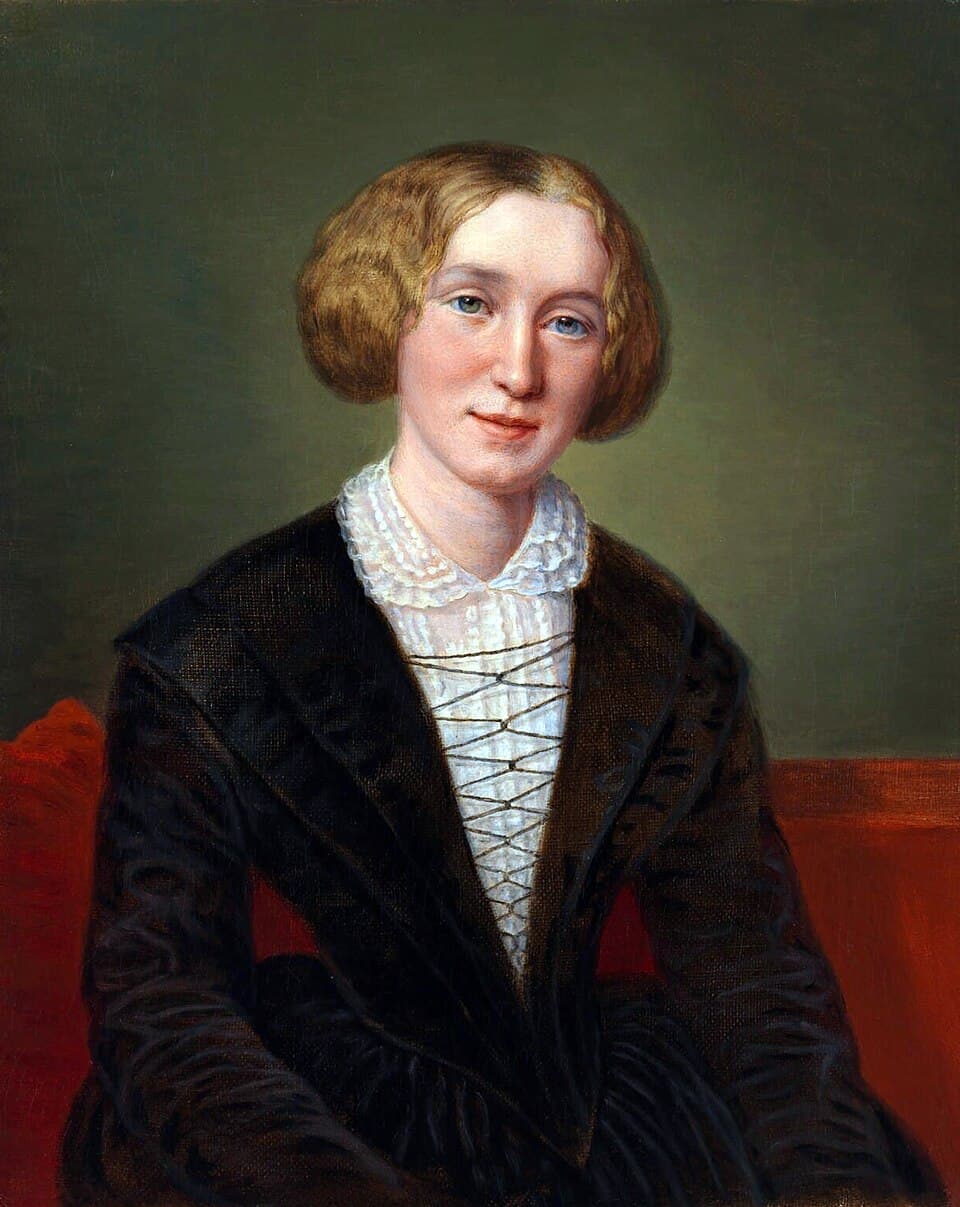
British, English · Literature
George Eliot
November 22, 1819 – December 22, 1880
Early Life and Background
George Eliot was born Mary Ann Evans on 22 November 1819 at Arbury Farm in the civil parish of Chilvers Coton, near Nuneaton in Warwickshire, England.[1][2][14][16] Her father, Robert Evans, was the estate manager for the Newdigate family at Arbury Hall, and her mother, Christiana Evans (née Pearson), came from a family connected with milling and local trade.[2][14] Growing up in rural Warwickshire, Evans spent her childhood in a landscape of farms, canals, and small towns that would later provide the model for the fictional locales of her novels.
Evans was the youngest surviving daughter in a blended family; her father had children from a previous marriage, and Christiana bore several children, including Isaac, whose relationship with Mary is often cited as an influence on the sibling dynamics portrayed in The Mill on the Floss.[2][14][16] Compared with most girls of her class and time, she received an unusually strong education. She attended schools in Attleborough, Nuneaton, and Coventry, where she studied languages, music, and literature, and became steeped in evangelical Anglicanism.[2][4][8] At the Misses Franklin’s school in Coventry, Evans came under the influence of the evangelically minded teacher Maria Lewis, whose piety reinforced the young Mary Ann’s intense religious feeling.[2][4]
Her mother died when Mary Ann was in her teens, after which she took on household responsibilities and moved with her father to Foleshill, near Coventry, in 1841.[2][16] The move exposed her to new intellectual circles. In Coventry she met Charles and Cara Bray, free‑thinking Unitarians whose home became a center for radical intellectuals. Through the Brays, Evans encountered writers such as Ralph Waldo Emerson and German biblical criticism, which challenged her evangelical beliefs.[2][5][16] These encounters, combined with her voracious reading, precipitated a painful but decisive shift away from traditional Christianity, a change that later strained relations with her family but profoundly shaped the moral and philosophical underpinnings of her fiction.
Career Beginnings: Translation, Journalism, and Early Writing
Evans’s literary career began not with fiction but with translation and religious writing. Her first known publication was a religious poem, “Knowing That Shortly I Must Put Off This Tabernacle,” which appeared anonymously in the Christian Observer in January 1840.[4] The poem reflects her early evangelical faith and demonstrates a seriousness of mind that distinguished her from many contemporary women writers, whose work was often limited to domestic or sentimental themes.
As her beliefs changed, Evans turned to the rigorous study of German theology and philosophy. In the mid‑1840s she translated David Friedrich Strauss’s monumental work Das Leben Jesu (The Life of Jesus, Critically Examined) into English, a project that took several years and was published in 1846.[2][5][16] This translation, performed for a modest payment, brought advanced German biblical criticism to an English audience and established Evans as a serious intellectual. Later, she translated Ludwig Feuerbach’s The Essence of Christianity (1854), further contributing to the dissemination of continental religious and philosophical thought in Victorian Britain.[2][5]
After her father’s death in 1849, Evans used her small inheritance to travel on the Continent, including significant time in Switzerland, before settling in London.[2][5][8] In the early 1850s she became assistant editor of the Westminster Review, a leading radical journal. Although her name did not appear on the masthead, she effectively functioned as an editor, commissioning articles, writing reviews and essays, and participating in the journal’s intellectual life.[2][5][8][16] Her critical writings from this period—including essays on contemporary fiction and social issues—show her developing commitments to realism, psychological depth, and ethical analysis, concerns that would become central to her novels.
During these years, Evans also formed friendships with major figures in London’s literary and philosophical circles, including Herbert Spencer. Most importantly, she met George Henry Lewes, a journalist, critic, and philosopher. Although Lewes was already in a complicated marriage from which he could not legally extricate himself, Evans and Lewes began a partnership in 1854 and chose to live together as if married.[2][6][8][16] She took the name “Marian Evans Lewes” in private life. Their unconventional union, which lasted until Lewes’s death in 1878, was central to her emotional stability and intellectual productivity, even as it scandalized Victorian society.
Turn to Fiction and the Creation of “George Eliot”
Evans came relatively late to fiction. Encouraged by Lewes, she tried her hand at short stories in the mid‑1850s. Her first major fiction piece, “The Sad Fortunes of the Reverend Amos Barton”, appeared anonymously in Blackwood’s Magazine in January 1857.[1][8] Set in a provincial parish and depicting the struggles of a minor clergyman and his family, the story revealed her talent for detailed social observation and sympathetic but unsentimental characterization.
In February 1857, responding to the publisher John Blackwood’s enthusiasm for the story, Evans signed a letter with the newly adopted pseudonym “George Eliot.”[4] The choice of a male pen name was deliberate. As she later explained, she wished to distance herself from what she saw as the trivial reputation of “lady novelists” and to ensure her work would be judged on its merits rather than on her gender.[8][11] The pseudonym allowed her to publish ambitious, intellectually engaged fiction without the immediate prejudice that often met women’s writing.
The success of “Amos Barton” led to two further stories for Blackwood’s: “Mr Gilfil’s Love Story” and “Janet’s Repentance.” These three tales, collectively portraying the lives of clergy and parishioners in provincial England, were collected and published in 1858 as Scenes of Clerical Life under the name George Eliot.[4][8] Critics praised the realism, moral seriousness, and emotional depth of the stories, and speculation grew about the identity of the anonymous author. Some believed George Eliot must be a clergyman, demonstrating how thoroughly Evans had entered a male professional domain through her pseudonym.
Major Works and Literary Accomplishments
Eliot’s first full‑length novel, Adam Bede, was published in 1859.[1][2][7][16] Drawing on her rural upbringing, the novel focuses on village carpenters, farmers, and Methodist preachers, centering on Dinah Morris, a devout lay preacher, and Hetty Sorrel, a dairymaid whose tragic story exposes the harsh consequences of social and moral judgments. The book was an immediate success and established Eliot as a major new voice in Victorian fiction.[1][2][8] Its vivid depictions of working‑class life and its ethical complexity marked a departure from more idealized or melodramatic representations of provincial society.
With the publication of The Mill on the Floss in 1860, Eliot deepened her exploration of family dynamics and female subjectivity.[2][14][16] Set in a mill town reminiscent of her childhood environment, the novel follows Maggie and Tom Tulliver, whose differing temperaments and aspirations lead to conflict and tragedy. Maggie’s hunger for intellectual and emotional fulfillment in a constrained social world has attracted sustained feminist and psychological criticism, making the novel central to discussions of women’s roles and frustrations in nineteenth‑century Britain.
Her next major work, Silas Marner: The Weaver of Raveloe (1861), presents the story of a linen weaver unjustly exiled from his community and later transformed by his love for an orphaned child.[2][16] Though shorter than her other novels, Silas Marner combines psychological realism with parable‑like structure, exploring themes of isolation, trust, and redemption. It became one of her most widely read works and remains a staple of English literature curricula.
Seeking to extend the range of the English novel, Eliot turned to historical fiction with Romola, set in fifteenth‑century Florence and first published in book form in 1863.[2][10][16] The novel, based on extensive archival research, intertwines the story of Romola and her husband Tito Melema with the political and religious upheavals surrounding the reformer Girolamo Savonarola. Though its reception was more mixed than that of her English provincial novels, Romola demonstrated her ambition to grapple with European history, politics, and religion within a fictional framework.
In Felix Holt, the Radical (1866), Eliot returned to English settings but foregrounded political questions. Set around the agitation for the Reform Bill of 1832, the novel explores class relations, electoral reform, and the ethics of radicalism.[2][10] The title character, Felix Holt, is a principled working‑class reformer, while Esther Lyon’s journey raises questions about property, class mobility, and moral responsibility. The novel contributed to debates about democracy and social justice in Victorian Britain and showed Eliot’s willingness to engage explicitly with public political issues.
Eliot reached the height of her artistic power with Middlemarch: A Study of Provincial Life, serialized between 1871 and 1872 and later issued as a single volume.[1][2][7][16] Set in a fictional Midlands town just before the Reform Bill, Middlemarch weaves together multiple narrative strands: the idealistic Dorothea Brooke’s misguided marriage to the pedantic scholar Casaubon; Dr Tertius Lydgate’s attempts to reform medical practice; Fred Vincy’s struggle between indolence and responsibility; and the intricate relations among landowners, tradespeople, and clergy. The novel’s panoramic scope and psychological depth have led many critics to regard it as one of the greatest novels in the English language.[2][5][11]
Her final completed novel, Daniel Deronda (1876), broke new ground by devoting significant attention to Jewish identity and aspirations within an English realist framework.[2][7][16] The novel bifurcates between the story of Gwendolen Harleth, a privileged but morally unsettled Englishwoman trapped in an unhappy marriage, and that of Daniel Deronda, who discovers his Jewish heritage and is drawn toward a proto‑Zionist vision of national renewal. Eliot’s sympathetic portrayal of Jewish characters and her serious engagement with Jewish nationalism were unusual in Victorian fiction and have been recognized as historically important in the context of emerging discussions about Zionism.
In addition to her novels, Eliot wrote poetry, essays, and a novella, The Lifted Veil (1859), which experiments with elements of science fiction and the supernatural.[1][2][16] Her satirical essay “Silly Novels by Lady Novelists” (1856) critiqued the frivolity and conventionality she perceived in much women’s fiction of the time, articulating her desire for more serious and intellectually robust literature by women.[1][2][8] Across genres, her work is characterized by realism, psychological insight, ethical complexity, and an ongoing dialogue with European philosophical traditions, particularly Spinoza and Romanticism.[5]
Awards, Honors, and Contemporary Reception
During her lifetime, formal literary awards and prizes were far fewer than in later periods, but Eliot nevertheless achieved extraordinary recognition within Victorian culture. Her novels were widely reviewed and discussed in leading journals, and she enjoyed substantial sales, particularly for Adam Bede, The Mill on the Floss, and Middlemarch.[2][8][16] Fellow writers and critics, including Henry James, acknowledged her importance; James’s early essays on her work participated in the critical framing of Eliot as a central figure in modern fiction.
Eliot’s unconventional domestic arrangements, however, meant she was not fully embraced by all sectors of respectable society. Her long, unmarried partnership with George Henry Lewes led some to refuse social contact with her, even as they admired her books.[2][6][16] She did not receive the kind of public honors—such as a burial in Westminster Abbey—that might have been granted to a writer of her stature had her personal life aligned more closely with Victorian norms.
Posthumously, recognition grew. In 1980, on the centenary of her death, a memorial stone to George Eliot was unveiled in Poets’ Corner in Westminster Abbey, symbolically inducting her into the national literary pantheon alongside Chaucer, Shakespeare, and other canonical figures.[1][2] Scholarly attention to her work expanded throughout the twentieth century, with major biographies, critical studies, and philosophical analyses underscoring her significance not only as a novelist but as an intellectual engaged with ethics, aesthetics, and the relation between art and morality.[5][13]
Personal Life and Relationships
Evans’s personal life was both a source of strength and public controversy. Her early break with evangelical Christianity strained relations with her brother Isaac, leading to a period of family estrangement.[2][16] Her move to London and work at the Westminster Review placed her in unconventional intellectual circles that questioned traditional religious, social, and gender norms.
In 1854 she and George Henry Lewes undertook what they called a “union of souls”, living together as husband and wife although Lewes remained legally married to Agnes Jervis, who had borne children by another man.[2][6][16] Because an English court would not grant Lewes a divorce, the couple could not marry legally. Evans nonetheless took the name Marian Evans Lewes and regarded the relationship as a true marriage. Lewes’s emotional support and editorial encouragement were crucial to her turn to fiction and to the sustained productivity of her major novel‑writing period.[2][8]
Their relationship, however, cost her social standing among more conservative acquaintances, and some of her family refused contact for years. Yet in literary and intellectual circles, the couple were widely respected; their home became a salon for writers, scientists, and philosophers. The pair traveled extensively, including trips to Germany, Switzerland, and Italy, which informed Eliot’s cosmopolitan outlook and provided material for works such as Romola.[2][10]
After Lewes’s death in 1878, Eliot was devastated.[2][6] In 1880 she married John Walter Cross, a friend and investment adviser more than twenty years her junior.[1][2][16] The marriage surprised some contemporaries but appears to have offered companionship in her final years. There is no evidence that she had children, either with Lewes or with Cross.[1][2][16] Her personal life, particularly her long partnership without legal marriage, has been central to later feminist and historical discussions about women’s autonomy, respectability, and the negotiation of social norms.
Later Life and Death
In the late 1870s, Eliot’s health declined, and she wrote little fiction after Daniel Deronda. She continued to read, correspond, and reflect on philosophical and ethical questions, but the great burst of novel‑writing that had begun in the late 1850s came to an end.[2][5][16] The death of George Henry Lewes in 1878 marked a profound emotional rupture; she helped oversee his literary estate and commemorated him in various ways.[2][6]
Her marriage to John Walter Cross in May 1880 was followed by a honeymoon trip to Italy, during which Cross, suffering from mental and physical strain, famously jumped into the Grand Canal in Venice but survived.[2][6][16] The couple returned to London and settled in Chelsea. Later that year, Eliot fell ill with a throat infection that developed into kidney disease. She died on 22 December 1880 at the age of sixty‑one.[1][2][7][12][16] Because of lingering objections to her unconventional life, she was buried not in Westminster Abbey but in Highgate Cemetery, near the grave of George Henry Lewes.[1][2]
Despite the initial denial of Abbey burial, the subsequent placement of a memorial in Poets’ Corner a century later signaled a reassessment of her life and contributions. Her death closed a remarkable trajectory from provincial Warwickshire to the apex of English letters, achieved under the constraints of gender expectations and moral scrutiny.
Legacy and Historical Impact
George Eliot’s legacy rests primarily on her transformative impact on the English novel and on her role as a pioneering woman intellectual. Her major works—especially Middlemarch, The Mill on the Floss, Silas Marner, Adam Bede, and Daniel Deronda—are celebrated for their realism, psychological insight, and ethical complexity.[1][2][5][7][16] She brought to fiction a seriousness of purpose more commonly associated with philosophy or theology, integrating explorations of morality, self‑deception, responsibility, and social interdependence into richly detailed narratives of everyday life.
Philosophically, Eliot was deeply influenced by Spinoza, German idealism, and Romanticism, and she developed her thinking in sustained dialogue with European intellectual traditions.[5] The Stanford Encyclopedia of Philosophy highlights her engagement with ethics and aesthetics, noting that her work challenges any strict separation between philosophy and art.[5] Her fiction often interrogates the limits of individualism, emphasizing the consequences of actions within webs of social relations, a perspective that has resonated with later sociological and feminist theories.
For women’s history, Eliot’s life and work are particularly significant. She adopted a male pseudonym to escape the dismissive label of “lady novelist” and to gain access to a literary marketplace that often undervalued women’s serious writing.[8][11] Her novels frequently center on women—such as Maggie Tulliver, Dorothea Brooke, Romola, and Gwendolen Harleth—whose aspirations collide with restrictive gender norms. Through these characters, Eliot explored the intellectual and emotional capacities of women, the costs of their constricted roles, and the moral complexities of their choices.
Eliot also expanded the social range of the novel, giving sustained attention to rural and lower‑middle‑class characters whose lives had often been marginalized.[1][2][11] In doing so, she helped shape the realist tradition that would influence writers such as Thomas Hardy and Henry James. Her nuanced depictions of religious belief and doubt, class tensions, and political reform contributed to broader Victorian debates about modernity, secularization, and democracy.
Her influence has extended across disciplines. Literary critics, philosophers, theologians, and historians have drawn on her work to analyze topics from moral psychology to nationalism and gender. Middlemarch, in particular, has been repeatedly cited by scholars and writers—including Virginia Woolf—as a pinnacle of the novel form.[2][5][11][13] Modern scholarship continues to reassess her contributions, exploring her editorial work at the Westminster Review, her translations, and her complex self‑fashioning across different names: Mary Ann Evans, Marian Evans Lewes, and George Eliot.[13]
In sum, George Eliot stands as one of the most important writers of European fiction and a central figure in women’s intellectual history. Her ability to unite rigorous ethical inquiry with narrative art, and her navigation of a male‑dominated literary culture through a carefully constructed pseudonym, make her life and work a touchstone for discussions about gender, authority, and the power of literature to engage with the deepest questions of human existence.
Dated achievements
14 indexed.
- Nov221819Science
Birth of Mary Ann Evans (George Eliot)
Mary Ann Evans, later known by the pen name George Eliot, was born at Arbury Farm in Chilvers Coton, Warwickshire, England.
View details George Eliot | Britannica - Jan011840Science
First published poem in the Christian Observer
George Eliot's first known publication, the poem 'Knowing That Shortly I Must Put Off This Tabernacle,' appeared in the January 1840 Christian Observer.