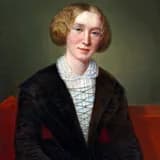
George Eliot died in London on 22 December 1880, at age 61, closing a major career in Victorian fiction.
George Eliot, born Mary Ann Evans, died in London on 22 December 1880 at the age of 61. Her death came just months after her marriage to John Walter Cross, a man twenty years her junior, following the earlier death of her long-time partner George Henry Lewes in 1878.
By the time of her death, Eliot was widely regarded as one of the greatest novelists of the Victorian age, and indeed one of the greatest novelists in the English language. Her body of work, from Scenes of Clerical Life through Middlemarch and Daniel Deronda, had established new standards for psychological realism, moral complexity, and intellectual seriousness in fiction, and had done so despite the significant social barriers she faced as a woman writer, including years of controversy over her unmarried domestic partnership with Lewes.
Because of the perceived irregularity of her personal life, Eliot was denied burial in Westminster Abbey's Poets' Corner, and she was instead buried in Highgate Cemetery in London, next to Lewes. It was not until 1980, on the centenary of her death, that a memorial stone was finally placed for her in Westminster Abbey, a belated acknowledgment of her towering literary stature. Her death marked the end of one of the most significant literary careers of the nineteenth century, and her novels continue to be studied, adapted, and celebrated as central achievements of world literature.