← All women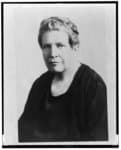
American · Activism · Law · Politics
Florence Kelley
September 12, 1859 – February 17, 1932
Early Life and Education
Florence Molthrop Kelley was born on September 12, 1859, in Philadelphia, Pennsylvania, into a family steeped in reform politics. Her father, William D. Kelley, was a prominent U.S. Congressman known as "Pig Iron" Kelley, a founding member of the Republican Party and a fervent abolitionist. Her mother, Caroline Bonsall Kelley, came from a Quaker background that emphasized education and moral seriousness. Growing up amid political debate and reform advocacy, young Florence developed an early consciousness of social injustice; her father reportedly took her on visits to glass factories where she witnessed child laborers working under dangerous conditions, an experience she later credited with shaping her life's purpose.
Chronic childhood illnesses disrupted her formal schooling, but she was an avid reader, educated substantially through her father's extensive library. She enrolled at Cornell University, one of the few institutions then admitting women, and despite interruptions due to illness, graduated in 1882. Her senior thesis on the legal status of children reflected her emerging intellectual focus. Barred from graduate study at the University of Pennsylvania because of her sex, Kelley traveled to Zurich, Switzerland in the early 1880s (having first visited in 1871 as a young girl with formative exposure to European social currents), where the University of Zurich admitted women. There she encountered European socialist thought and a vibrant community of politically engaged women students, experiences that radicalized her politically and intellectually.
Marriage, Socialism, and Return to America
While in Zurich, Kelley met and in 1884 married Lazare Wischnewetzky, a Russian-Polish socialist medical student. That same year, she completed an English translation of Friedrich Engels's The Condition of the Working Class in England in 1844, introducing one of the foundational texts of Marxist social criticism to American and British readers and cementing her reputation as a serious socialist intellectual. The couple moved to New York City, where Kelley bore three children and became active in socialist circles, joining the Socialist Labor Party.
The marriage, however, grew abusive, and by 1891 Kelley had fled with her children to Chicago, taking advantage of Illinois's more favorable divorce laws. This dramatic personal rupture proved pivotal: in Chicago she found refuge and purpose at Hull-House, the pioneering settlement house founded by Jane Addams and Ellen Gates Starr. There Kelley joined a remarkable community of women reformers—including Julia Lathrop, Alice Hamilton, and Ellen Gates Starr—who combined residence among the urban poor with rigorous social investigation and legislative advocacy.
Chicago Years and the Birth of Factory Reform
At Hull-House, Kelley conducted an intensive investigation of Chicago's sweatshop district, documenting wages, ethnicities, and working conditions of the largely immigrant workforce concentrated near the settlement. Her findings, gathered partly under a commission from the Illinois Bureau of Labor Statistics and partly as a special agent for the U.S. Bureau of Labor around the time of the 1893 World's Columbian Exposition, provided empirical ammunition for legislative reform. This research fed directly into Hull-House Maps and Papers, published in book form around March 1895, an influential early work of American urban sociology that combined statistical rigor with reformist purpose.
Kelley's investigations directly informed the landmark Illinois Factory Act of 1893, which limited women's working hours to eight per day and prohibited employment of children under fourteen in most manufacturing—among the first laws of its kind in the United States. In recognition of her expertise and advocacy, Illinois Governor John Peter Altgeld appointed Kelley as Chief Factory Inspector of Illinois on June 22, 1893, making her the first woman in American history to hold a state factory inspector post. She led a staff of a dozen deputy inspectors, several of them women, and pursued vigorous enforcement against manufacturers who resisted the new labor standards, weathering legal challenges including a state supreme court ruling that struck down the hours provision for adult women.
To strengthen her ability to fight these legal battles, Kelley enrolled at Northwestern University Law School, earning her law degree in 1894—one of relatively few women lawyers of her era. Her combination of empirical social science, legal training, and administrative experience made her uniquely equipped for the reform work that would define the remainder of her career.
Leadership of the National Consumers League
Following the change in Illinois's political administration in 1897, which cost her the factory inspectorship, Kelley relocated to New York City, taking up residence at the Henry Street Settlement under Lillian Wald. In 1899, Kelley helped organize the National Consumers League (NCL), a national organization emerging from local consumer leagues that had pioneered "White Label" campaigns certifying goods manufactured under fair labor conditions. On December 15, 1899, Kelley was named the NCL's first general secretary, a position she held until her death in 1932.
Under her leadership, the NCL became the nation's most influential clearinghouse for labor reform legislation, drafting model minimum-wage and maximum-hour laws that were adopted by dozens of states. Kelley traveled extensively, delivering thousands of lectures, and built coalitions among middle-class consumers, labor unions, and women's clubs, pioneering the strategic use of consumer purchasing power as a lever for industrial reform.
Kelley's rigorous approach to using social-scientific data in legal advocacy reached a pinnacle in 1908, when she and Josephine Goldmark assisted attorney (later Supreme Court Justice) Louis Brandeis in preparing the famous "Brandeis Brief" for Muller v. Oregon. This brief, which relied heavily on sociological and medical data rather than purely legal precedent to argue for maximum-hour laws for women workers, revolutionized American legal argumentation and established a template still used in constitutional litigation today. The Supreme Court's favorable ruling upheld Oregon's ten-hour law for women and validated the strategy. Kelley and allied reformers built on this victory in 1917 with Bunting v. Oregon, in which the Supreme Court upheld maximum-hour legislation extending to factory work more broadly, including men.
Federal Advocacy and the Children's Bureau
Kelley's activism increasingly targeted the federal government. She was a key strategist in the campaign that led to the creation of the United States Children's Bureau, established by Congress on April 9, 1912—the first federal agency in American history dedicated to children's welfare. Kelley's close colleague and fellow Hull-House alumna Julia Lathrop became its first chief.
Kelley also lobbied vigorously for federal child labor legislation, helping secure passage of the Keating-Owen Child Labor Act of 1916, which restricted interstate commerce in goods produced using child labor, though the Supreme Court struck it down in 1918 as an unconstitutional exercise of federal commerce power. Undeterred, Kelley continued campaigning for federal child labor and maternal health protections throughout the 1920s.
Her most significant legislative achievement of this later period was the Sheppard-Towner Maternity and Infancy Protection Act, signed into law on November 23, 1921—the first federal grant-in-aid program dedicated to maternal and child health. Passed shortly after women gained the vote nationally through the Nineteenth Amendment, the Act reflected legislators' new political calculus regarding women voters and represented the culmination of years of Kelley's advocacy using Children's Bureau data on infant and maternal mortality. Though the Act lapsed in 1929 amid conservative and medical-establishment opposition, it established crucial precedents later embedded in the Social Security Act of 1935.
Civil Rights and Broader Activism
Kelley's reform vision extended beyond labor and child welfare to civil rights. On February 12, 1909—the centennial of Abraham Lincoln's birth—she joined W.E.B. Du Bois, Jane Addams, Mary White Ovington, and other reformers in founding the National Association for the Advancement of Colored People (NAACP), reflecting her belief that labor justice and racial justice were intertwined causes. She also supported the Pure Food and Drug Act, signed into law on June 30, 1906, which the NCL had campaigned for as an extension of consumer protection principles.
Kelley's outspoken socialism and uncompromising advocacy made her a target of conservative suspicion throughout her career. In 1923, an FBI report characterized her, then 64 years old, as a "radical," reflecting the broader Red Scare-era surveillance of left-leaning reformers, feminists, and pacifists, many of whom (including Kelley) were falsely linked in the notorious "Spider Web Chart" alleging a Bolshevik conspiracy among women's organizations.
Personal Life
Kelley's marriage to Lazare Wischnewetzky ended after years of abuse; she resumed her maiden name and, drawing on Illinois's comparatively liberal divorce laws, obtained a divorce and raised her three children—Nicholas, Margaret, and John—largely as a single mother while building her reform career. She never remarried, dedicating her life fully to her activism and to the network of women reformers, many unmarried or divorced, who staffed the settlement house and consumer league movements. This "Hull-House network" of professional women became one of the most influential informal policy communities in American history, shaping labor law, public health, and social welfare policy for decades.
Legacy and Death
Florence Kelley died on February 17, 1932, in Philadelphia, at age 72, still serving as general secretary of the National Consumers League. Supreme Court Justice Felix Frankfurter, a close collaborator, eulogized her as one of the most effective social reformers of her era. Kelley did not live to see the full fruition of her life's work, but within a few years many of her core demands—minimum wage laws, restrictions on child labor, and federal maternal and child welfare programs—were enshrined in New Deal legislation, including the Social Security Act of 1935 and the Fair Labor Standards Act of 1938.
Kelley's legacy endures as one of the most consequential in American social and labor policy history. She helped invent the modern practice of using social-scientific evidence in legislative and legal advocacy, pioneered women's entry into public regulatory administration, and built durable institutions—chiefly the National Consumers League—that carried reform momentum across generations. Modern institutions, including Northwestern University's Florence Kelley Project and numerous scholarly biographies, continue to study her as a central architect of the American welfare state.
Dated achievements
9 indexed.
- Sep121859Science
Birth of Florence Kelley
Florence Kelley born in Philadelphia into a politically active, reform-minded family.
View details Florence Kelley - Wikipedia - Jun221893Law
Appointed first woman state factory inspector in the United States
Illinois Gov. John Peter Altgeld appointed Kelley as Chief Factory Inspector, the first woman to hold such a post in U.S. history.