← All women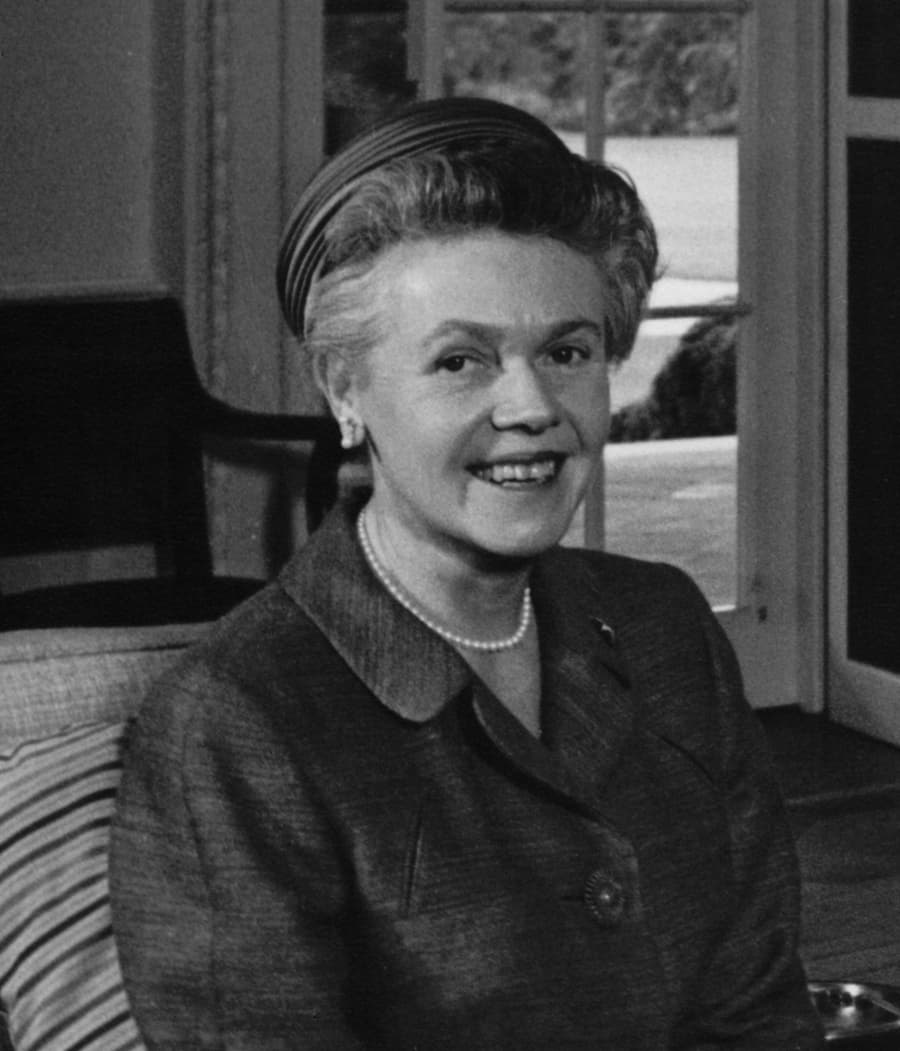
American · Politics
Eugenie Anderson
July 26, 1909 – April 2, 1997
Early Life and Background
Helen Eugenie Moore Anderson, widely known as Eugenie Anderson, was a groundbreaking American diplomat whose career profoundly reshaped expectations for women in foreign policy. She was born in Adair, Iowa, in 1909, the daughter of a Methodist minister, Rev. Ezekial A. Moore, and his wife, FloraBelle.[16][1] Growing up in a small Midwestern town in a deeply religious household, she absorbed values of service, public speaking, and moral responsibility that later informed her political and diplomatic style.
From an early age, Anderson showed a strong aptitude for music. Biographical accounts note that she studied at several institutions, including Stephens College in Columbia, Missouri, Simpson College in Indianola, Iowa, and Carleton College in Northfield, Minnesota.[4][10] She later continued her musical training in New York City at the Institute of Musical Art, which would become the Juilliard School.[2][13] Her original ambition was to become a concert pianist, and she focused on music as a student, indicating that her path to diplomacy was not straightforward but forged through evolving interests and political engagement.
Her liberal arts education also exposed her to philosophy and public affairs. Anderson’s granddaughter has described how she studied music and philosophy at multiple colleges, laying a foundation for the analytical skills and cultural sensitivity that characterized her later diplomatic work.[10] This combination of artistic training and intellectual curiosity helped her develop poise, discipline, and an ability to communicate across cultural boundaries.
Marriage, Family, and Move into Public Life
In 1929, Anderson transferred to Carleton College, where she met John Pierce Anderson, an aspiring artist from Red Wing, Minnesota.[4][10] Their shared interests in the arts and ideas forged a strong bond. They married around 1930 and moved to New York City, where John pursued his art career and Eugenie continued her musical studies at the Institute of Musical Art.[4][2] The couple eventually had two children, Hans and Johanna, and later settled in Red Wing, Minnesota.[2][10]
During the 1930s, Anderson’s focus began to shift from music to public affairs. The economic hardships of the Great Depression and the rise of fascism in Europe spurred her interest in politics and international issues. Living in Minnesota, she increasingly engaged in local discussions on social justice, democracy, and peace, drawing on her experience in public speaking and her capacity to analyze complex problems.[11][9]
Her marriage was both a personal partnership and a political alliance. John Anderson’s artistry and support allowed Eugenie to travel and speak, while she brought intellectual rigor and organizational energy to their shared public life. Their home in Red Wing became a hub for political conversation and planning in the region.[10]
Career Beginnings in Minnesota Politics
Anderson’s entry into formal politics came through the dynamic world of mid‑twentieth‑century Minnesota. She became deeply involved in efforts to organize progressive forces, helping to create the Democratic–Farmer–Labor (DFL) Party in 1944.[9][11] This merger of the Minnesota Democratic Party with the Farmer–Labor Party aimed to unify liberal and labor constituencies under one banner. Anderson worked closely with figures such as Hubert H. Humphrey, whose political career she strongly supported.
Within the DFL, Anderson developed a reputation as a skilled strategist and persuasive speaker. Accounts from Minnesota political history describe how she “held her own in smoke‑filled rooms,” engaging in policy debates and organizational decisions typically dominated by men.[12] She studied issues in depth—civil rights, foreign policy, and economic reform—and presented them in accessible language to grassroots audiences.
Her activism extended beyond party structures. Anderson spoke on radio programs, addressed civic groups, and wrote on the dangers of totalitarianism and the importance of democratic engagement. A later University of Minnesota project, "Women on the Air," highlighted her role as an early female voice using broadcast media to reach the public and advocate for diplomacy and civic participation.[14] Through these efforts, she built a profile as an informed and articulate citizen‑politician, even though she did not hold elected office.
Appointment as Ambassador to Denmark: Breaking the Ambassadorial Barrier
Anderson’s political work in Minnesota drew national attention, especially within the Truman administration. In October 1949, President Harry S. Truman nominated her as United States ambassador to Denmark, making her the first woman in U.S. history nominated to ambassadorial rank.[1][16] The New York Times reported the nomination under the headline "Woman Nominated as U.S. Ambassador," stressing the novelty of a woman being chosen to head an American mission abroad.[0]
On October 24, 1949, the Senate confirmed her appointment, formally establishing Anderson as the first American woman ambassador.[3][4] This confirmation overcame deeply rooted skepticism about women’s suitability for high diplomatic office. Many senior State Department posts were still reserved for male career officers, and the idea of a woman chief of mission raised questions among some legislators and officials. Truman, however, publicly defended her nomination, pointing to her political experience and understanding of European affairs.[11]
By late October 1949, Anderson had taken up her duties in Copenhagen, serving as Ambassador Extraordinary and Plenipotentiary.[3][4] She arrived at a crucial moment in European reconstruction and the consolidation of the North Atlantic alliance. Her portfolio included issues related to the Marshall Plan, NATO cooperation, and the strengthening of democratic institutions in Denmark.
Diplomatic Work in Denmark
As ambassador, Anderson quickly distinguished herself by her energetic and accessible style. She engaged not only with Danish officials but also with ordinary citizens, traveling widely across the country, speaking in Danish, and explaining American policies in town halls and public meetings.[4][11] She described her approach as "people’s diplomacy," emphasizing direct contact between diplomats and the populations they served.[6][3]
One of her most notable achievements in Denmark was her role in negotiating and signing a trade and navigation agreement—often referred to as a treaty of commerce and friendship—between the United States and Denmark in 1951.[6][10] In signing this treaty on behalf of the U.S., Anderson became the first American woman to sign a treaty in an official diplomatic capacity.[6][3] This act symbolized a new level of trust placed in women diplomats: she was not only representing the United States but also legally binding the nation in international law.
During her tenure, Anderson also served as the U.S. representative to the third session of the United Nations Ad Hoc Commission on Prisoners of War in August 1952, extending her work into multilateral humanitarian issues.[4] The commission addressed complex questions about the treatment and repatriation of prisoners in the postwar and Korean War context, indicating that Anderson was entrusted with sensitive negotiations with global implications.
Her ambassadorship to Denmark lasted until early 1953, and she left a legacy of strong U.S.–Danish relations and an example of effective female leadership in a top diplomatic post. Danish and American sources emphasize the respect she commanded from Danish officials and the fondness with which many citizens remembered her accessible manner.[4][7]
Minister to Bulgaria: First Woman Chief of Mission in a Soviet Bloc Country
In 1962, President John F. Kennedy appointed Anderson as U.S. minister to Bulgaria, making her the first American woman to head a diplomatic mission in a Soviet bloc country.[3][4][8] Although the title "minister" rather than "ambassador" reflected the legation status of the mission, she was nonetheless the chief of mission, responsible for all U.S. activities and staff in Sofia.
Her posting placed her behind the Iron Curtain at a time when the Cold War was intensifying. Bulgaria was a loyal ally of the Soviet Union, and diplomatic work there required navigating strict state control, pervasive surveillance, and deep ideological suspicion. Anderson’s assignment demonstrated that the U.S. government believed a woman could handle one of the more challenging and politically sensitive posts in Europe.[3]
During her tenure from 1962 until December 1964, Anderson dealt with issues including trade, cultural exchanges, and the welfare of U.S. citizens and staff under a repressive regime.[4][7] She also worked to maintain lines of communication that could be useful in managing broader East–West tensions. Reports from this period underscore her professionalism and persistence in an environment where progress was incremental and often constrained by larger geopolitical realities.
Her service in Bulgaria further expanded the geographic and strategic range of women’s diplomatic leadership. It showed that women could be effective chiefs of mission even in hostile contexts, weakening arguments that they should be confined to "safer" or more ceremonial postings.
United Nations Work and the Security Council First
After returning from Bulgaria, Anderson continued her international career on a global stage. In 1965, President Lyndon B. Johnson appointed her as a U.S. delegate to the United Nations.[3][6] In that role, she became the first woman to represent the United States on the U.N. Security Council, the body responsible for decisions on international peace and security.[6][8]
Anderson served as a UN delegate through 1968, participating in debates and decisions during a period marked by decolonization, regional conflicts, and ongoing Cold War disputes.[10][3] Her work included advocating for cooperative approaches to conflict resolution and supporting peacekeeping and diplomatic initiatives that aligned with her long‑standing commitment to peace.
Being the first U.S. woman on the Security Council was a milestone in both American and UN history. The Council had long been dominated by male representatives from the major powers, and Anderson’s presence signaled that the United States was willing to entrust a woman with the highest level of multilateral responsibility. Her role helped normalize women’s participation in global security discussions and provided a precedent for later female representatives and ambassadors to the UN.[6][8]
Major Works, Ideas, and Diplomatic Style
Anderson did not produce academic treatises or theoretical works in the way some foreign policy thinkers did, but her career embodied a distinctive diplomatic philosophy she called "people’s diplomacy".[6] She believed that diplomats should engage directly with citizens, not just elites, and that mutual understanding among peoples was as important as formal negotiations among governments.
In Denmark, Bulgaria, and at the UN, she frequently spoke in accessible language, traveled outside capital cities, and used media such as radio to reach broader audiences.[14] She emphasized the human dimensions of policy—how decisions affected everyday lives—and advocated for diplomacy as a means of preventing conflict and promoting peace.
Her ideas and practice helped shift perceptions of diplomacy away from an exclusively elite, male, and secretive activity toward a more inclusive, publicly accountable, and human‑centered endeavor. This orientation resonated with the post–World War II growth of public diplomacy, cultural exchanges, and international broadcasting as tools of foreign policy.
Awards, Honors, and Recognition
Throughout her career, Anderson received significant recognition, although some records emphasize her groundbreaking posts more than formal awards. She is consistently cited as:
- The first American woman ambassador, appointed to Denmark in 1949.[3][4][11]
- The first American woman to sign a treaty on behalf of the United States, with the 1951 trade and navigation agreement with Denmark.[6][10]
- The first American woman to head a diplomatic mission in a Soviet bloc country, as U.S. minister to Bulgaria in 1962.[3][4]
- The first woman to represent the United States on the U.N. Security Council, beginning in 1965.[6][8]
These "firsts" are themselves a form of recognition: her appointments and responsibilities acknowledged her competence and leadership at a time when systemic barriers still limited women’s roles.
Her legacy has been further honored in historical writings, documentary projects, and the biography "Mrs. Ambassador: The Life and Politics of Eugenie Anderson", published by the Minnesota Historical Society Press.[5] The U.S. embassies and official U.S. government sites have profiled her as "America’s First Madam Ambassador," underscoring her role as a trailblazer in diplomatic history.[3][4]
Personal Life and Relationships
Despite the demands of her career, Anderson remained deeply connected to her family. She and John Anderson raised two children, Hans and Johanna, and maintained their home base in Red Wing, Minnesota, even as she traveled for diplomatic work.[2][10] Family accounts emphasize her ability to balance motherhood with political and diplomatic responsibilities, reflecting the additional burdens placed on women who pursued professional careers in mid‑century America.
Her relationship with John was characterized in biographical accounts as supportive and egalitarian. He continued his work as an artist while she embarked on diplomatic missions, and he was often described as proud of her achievements. Their partnership helped counter stereotypes that a woman’s public success would necessarily undermine her marriage.
Anderson also cultivated strong political relationships, most notably with Hubert H. Humphrey, who became a U.S. senator and later Vice President. She served as an adviser and ally, contributing to the broader liberal agenda in domestic and foreign policy.[9][11] These networks amplified her influence far beyond the formal positions she held.
Legacy and Historical Impact
Eugenie Anderson’s legacy lies primarily in the barriers she broke and the example she set. As the first American woman ambassador, she demonstrated that women could hold and effectively exercise the highest diplomatic rank.[3][4][11] Her treaty‑signing, leadership in a Soviet bloc mission, and service on the U.N. Security Council each extended the domains in which women could participate in high‑level international decision‑making.
Her career contributed to a gradual shift in institutional attitudes within the State Department and the broader U.S. foreign policy establishment. While change was slow and uneven, the fact that she had successfully served in Denmark, Bulgaria, and the UN made it harder to argue that women were inherently unsuited to such roles. Later generations of women ambassadors, including those profiled in contemporary State Department and ShareAmerica publications, have cited Anderson as an early model of female diplomatic leadership.[6][3]
Beyond gender, Anderson influenced the practice of diplomacy through her emphasis on "people’s diplomacy." Her insistence on direct engagement with citizens, public education about foreign policy, and humane treatment of issues such as prisoners of war anticipated later developments in public diplomacy and human rights–oriented foreign policy.[6][4]
Her story continues to be told in historical articles, museum initiatives, and educational projects. MNopedia, MinnPost, the Minnesota Lawyer, and university media projects have highlighted her contributions to Minnesota politics and international diplomacy, ensuring that her name remains prominent in regional and national memory.[16][11][12][14]
Later Life and Death
After her formal diplomatic service concluded in the late 1960s, Anderson remained active in public affairs. She continued to speak on foreign policy, peace, and women’s participation in politics, and she was frequently consulted as an informal adviser by political figures and journalists.[10][11] She also devoted time to her family and community in Red Wing.
On April 2, 1997, Anderson died in Red Wing, Minnesota, at the age of 87.[0][16] Obituaries emphasized her status as a trailblazer—the first American woman ambassador, the first U.S. woman to sign a treaty, the first woman chief of mission in a Soviet bloc country, and the first woman to represent the United States on the Security Council.[0][8]
Her death marked the end of a life that had spanned the era from pre–women’s suffrage America through the Cold War and into the post–Cold War world. Yet her influence has persisted. Diplomatic historians, women’s studies scholars, and public institutions continue to draw on her example to illustrate how individual determination and political skill can open institutions to those previously excluded.
Today, Anderson is remembered not only as a "first" but as a competent and creative diplomat. Her career demonstrates that women’s inclusion in high diplomatic office is not merely symbolic; it can enhance the substance and reach of foreign policy. In the broader narrative of women’s history, she occupies a central place among the pioneers who pushed open the doors of international politics for future generations.
Dated achievements
10 indexed.
- Jul261909Politics
Birth of Helen Eugenie Moore Anderson in Adair, Iowa
Helen Eugenie Moore Anderson was born in Adair, Iowa, on July 26, 1909, to a Methodist minister’s family, beginning the life of a future trailblazing U.S. diplomat.
View details MNopedia – Anderson, Helen Eugenie Moore (1909–1997) - Oct121949