← All women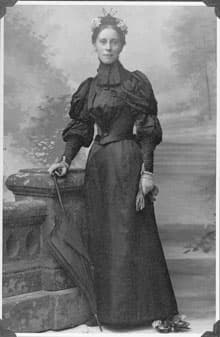
British · Exploration · Literature · Science
Mary Kingsley
October 13, 1862 – June 3, 1900
Early Life and Background
Mary Henrietta Kingsley was born on 13 October 1862 in Islington, London, into a family already marked by intellectual distinction. Her father, Dr. George Kingsley, was a physician who spent much of his career traveling the world as a personal doctor and companion to wealthy aristocrats, giving him firsthand experience of foreign lands that he shared with his daughter through letters and stories. Her uncle was the celebrated novelist and clergyman Charles Kingsley, author of The Water-Babies and Westward Ho!, and her cousin was the novelist Henry Kingsley. Mary's mother, Mary Bailey, suffered from chronic ill health for most of Mary's childhood and adolescence.
In a pattern typical of Victorian gender expectations, Mary's younger brother Charles was sent to Cambridge University while Mary received no formal schooling. She later remarked that she had received only a few German lessons so that she could translate scientific texts for her father. However, she was given unrestricted access to her father's substantial personal library, filled with volumes on natural history, science, geography, and travel. She read voraciously and largely self-taught herself in scientific method, comparative anatomy, and ethnography—skills that would later distinguish her from typical travel writers of her era.
Throughout her twenties and early thirties, Mary's life was almost entirely consumed by domestic duty: she nursed her invalid mother and managed the household. She had little opportunity for social life, travel, or personal ambition during this period. This confinement, however painful, gave her time to develop a formidable intellectual foundation entirely through self-directed reading.
The Turning Point: Freedom and First Journey
The pivotal moment in Kingsley's life came in 1892, when both her parents died within a few months of each other—her father in February and her mother shortly after. At age thirty, unmarried and now independently placed (though not wealthy), Kingsley found herself, for the first time, free of caregiving obligations and social constraints that had defined her life. Rather than settle into the expected role of a spinster aunt or companion, she resolved to travel, driven by a desire to complete research her father had begun on "Africana"—comparative studies of religion and law among indigenous peoples—and by her own long-simmering fascination with the natural world.
In August 1893, defying convention and the concerns of friends and family, Kingsley sailed for West Africa aboard a cargo steamer, the Lagos. She traveled without European companions, a striking and dangerous choice for a single woman in that era, relying instead on the practical knowledge of ship captains, traders, and missionaries she met en route. Her stated purpose was to study "fetish" religious practices and collect specimens of fish and insects for the British Museum of Natural History, but her journey rapidly became a broader ethnographic and exploratory undertaking.
Major Expeditions and Discoveries
Kingsley's first expedition took her through Sierra Leone, the Gold Coast (modern Ghana), Nigeria, and Angola. She adopted local modes of travel and trade, learning to navigate rivers by canoe and bartering goods such as cloth, tobacco, and fishhooks with local communities, in stark contrast to the segregated and paternalistic norms practiced by most European colonial officials and missionaries. She stayed in African villages, ate local food, and observed customs with what she described as a scientific rather than moralizing eye.
Her second and more ambitious expedition began in late 1894 and continued through 1895. Traveling into the French Congo, she journeyed up the Ogooué River, becoming one of very few Europeans—and virtually the only European woman—to travel extensively among the Fang people, who were widely rumored among Europeans to practice cannibalism. Kingsley approached this reputation with characteristic empirical curiosity rather than sensationalism, documenting funerary and ritual practices with unusual care and nuance for her time.
During this second journey, Kingsley achieved one of her most celebrated feats: she became the first woman, and one of the first Europeans of any gender, to climb Mount Cameroon via its unexplored southeast face, reaching the summit in 1895. She undertook this climb, like all her travels, in traditional Victorian dress—heavy skirts and blouses—famously noting that her thick skirts once saved her from serious injury when she fell into a covered game pit and was cushioned by her voluminous clothing.
Throughout her travels, Kingsley collected numerous specimens for the British Museum, including previously undocumented species of freshwater fish. Several species were subsequently named in her honor by the ichthyologist Albert Günther, including Ctenopoma kingsleyae and other taxa bearing the epithet "kingsleyae." Her contributions to natural history collection were substantial enough to earn her serious respect among scientific institutions, despite her lack of formal training.
Literary Career and Public Influence
Kingsley's 1897 book, Travels in West Africa: Congo Français, Corisco and Cameroons, transformed her into a public figure. The book combined vivid adventure narrative with serious ethnographic observation, written in a distinctive voice that mixed self-deprecating humor with sharp intellectual argument. It became an immediate bestseller in Britain and was widely reviewed and discussed.
The book's most controversial and influential aspect was its critique of missionary approaches to Africa. Kingsley argued that European missionaries often did more harm than good by attempting to impose Christian and Western values on African societies without understanding their existing social, legal, and religious structures. She contended that traditional African systems of law, religion, and governance—which she had observed firsthand—were coherent, functional, and deserving of serious study rather than eradication. This stance put her at odds with powerful missionary societies but earned her admiration among anthropologists, geographers, and colonial administrators interested in more "informed" governance.
She followed this success with a second book, West African Studies (1899), which delved further into ethnographic analysis, trade policy critique, and practical recommendations for British colonial administration in West Africa, including controversial arguments in favor of local self-governance structures and against certain forms of direct taxation imposed by colonial powers.
Kingsley became a popular and sought-after public lecturer, speaking to institutions including the Liverpool Chamber of Commerce, the Scottish Geographical Society, and various learned societies across Britain. Notably, the Royal Geographical Society, which did not admit women as full fellows until 1913, never formally recognized her membership despite her achievements—though she was invited to lecture and her work was taken seriously by many of its members. This exclusion exemplifies the institutional barriers facing women explorers and scientists of the era, even those, like Kingsley, whose fieldwork rivaled or exceeded that of male contemporaries.
Views on Colonialism and Feminism
Kingsley held complex and sometimes contradictory views by modern standards. She was a fierce critic of certain colonial policies and missionary paternalism, and she respected many aspects of African culture and governance, but she was not an anti-colonialist in the modern sense; she generally supported British trade interests in Africa and did not advocate for African political independence. She also famously distanced herself from the contemporary feminist movement, describing herself as no "New Woman" and expressing skepticism about suffrage activism, even as her own life and work embodied radical departures from Victorian gender norms. This tension has made her a subject of ongoing historical debate among scholars of gender, empire, and race.
Later Life, Boer War Service, and Death
After her second African expedition, Kingsley remained a prominent public figure in Britain, continuing to write, lecture, and advise on African affairs. When the Second Boer War broke out in 1899, Kingsley volunteered to travel to South Africa to nurse Boer prisoners of war, arriving in early 1900. She worked at a hospital for Boer POWs in Simon's Town, near Cape Town, tending to the sick and wounded despite the risks of infectious disease in the crowded camp conditions.
She contracted typhoid fever while nursing patients and died on 3 June 1900, at the age of thirty-seven. In accordance with her explicit wishes, she was buried at sea off Simon's Town, an unusual honor arranged with the assistance of British naval authorities. Her sudden death cut short a career many believed was only beginning to reach its full potential; she left behind an unfinished manuscript concerning Islamic populations in West Africa.
Legacy
Mary Kingsley's legacy endures on multiple fronts. She is remembered as one of the pioneering women explorers of the Victorian era, having undertaken solo expeditions into regions of West and Central Africa that few Europeans, male or female, had penetrated. Her scientific contributions, including numerous species collected and later classified, secured her a lasting, if modest, place in the history of zoology and ichthyology.
Her writings remain foundational texts in the history of travel literature and early ethnography, valued both for their vivid narrative style and for their comparatively respectful, non-missionary engagement with African societies—though modern scholars note the persistent colonial-era assumptions embedded in her work. In 1901, the African Society (later renamed the Royal African Society) was founded in London partly in tribute to her memory and her contributions to the study of Africa; it continues to operate today as a leading institution for African studies.
Kingsley is frequently cited in histories of women's exploration alongside figures such as Isabella Bird and Gertrude Bell, as an example of a woman who used the relative freedoms of widowhood or spinsterhood, combined with sheer force of will and self-education, to break into fields—exploration, natural science, and ethnographic writing—almost entirely closed to women in her time. Numerous plaques, memorials, and scholarly biographies commemorate her today, and her life continues to be studied as an example of the complex intersections between gender, empire, and science in the late Victorian period.
Dated achievements
5 indexed.
- Oct131862Science
Birth of Mary Kingsley in Islington, London
Mary Henrietta Kingsley was born in Islington, London, on 13 October 1862, daughter of physician-traveler George Kingsley.
View details Mary Kingsley - Wikipedia - Aug011893Exploration
First voyage to West Africa
Kingsley departed for her first independent expedition to West Africa in August 1893, beginning her career as an explorer and ethnographer.