← All women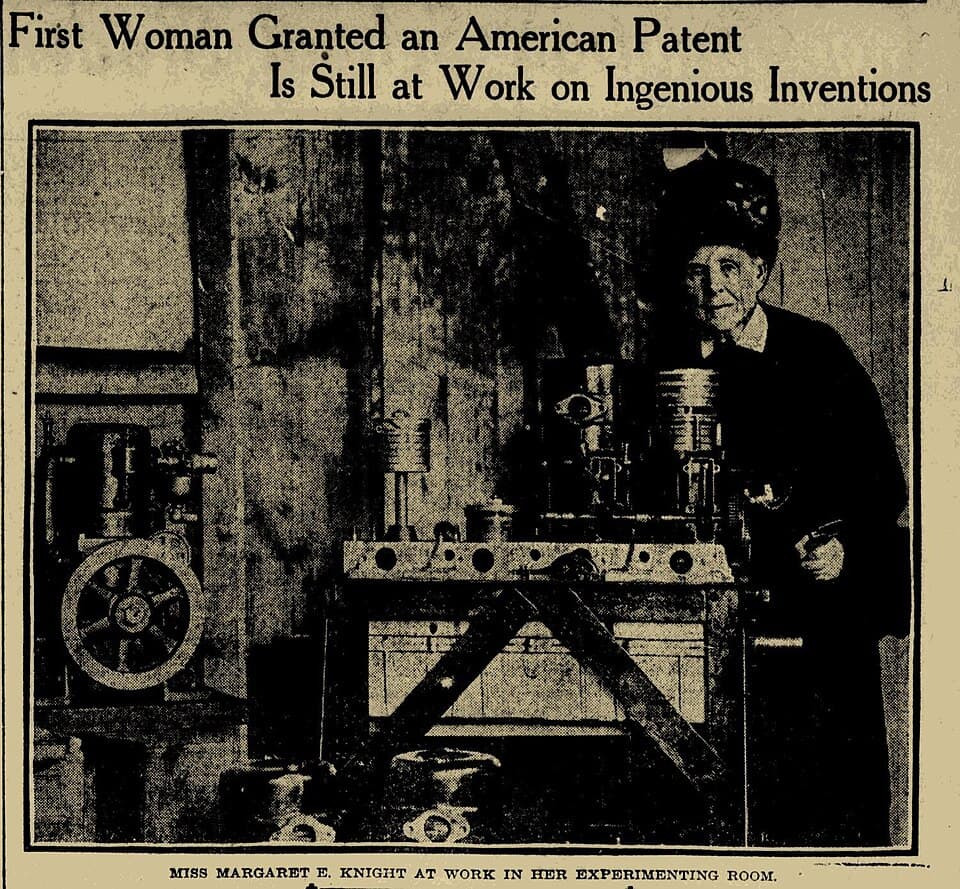
American · Science
Margaret E Knight
February 14, 1838 – October 12, 1914
Margaret Eloise Knight (February 14, 1838 – October 12, 1914) was one of the most prolific and inventive American engineers of the nineteenth century, male or female, holding at least 27 U.S. patents across industries as varied as paper manufacturing, footwear production, window hardware, and automotive engineering. She is best remembered for inventing the machine that produces the flat, square-bottomed paper bags still used in grocery stores today — a landmark invention she was forced to defend in a dramatic patent interference lawsuit against a man who attempted to steal her design.
Early Life and Formative Influences
Knight was born on February 14, 1838, in York, Maine. Her family later moved to Manchester, New Hampshire, a booming textile mill town, following the death of her father. Like many children of working-class families in this era, Margaret received little formal schooling and instead began working in the cotton mills as a child, alongside her brothers.
It was in the mills that Knight's mechanical aptitude first became evident. Around age twelve, she witnessed a serious accident when a steel-tipped shuttle flew out of a loom and struck a worker — an alarmingly common hazard in textile mills of the period. In response, young Margaret devised a simple protective device to prevent shuttles from flying loose. The invention was adopted by mills in the region, improving worker safety for others, though she never patented it and received no financial benefit — an early sign both of her natural engineering talent and of the structural barriers that would follow her throughout her career, as she often failed to fully capitalize financially on her innovations.
Career Beginnings: The Paper Bag Revolution
In 1867, Knight took a job at the Columbia Paper Bag Company in Springfield, Massachusetts. At the time, paper bags were manufactured with a simple envelope-style fold that lacked a flat, stable bottom, making them poorly suited for carrying groceries or other goods. Knight recognized that a mechanized process could produce a far more useful flat-bottomed, or "satchel-bottom," bag — the style still ubiquitous today.
By 1868, she had built a working wooden prototype of a machine capable of automatically cutting, folding, and gluing paper into this flat-bottomed shape. Seeking to have a more durable iron version constructed for her patent application, she contracted with a machine shop — where, unbeknownst to her, a man named Charles Annan observed her design and promptly filed his own patent application for a strikingly similar machine.
Knight filed a patent interference suit against Annan in the fall of 1870, initiating one of the most consequential legal battles fought by a woman inventor in nineteenth-century America. The hearing stretched across sixteen grueling days, at a personal cost to Knight of roughly $100 per day — an enormous sum for a working woman at the time. Annan's legal team argued, remarkably, that a woman could not possibly have possessed the technical understanding required to design such a complex mechanism. Knight countered with meticulous evidence: detailed technical drawings, personal diaries documenting her design process, and witness testimony. She won decisively, and on July 11, 1871, was granted US Patent 116,842 for her flat-bottomed paper bag machine.
The machine was transformative for the packaging industry, performing the work of approximately thirty manual bag-folders and dramatically reducing production costs. Knight went on to co-found the Eastern Paper Bag Company in Hartford, Connecticut (accounts vary as to whether this occurred in 1870 or 1871), to manufacture and license her invention commercially. She continued refining the technology for years afterward, patenting an improved version, US Patent 220,925, on October 28, 1879.
An Earlier Patent and a Pattern of Innovation
Notably, Knight's very first patent predates her famous bag machine: on November 15, 1870, she received US Patent 109,224 for a pneumatic, suction-based paper-feeding machine — technology that fed into her subsequent bag-making innovations. This patent was issued under her full name, Margaret E. Knight, rather than gender-obscuring initials, a small but meaningful marker of visibility for a woman in a field almost entirely dominated by men.
It is worth noting explicitly that Knight was not the first woman to receive a U.S. patent — that distinction belongs to Mary Kies in 1809. However, Knight's sustained, decades-long career as a prolific inventor across multiple unrelated industries remains virtually unmatched among women of her generation.
Diversification: Domestic Goods and Shoe Machinery
Knight's inventive interests were remarkably broad. On August 7, 1883, she patented a dress and skirt protector (US Patent 282,646) jointly with Harriet M. Macfarland, addressing a common practical problem of the era's long skirts dragging through mud and dust. This period of her career shows her engaging with domestic and consumer-oriented inventions alongside her industrial machinery work.
In the early 1890s, Knight turned her attention to the booming shoe manufacturing industry centered in New England. On September 16, 1890, she was granted two sole-cutting machine patents simultaneously (US Patents 436,358 and 436,359), marking the start of a new engineering focus. A few years later, on May 8, 1894, she co-patented a window frame and sash design (US Patent 519,333) with Albert B. Harrington, further demonstrating her willingness to apply mechanical reasoning to entirely new domains.
A Remarkable Late-Career Pivot: Automotive Engineering
Perhaps most extraordinary is the final chapter of Knight's inventive career. Beginning in her mid-sixties — a period when most inventors of her era, particularly women, would have been considered well past their productive years — Knight pivoted into the cutting-edge field of automotive and engine engineering. On December 30, 1902, she patented a compound rotary engine (US Patent 716,903), the first in a series of five rotary engine and motor patents she developed over the following two years: US 717,869 (January 6, 1903), US 720,818 (February 17, 1903), US 730,543 (June 9, 1903), US 758,321 (April 26, 1904), and US 777,832 (December 20, 1904).
She continued this engineering work into her seventies, patenting a resilient wheel design on January 23, 1912 (US Patent 1,015,761), intended to improve shock absorption for the rough, often unpaved roads of the early automotive age. In her final two years of life, she formed an apparent working relationship with the K D Motor Company, which received assignment of her internal-combustion engine patent (US Patent 1,068,781, granted July 29, 1913) and her packing-ring patent (US Patent 1,086,299, granted February 3, 1914) — the latter issued just eight months before her death. Remarkably, a final internal-combustion engine patent, US Patent 1,132,858, was granted posthumously on March 23, 1915, meaning Knight was inventing literally until the end of her life.
Personal Life
Knight never married and had no children, devoting her working life entirely to her inventions and engineering pursuits. Details of her personal relationships are sparse in the historical record, consistent with the limited documentation typically available for working women inventors of her era who did not come from prominent families. She was known to work tirelessly, reportedly spending long hours in workshops and machine shops throughout her adult life, an unusual and sometimes controversial pursuit for a woman of her time.
Recognition, Legend, and Legacy
Popular accounts of Knight's life have sometimes included the claim that she received the "Royal Legion of Honour" from Queen Victoria in 1871. This claim is poorly substantiated and historically dubious — the Legion of Honour is a French, not British, honor, and no reliable documentary evidence supports the story. It should be treated as legend rather than verified fact.
Formal institutional recognition of Knight's contributions came much later. In 2006, she was inducted into the National Inventors Hall of Fame, specifically honoring her 1871 flat-bottomed paper bag machine patent — a fitting, if belated, acknowledgment of an invention that fundamentally shaped modern retail packaging and remains in daily use worldwide more than 150 years later.
Knight's patent model for her improved 1879 bag machine is preserved in the collection of the Smithsonian National Museum of American History, and her story has been featured extensively in modern retrospectives on overlooked women in the history of invention, including a 2024 New York Times "Overlooked" obituary.
Death and Enduring Impact
Margaret Knight died on October 12, 1914, in Framingham, Massachusetts, at the age of 76. At the time of her death, she held at least 27 verified U.S. patents — though a historical marker in Framingham claims 87, a figure unsupported by patent records. She died with relatively modest personal means, having, like many inventors of her era, realized only a fraction of the commercial value her inventions generated for the companies that manufactured and licensed them.
Nevertheless, Knight's legacy endures profoundly in everyday life: the flat-bottomed paper bag she invented remains a global retail staple, and her extraordinary, decades-spanning career — from a child's unpatented mill safety device to automotive engine patents granted in her seventies — stands as a testament to sustained technical brilliance in the face of significant social and economic barriers facing women inventors in nineteenth- and early twentieth-century America. She is remembered today as one of the most versatile and historically significant American inventors of her generation.
Dated achievements
12 indexed.
- Feb141838Science
Birth in York, Maine
Margaret Eloise Knight born in York, Maine, in 1838; later devised a loom safety device as a child mill worker.
View details Margaret E. Knight | Britannica - Nov151870Science
First patent granted: pneumatic paper feeder
US Patent 109,224 for an 'Improvement in Paper-Feeding Machines,' issued under her full name rather than initials.