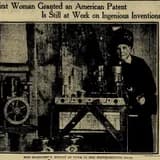
US Patent 716,903, the first in a series of rotary engine and motor patents Knight developed in her sixties.
On December 30, 1902, at 64 years old, Margaret Knight was granted US Patent 716,903 for a compound rotary engine — marking a striking late-career pivot into mechanical and automotive engineering, a field then in its technological infancy. This was the first of what became a sustained series of engine-related patents she developed over the following two years.
Rotary engines of this period represented cutting-edge propulsion technology, sought after for their potential efficiency and smoother operation compared to conventional reciprocating engines. That Knight, then in her seventh decade of life, chose to master this emerging and highly technical field — one dominated almost entirely by male engineers — speaks to her extraordinary intellectual vitality and refusal to be confined by age or gender expectations.
This 1902 patent launched a remarkable five-patent sequence: US 717,869 (January 6, 1903), US 720,818 (February 17, 1903), US 730,543 (June 9, 1903), US 758,321 (April 26, 1904), and US 777,832 (December 20, 1904) — each refining rotary engine and motor designs. This body of work positioned Knight at the forefront of early automotive-era innovation, eventually leading to her association with the K D Motor Company and further internal-combustion engine patents in the final years of her life.