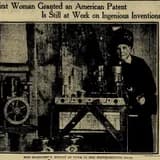
Margaret Knight died at 76 in Framingham, Massachusetts, holding at least 27 patents; a final patent was granted posthumously in 1915.
Margaret Knight died on October 12, 1914, in Framingham, Massachusetts, at the age of 76. At the time of her death, she held at least 27 U.S. patents spanning an extraordinary range of industries: paper-bag manufacturing, domestic goods, shoe machinery, window hardware, and automotive engine technology — a body of work that few inventors of any gender achieved in this era.
Remarkably, her inventive career did not end with her death. A final patent, US 1,132,858, for an internal-combustion engine, was granted posthumously on March 23, 1915, reflecting work she had completed and filed before she died. This posthumous grant stands as a poignant coda to a career that began with an unpatented childhood safety device in a New Hampshire cotton mill and ended with cutting-edge automotive engine technology some six decades later.
Knight died with modest personal wealth, having received relatively little financial reward compared to the commercial value her inventions generated for the companies that licensed and manufactured them — a common fate for inventors, and especially women inventors, of her era. Her legacy was formally recognized nearly a century later, in 2006, when she was inducted into the National Inventors Hall of Fame for her landmark 1871 paper-bag machine patent. She is buried in Framingham, and a historical marker there commemorates her inventive achievements, though its claim of '87 patents' is unsupported by verified patent records.