← All women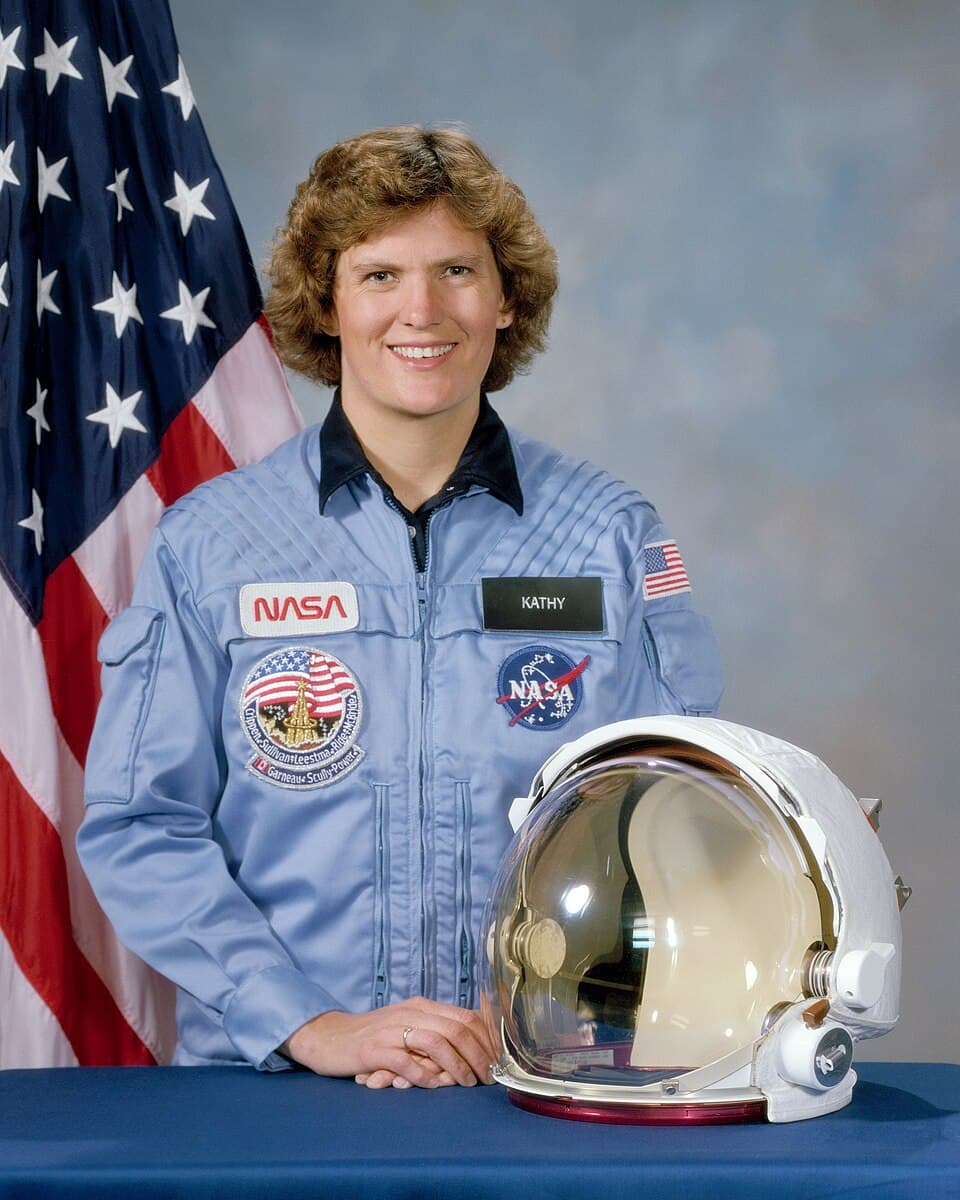
American · Science · Science
Kathryn D. Sullivan
October 3, 1951 – present
Early life and education
Kathryn Dwyer Sullivan was born on October 3, 1951, in Paterson, New Jersey, and grew up in California, where she later identified Woodland Hills as her hometown. Her family and schooling placed her in the orbit of the postwar American education system at a moment when scientific careers for women were still constrained by convention and institutional barriers. Sources describing her early life note her parents as Donald P. Sullivan and Barbara K. Sullivan, and she graduated from William Howard Taft High School in Los Angeles in 1969.
Sullivan attended the University of California, Santa Cruz, where she earned a bachelor’s degree in Earth sciences in 1973. She also spent time as an exchange student at the University of Bergen in Norway, an experience that broadened her international perspective. She later completed a doctorate in geology at Dalhousie University in Halifax, Nova Scotia, in 1978. Her academic training in geology and Earth science would become central to both her astronaut career and her later work in oceanography and public science administration.
Selection by NASA and astronaut training
In 1978, Sullivan was selected as one of the 35 astronaut candidates in NASA’s Astronaut Group 8, the first astronaut class in the agency’s history to include women. This selection was itself historic. NASA had only recently opened its astronaut program to women and minority candidates, and the 1978 class became a defining marker of institutional change in American human spaceflight. Sullivan joined a cohort that included some of the most famous names in the history of women astronauts, and her inclusion reflected both her scientific qualifications and her physical and operational readiness.
NASA’s own retrospective on Sullivan notes that she was part of the barrier-breaking class often nicknamed the “Thirty-Five New Guys.” During training, she also demonstrated advanced aviation capability. On July 1, 1979, she set an unofficial sustained American aviation altitude record for women in a NASA WB-57F reconnaissance aircraft, reaching roughly 63,000 feet during a four-hour flight. The flight underscored the rigorous demands placed on astronaut candidates and positioned Sullivan as a highly capable aviator well before her first spaceflight.
STS-41G and the first American woman to spacewalk
Sullivan’s first mission came with STS-41G, launched on October 5, 1984, aboard Space Shuttle Challenger. The mission was historically important because it was the first American spaceflight to carry two women, with Sullivan flying alongside Sally Ride. In an era when women were still fighting for equal representation in science, engineering, and the military, the image of two women on the same shuttle crew had a powerful cultural effect.
During the mission, on October 11, 1984, Sullivan performed the first spacewalk by an American woman. The extravehicular activity lasted about three and a half hours and took place in the Challenger payload bay. The EVA became one of the most enduring milestones in the history of U.S. spaceflight. It was a visible, high-risk, technically demanding task that had previously symbolized the limits of female participation in the astronaut corps. Sullivan’s successful spacewalk helped prove that women could perform every category of astronaut work expected of their male colleagues.
STS-41G was not simply a symbolic mission. It included scientific and operational tasks that demanded precision, teamwork, and endurance. Sullivan’s performance reinforced the argument that women astronauts were not exceptions to be displayed but professionals capable of handling complex mission responsibilities. The mission’s success helped establish a stronger foundation for women’s future participation in NASA and other space programs.
Deploying Hubble and expanding scientific exploration
Sullivan flew again on STS-31, launched on April 24, 1990, aboard Space Shuttle Discovery. This mission deployed the Hubble Space Telescope into orbit, a transformative event in the history of astronomy. Hubble would go on to produce some of the most important images and observations in modern science, reshaping understanding of the age, structure, and expansion of the universe.
The mission landed on April 29, 1990, at Edwards Air Force Base in California. Sullivan’s role in launching Hubble linked her to one of the most consequential scientific projects of the late twentieth century. It also highlighted the increasingly science-heavy nature of shuttle missions, in which astronauts were expected to operate as both crew members and research specialists.
Her third and final shuttle flight was STS-45, launched on March 24, 1992. Serving as Payload Commander, Sullivan led the first Spacelab mission dedicated to NASA’s Mission to Planet Earth. This mission signaled the growing importance of Earth-observation science and environmental monitoring from space. It also reflected Sullivan’s unusual combination of astronaut experience and Earth-science expertise, placing her at the center of a mission devoted to studying the planet itself.
STS-45 landed on April 2, 1992, completing a scientific flight that demonstrated how shuttle missions could support systematic Earth research. Sullivan’s leadership role was especially significant in women’s history because it showed that female astronauts were not confined to pioneering novelty but were entrusted with mission-command responsibilities in major scientific programs.
NASA career, Navy service, and NOAA leadership
Sullivan left NASA in 1993 after three spaceflights totaling 22 days, 4 hours, and 49 minutes in space. Her post-NASA career moved further into science policy and ocean governance. She served in leadership roles at the National Oceanic and Atmospheric Administration, including as chief scientist and later as Administrator of NOAA and Under Secretary of Commerce for Oceans and Atmosphere. Senate confirmation for that post came on March 6, 2014.
Biographical sources also note her service as an officer in the U.S. Navy Reserve, where she held the rank of captain. Sullivan’s professional life therefore bridged military service, astronautics, and ocean science—three domains in which women had historically faced substantial barriers. Her career trajectory illustrates the growing permeability of those barriers in the late twentieth and early twenty-first centuries.
Challenger Deep and exploration across extremes
On June 7, 2020, Sullivan descended to the bottom of the Challenger Deep in the Mariana Trench aboard the deep-submergence vehicle Limiting Factor. This made her the first woman to reach the deepest known point in the oceans and the first person to have been both in space and at Challenger Deep. The achievement linked outer space and the ocean’s greatest depth in a single career, symbolizing a lifetime of exploration at the edges of human capability.
The dive also reinforced Sullivan’s standing as a public scientist whose work spans disciplines. Her earlier career had already connected geology, spaceflight, and Earth-observation science; the Mariana Trench dive extended that pattern into one of the last great physical frontiers on Earth. It was widely recognized as one of the most striking late-career feats by any astronaut-scientist and a powerful statement about women’s continuing presence at the frontier of exploration.
Honors, recognition, and public legacy
Sullivan’s achievements brought numerous honors and lasting recognition. She was inducted into the U.S. Astronaut Hall of Fame in 2004. She has also been celebrated in institutional histories and educational materials from NASA, the Smithsonian, the American Academy of Arts and Sciences, and other organizations. These tributes emphasize not only her status as the first American woman to walk in space but also her contribution to mission science and public understanding of exploration.
Her legacy in women’s history rests on the accumulation of firsts rather than a single headline moment. She was part of NASA’s first mixed-gender astronaut class; she flew on the first shuttle mission to include two women; she became the first American woman to spacewalk; she helped deploy Hubble; she commanded a major Earth-science shuttle payload; and decades later she reached Challenger Deep. Together, these milestones show a career that repeatedly expanded the boundaries of what women could do in science, exploration, and public service.
Personal life and later years
Publicly available biographies focus more on Sullivan’s professional accomplishments than on private life. What is clear is that she remained active well after NASA, moving into science leadership, ocean policy, and historical preservation of aerospace heritage. She has also appeared in educational and documentary settings, helping explain the historical significance of women’s progress in human spaceflight.
Sullivan’s later life has continued to reflect her lifelong identity as both a scientist and an explorer. Rather than retiring into obscurity after NASA, she used her expertise in Earth science and public administration to shape national ocean policy, while also becoming a widely recognized historical figure in the story of women’s advancement in STEM. Her career remains notable for the way it fused technical excellence, institutional leadership, and barrier-breaking visibility.
Dated achievements
10 indexed.
- Oct031951Exploration
Birth of Kathryn D. Sullivan
Kathryn Dwyer Sullivan was born in Paterson, New Jersey, USA.
View details Kathryn D. Sullivan - Wikipedia - Jul011979Aviation
Sets unofficial American women's aviation altitude record
During astronaut training, Sullivan reached 63,000 feet in a NASA WB-57F, an unofficial sustained U.S. women's altitude record.