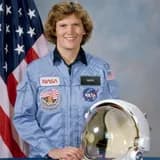
Sullivan flew on Discovery's STS-31 mission, helping deploy the Hubble Space Telescope into Earth orbit.
On April 24, 1990, Kathryn Sullivan launched on her second spaceflight aboard Space Shuttle Discovery, mission STS-31, lifting off from Kennedy Space Center.
The primary objective of this mission was the deployment of the Hubble Space Telescope, one of the most consequential scientific instruments ever placed in orbit. As a mission specialist, Sullivan played a direct role in the careful, high-stakes process of releasing the telescope from the shuttle's payload bay into low Earth orbit using the Remote Manipulator System (robotic arm).
Hubble would go on to revolutionize astronomy, providing unprecedented images and data about the universe, from distant galaxies to exoplanets, and fundamentally reshaping humanity's understanding of cosmology. Sullivan's involvement in its successful deployment placed her at the center of one of the most important scientific undertakings of the 20th century.
The mission also involved Sullivan being trained and prepared to perform a contingency spacewalk if the telescope's solar arrays failed to deploy properly, underscoring the criticality of her role as a spacewalk-qualified specialist. Fortunately, deployment went smoothly, and Hubble began its decades-long mission of scientific discovery. Sullivan's work on STS-31 further cemented her reputation as one of NASA's most capable and versatile astronauts, bridging Earth science, spaceflight operations, and hands-on engineering work in orbit.