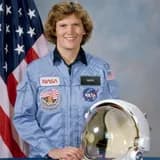
Sullivan became the first American woman to conduct a spacewalk, working for 3.5 hours in Challenger's payload bay during STS-41G.
On October 11, 1984, during the STS-41G mission, Kathryn Sullivan stepped out of Space Shuttle Challenger and became the first American woman to perform a spacewalk (extravehicular activity, or EVA).
Wearing NASA's Extravehicular Mobility Unit (EMU) spacesuit, Sullivan worked in the shuttle's payload bay for approximately three and a half hours, demonstrating a satellite refueling system designed to test techniques for on-orbit servicing of spacecraft—technology that would later prove essential for missions such as repairing the Hubble Space Telescope.
This spacewalk made Sullivan only the second woman ever to walk in space, following Soviet cosmonaut Svetlana Savitskaya by mere months, but the first American woman to do so. At a time when the astronaut corps and the broader aerospace engineering workforce were still overwhelmingly male, this achievement carried enormous symbolic and practical weight—proving that women could perform the same rigorous, physically demanding tasks as their male counterparts in the harsh environment of open space.
Sullivan's spacewalk is widely regarded as one of the pivotal moments in the history of women in STEM and space exploration, inspiring generations of women to pursue careers in aerospace engineering, physics, and astronaut training. It remains one of the signature achievements of her career and a landmark in American space history.