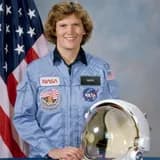
STS-45 landed at Kennedy Space Center, concluding Sullivan's final spaceflight and the first Spacelab Mission to Planet Earth.
On April 2, 1992, Space Shuttle Atlantis landed at Kennedy Space Center in Florida, bringing to a close the STS-45 mission and marking the end of Kathryn Sullivan's spaceflight career.
Over the course of the nine-day mission, the ATLAS-1 payload had gathered an enormous volume of atmospheric and solar data, contributing significantly to scientific understanding of Earth's atmosphere and its interactions with solar radiation—research that would inform later climate science and environmental policy.
With the completion of STS-45, Sullivan concluded a spaceflight career spanning three missions and 22 days, 4 hours, and 49 minutes in space (accumulated across STS-41G, STS-31, and STS-45). She left NASA the following year, in 1993, to take up a position as Chief Scientist of the National Oceanic and Atmospheric Administration (NOAA), continuing her lifelong dedication to Earth and ocean sciences in a new capacity.
The successful conclusion of this mission cemented her legacy as one of the most scientifically accomplished astronauts of her generation, someone whose career seamlessly connected human spaceflight with rigorous Earth science research.