← All women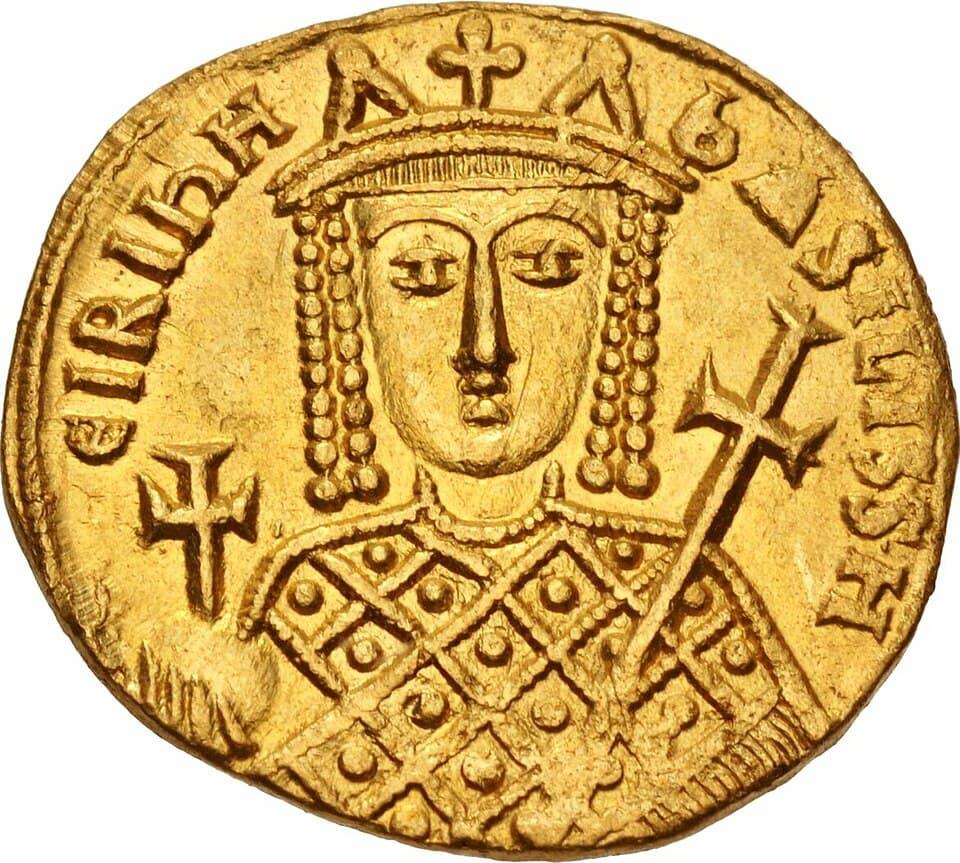
Byzantine, Greek · Politics
Irene of Athens
January 1, 752 – August 9, 803
Early Life and Background
Irene of Athens (Greek: Εἰρήνη, Eirēnē), also known by the surname Sarantapechaena, was born in Athens around 752 into an obscure but noble Greek family.[1][4][10][13] Her exact birth year is uncertain, with sources generally placing it between 750 and 756, but all agree on her Athenian origin and aristocratic status.[1][10] Little is recorded about her parents or childhood, a common omission in Byzantine sources for women, especially before they enter the political stage.
Despite the scarcity of detail, historians infer that Irene would have received an education suitable to a provincial noblewoman of the mid‑eighth century, including literacy, religious instruction, and familiarity with the ceremonial and social expectations of the imperial court.[4][13] At the time, Athens was no longer a major political center, but it retained cultural prestige as a city of classical heritage within the Byzantine world. Irene’s provincial origin meant she stood somewhat apart from the entrenched Constantinopolitan aristocracy, a factor that may have made her both a useful dynastic bride and a more independent political actor later in life.
Irene’s early life unfolded during the height of the first phase of Byzantine iconoclasm, inaugurated by Emperor Leo III and intensified under Constantine V.[5][10][13] The official disfavor or destruction of icons would profoundly shape her later career. While the sources do not explicitly describe her childhood piety, her subsequent policies suggest she grew into a committed iconophile, favoring the veneration of religious images against the dominant court ideology of her youth.
Marriage to Leo IV and Entry into Imperial Politics
Irene’s life changed dramatically when she was selected as bride for the heir to the throne. Emperor Constantine V, continuing the Isaurian dynasty, chose her to marry his son Leo IV, possibly to strengthen ties with the Greek aristocracy.[1][4] The marriage took place on 14 September 775, and Irene was brought to Constantinople, where she became empress consort
As consort, Irene shared the court of a strongly iconoclast dynasty. Constantine V and Leo IV adhered to policies of suppressing religious images, which clashed with the growing unease among monastic communities and many lay believers.[5][10] Irene, however, appears to have been privately sympathetic to icon veneration. Her personal religious convictions, though not overtly expressed at first, would become central to her political identity once she gained greater authority. The marriage produced one son, Constantine VI, born in 771.[1][4] As the only legitimate male heir, he embodied dynastic continuity. Irene’s status as the emperor’s wife and mother of the heir increased her influence at court, though formal power remained in male hands during Leo IV’s reign. In 775, Constantine V died, and Leo IV ascended the throne with Irene as empress.[1] Leo’s rule combined military campaigns with continued commitment to iconoclasm. He died prematurely in 780, leaving Irene a widow and their son underage.[1][4] This moment opened the door for Irene’s first major political role. After Leo IV’s death in 780, his nine‑year‑old son Constantine VI technically became emperor, but Irene of Athens assumed the regency as empress dowager.[1][5] From 780 to 790, she ruled the empire in her son’s name, exercising de facto control over state affairs.[1][4] Her regency is notable for both internal consolidation and major religious initiatives. Initially, Irene faced opposition from factions loyal to the broader Isaurian family. Some of Leo IV’s half‑brothers, known as the "Caesars," challenged her authority.[1][4] Irene navigated these tensions by cultivating allies among court officials and military leaders and by relying on her capable eunuch ministers, including Staurakios. She successfully suppressed plots and preserved her son’s position, thereby stabilizing imperial succession. Irene’s regency also saw important diplomatic and military actions. She maintained peace with the Abbasid Caliphate for periods, while confronting threats on the empire’s Balkan frontiers.[4][13] Under her rule, Byzantine forces engaged in campaigns against the Slavs and Bulgars, contributing to the gradual reassertion of Byzantine influence in the region, though detailed accounts of these operations vary.[1][5] Crucially, Irene began to reveal her religious agenda. She was a known supporter of icons, in contrast to the iconoclast stance of her late husband’s dynasty.[5][10] Early in her regency, she replaced key iconoclast bishops and officials with iconophile sympathizers.[1][4] This incremental reshaping of the ecclesiastical hierarchy laid the groundwork for a decisive resolution of the controversy. Irene’s most celebrated achievement as regent was her role in convening the Second Council of Nicaea in 787, recognized as the Seventh Ecumenical Council of the Christian Church.[4][5][10][13] After a failed attempt to gather bishops in Constantinople—disrupted by iconoclast soldiers loyal to the old regime—she relocated the council to Nicaea, ensuring that it could meet safely under imperial protection.[1][4] The council formally opened on 24 August 787
The council distinguished between the latreia (worship) owed only to God and the proskynesis (veneration) appropriate to images, arguing that honor given to an icon passes to its prototype.[4][13] This doctrinal clarification allowed icons to resume their central role in Christian devotion without, in the council’s view, violating the biblical prohibition of idolatry. By convening and backing the Second Council of Nicaea, Irene effectively ended the first phase of Byzantine iconoclasm (726–787).[5][10] The council’s canons restored images to churches and monasteries and rehabilitated many previously persecuted iconophile clergy.[3][4] While iconoclasm would briefly return under later emperors, Irene’s settlement provided the intellectual and institutional foundation for the eventual, permanent triumph of the iconophile position in 843 under Empress Theodora.[3][10] From the perspective of women’s and church history, Irene stands out as the first woman to convoke and effectively preside over an ecumenical council, wielding imperial authority to shape doctrine.[4][13] Her actions had lasting impact on Eastern Orthodox theology, liturgy, and sacred art. As Constantine VI approached adulthood, tensions between mother and son intensified. Many military leaders and aristocrats resented Irene’s continued dominance and wanted the young emperor to rule in his own right.[1][4] In 790, a revolt led by the army of the Armeniac theme forced Constantine to assert his authority, leading to Irene’s removal as regent and her confinement.[1][4][13] For a brief period, Constantine VI ruled independently. However, his reign was troubled by military setbacks, including defeats against the Bulgars, and controversial personal decisions such as the repudiation of his first wife and remarriage, which sparked the "Moechian" controversy with segments of the clergy.[1][4][13] His perceived incompetence and moral failings eroded support among both the army and the church. By 792, Constantine had recalled Irene to the court and restored her to a position of shared authority.[1][4] Coins and official documents began to depict and name them as co‑rulers of the empire.[1][4] This arrangement reflected the reality that Irene, with her political experience and ecclesiastical backing, remained indispensable to stable governance. The co‑rule between Constantine VI and Irene deteriorated amid continued dissatisfaction with Constantine’s leadership. In 797, palace officials loyal to Irene organized a coup. On or about 15 August 797, Constantine VI was seized, blinded, and imprisoned in a monastery, likely dying soon thereafter from his injuries.[1][4][13][15] Irene emerged as the undisputed head of state. Following the coup, Irene took the unprecedented step of adopting the title Basileus ton Rhomaion (Emperor of the Romans), rather than the feminine title Basílissa.[1][4][17] She ruled as empress regnant and sole sovereign of the Byzantine Empire from 797 to 802.[1][5] Contemporary and later sources recognize her as the first woman to hold the throne of the Roman Caesars in her own right, albeit through what many contemporaries considered an illegal usurpation.[4][13][17] Irene’s reign combined religious patronage with complex foreign relations. She continued to support icons and monasteries, reinforcing the settlement of 787 and enhancing her standing among the clergy.[10][15] Economically, she engaged in significant fiscal policies, some of which, such as heavy taxation and generous religious endowments, later contributed to discontent among the elite.[1][4] One of the most intriguing episodes of her reign involves Charlemagne, king of the Franks. Some sources and later historians suggest that plans were discussed for a dynastic marriage between Irene and Charlemagne, which would have theoretically united the Eastern and Western empires.[8][13] The scheme never materialized, but it illustrates the magnitude of Irene’s political imagination and the significance Western leaders attached to her position. Irene’s status as a female emperor played into broader debates about imperial legitimacy in Christendom. On 25 December 800, Pope Leo III crowned Charlemagne "Emperor of the Romans" in Rome.[4] The act created a new Western imperial title, later associated with the Holy Roman Empire. According to historical analysis, Irene’s usurpation of the Byzantine throne and her rule as a woman provided part of the ideological justification for this coronation.[4] Many in the Latin West, including the papacy, questioned whether a woman could properly be "Emperor of the Romans". The absence of a universally acknowledged male emperor in Constantinople, combined with dynastic controversy after Constantine VI’s blinding, gave Leo III grounds to claim that the imperial dignity had fallen vacant and could be legitimately conferred on Charlemagne.[4][13] Thus, Irene’s groundbreaking but contentious reign indirectly contributed to the emergence of a separate Western imperial order. Her exercise of power forced Western leaders to address the possibility of female sovereignty and, in rejecting it, helped shape the political map of medieval Europe. By the early 9th century, Irene faced increasing opposition from the Byzantine aristocracy and bureaucracy. Critics objected to her fiscal policies, including high taxation and extensive spending on religious foundations, and worried about the absence of a clear male heir.[1][4] On 31 October 802, a palace coup led by senior officials, notably the logothete of the general treasury Nikephoros, overthrew Irene.[1] Nikephoros was proclaimed Emperor Nikephoros I, and Irene was exiled first to the palace of Eleutherios and then to the island of Lesbos.[1][4] There she lived in diminished circumstances, reportedly supporting herself by spinning wool.[4] Her fall from power marked the end of the brief experiment of a female emperor in Byzantium and a return to more conventional male succession. Irene died on Lesbos on 9 August 803.[1][10] By this time, the political order had shifted decisively away from her. Yet her religious policies, especially the restoration of icons, remained embedded in the life of the church. Irene’s reign is most often remembered for her zeal in restoring the veneration of icons and her patronage of monasticism.[3][4][10][15] Through the Second Council of Nicaea and her subsequent support for iconophile clergy and monasteries, she ensured that icons regained and retained a central role in Eastern Christian worship. In recognition of this role, the Eastern Orthodox Church later came to venerate Irene as a saint.[8][10][15] Britannica notes that "Irene’s zeal in restoring icons and her patronage of monasteries ensured her a place among the saints of the Greek Orthodox Church."[10] Modern Orthodox sources identify her feast day as 9 August, the anniversary of her death.[8] Her sainthood highlights the complex interplay between political power and religious virtue in Byzantine hagiography, where doctrinal service could outweigh even severe moral transgressions. Beyond ecclesiastical veneration, Irene has been honored in historical memory as a trailblazer. Encyclopedia entries describe her as the first woman to be sole ruler (Autokrator) of the Byzantine Empire, ruling for ten years with "firmness and intelligence".[13] She is frequently cited in modern discussions of women in power as an early example of a female head of state in a major premodern empire.[7][9] Our knowledge of Irene’s personal life is limited, but several aspects stand out. She was married to Leo IV and had one son, Constantine VI.[1][4] No other children are recorded. The most dramatic episode of her personal and political life was the blinding of Constantine VI in 797, ordered to eliminate him as a rival and secure her own position as sole ruler.[1][4][15] This act has shaped many assessments of her character. Some later writers have portrayed Irene as an archetype of ruthless ambition, "doing everything to stay in power," including sacrificing her own child.[9][12][15] Contemporary and near‑contemporary sources also viewed the blinding as a grave sin, at odds with Christian ideals of motherhood and mercy. At the same time, other evaluations stress her political skill, piety, and courage in confronting entrenched military and aristocratic interests to restore icons and hold the empire together during periods of crisis.[3][4][13] Her personality appears to have combined diplomatic shrewdness with strong religious convictions, making her a complex figure rather than a simple villain or heroine. Irene of Athens occupies a distinctive place in both Byzantine and global history. In political terms, she was the first woman to rule the Byzantine Empire as sole emperor, styling herself Basileus rather than Basílissa.[4][13][17] Her reign demonstrated, for a brief period, that the imperial office could be held by a woman in her own name, challenging deep‑seated patriarchal assumptions about sovereignty. Her rule also had far‑reaching diplomatic consequences. By undermining the perceived legitimacy of the Eastern imperial line through her controversial usurpation and female status, Irene contributed to the circumstances that led to Charlemagne’s coronation as Emperor of the Romans in 800.[4][13] This event, in turn, facilitated the long‑term political division between the Byzantine Empire and the Latin West and gave rise to the institution later known as the Holy Roman Empire, which influenced European politics until the 19th century.[4] Religiously and culturally, Irene’s impact is even more enduring. The Second Council of Nicaea and the restoration of icons under her rule solidified the place of sacred images in Eastern Orthodox Christianity and shaped Byzantine art and liturgy.[3][4][5][10] Icons remain central to Orthodox devotional life today, and the theological arguments endorsed at Nicaea II continue to inform Christian understandings of art, incarnation, and worship. In women’s history, Irene is frequently highlighted as a trailblazer—a woman who "shocked the world" by becoming the first female Roman emperor and demonstrating that Byzantine women could, under certain conditions, attain supreme power.[7] Her career illustrates both the possibilities and limits of female rule in premodern societies: she achieved heights of authority unprecedented for a woman in her context, yet her reign was fragile, ending in deposition and exile. Modern scholarship and popular media continue to reassess Irene’s legacy, debating whether she was a "bad empress" or a visionary ruler constrained by her era’s brutal political norms.[6][15][18] Podcasts, articles, and museum‑oriented projects situate her within broader narratives about women, power, and faith in the medieval world.[6][7] Irene of Athens remains a figure of paradox. She was both a saint and a usurper, a defender of images and a blinded son’s mother, a pious patron of monasteries and a ruthless practitioner of palace politics. Her life encapsulates the complexities of Byzantine imperial ideology, where theological orthodoxy, dynastic legitimacy, and personal ambition intersected. For historians, her career offers a rare window into how a woman could navigate and manipulate the structures of a highly militarized, male‑dominated empire to secure and exercise power. For theologians and believers, her sponsorship of the Second Council of Nicaea and restoration of icons represent a pivotal moment in the story of Christian doctrine and devotion. In sum, Irene of Athens stands as one of the most significant women in medieval history: the first female emperor of the Romans, a key architect of Orthodox icon theology, and a central figure in the political transformations that reshaped the Mediterranean world around the year 800.[1][4][10][13][17]Regency for Constantine VI (780–790) and Consolidation of Power
The Second Council of Nicaea (787) and the End of the First Iconoclasm
Conflict with Constantine VI and Temporary Fall from Power (790–792)
Coup Against Constantine VI and Irene as Sole Emperor (797–802)
Charlemagne’s Coronation and the Question of Legitimacy (800)
Deposition and Exile (802–803)
Religious Reputation, Sainthood, and Honors
Personal Life and Character
Legacy and Historical Impact
Assessment
Dated achievements
7 indexed.
- Aug09752Politics
Birth and later feast-day commemoration of Irene of Athens
Traditional commemoration of Irene of Athens’s birth/feast day on 9 August, marking the beginning of the life of a future Byzantine empress and saint.
View details Irene of Athens – Wikipedia - Sep14775Politics
Marriage to Leo IV and elevation as Byzantine empress consort
Marries Leo IV on 14 September 775, becoming Byzantine empress consort and entering the imperial dynasty from provincial Athenian nobility.