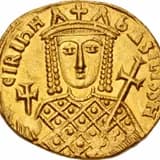
On 25 December 800, Charlemagne is crowned Emperor of the Romans, partly justified by Irene’s female usurpation of the Byzantine throne.
On 25 December 800, Pope Leo III crowned Charlemagne as "Emperor of the Romans" in Rome. Although Irene of Athens was not present, her earlier usurpation of the Byzantine throne and status as a female emperor were central to the ideological context of this act.
Since Irene, rather than a male monarch, ruled Constantinople as Basileus, some Western thinkers questioned whether the Byzantine ruler could properly be considered a Roman emperor. Her controversial accession in 797, achieved by deposing and blinding Constantine VI, undermined for some the perceived legitimacy of the Eastern imperial line.
By crowning Charlemagne, the pope asserted the existence of an independent Western empire, effectively creating the political entity later known as the Holy Roman Empire. Encyclopedia accounts note that Irene’s usurpation "provided the ideological justification" for this coronation, as the papacy sought a male emperor who aligned with its interests.
In terms of women’s history, 25 December 800 illustrates a paradoxical legacy: Irene’s position as the first female emperor helped inspire a rival imperial project designed to bypass female sovereignty. Her reign forced Western leaders to confront—and ultimately reject—the idea of a woman ruling the Roman world, catalyzing a major geopolitical realignment whose repercussions shaped European politics for a millennium.